




01. Edit your form 3903 online
Type text, add images, blackout confidential details, add comments, highlights and more.

Type text, add images, blackout confidential details, add comments, highlights and more.
Draw your signature, type it, upload its image, or use your mobile device as a signature pad.

Send form 3903 instructions 2021 via email, link, or fax. You can also download it, export it or print it out.
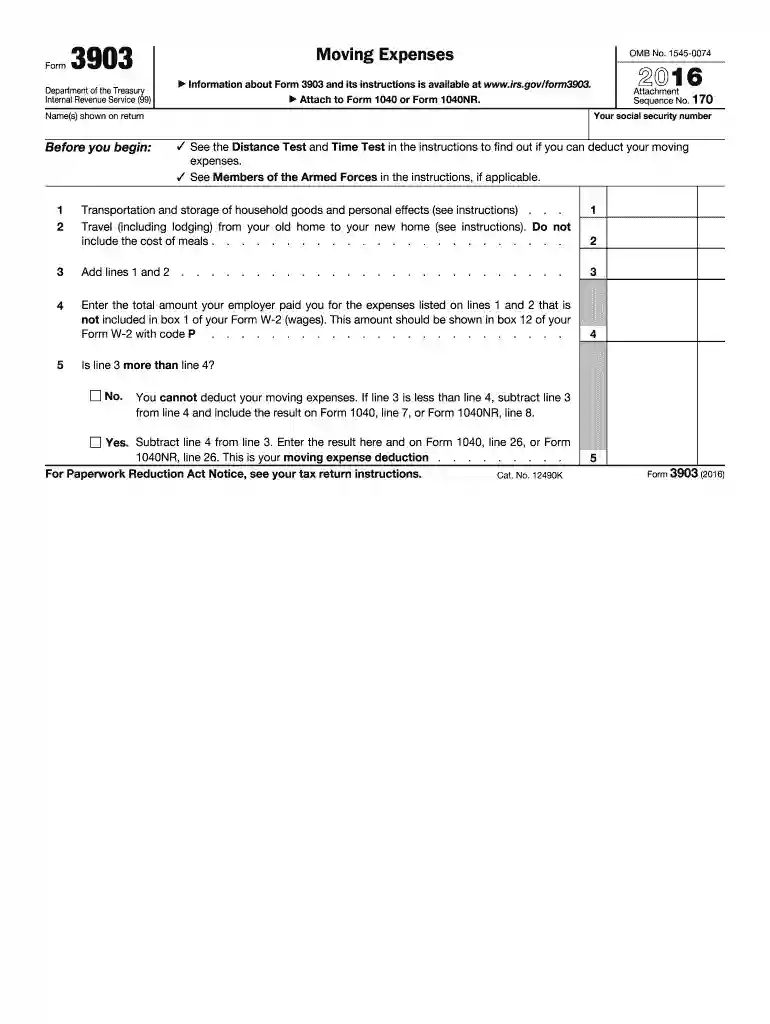
Form 3903 for the 2016 tax year is primarily used by individuals to report moving expenses for tax deduction purposes. Its main objective is to allow taxpayers to deduct eligible moving expenses incurred as a result of relocating for a new job or, in some cases, military reassignment. The form captures specific costs like transportation, storage of household goods, and travel expenses (excluding meals) from the old residence to the new one. Through this form, qualifying individuals can reduce their taxable income by the amount of eligible moving expenses, effectively lowering their overall tax liability.
Taxpayers can acquire the 2016 Form 3903 through several methods. It is available for download directly from the Internal Revenue Service (IRS) website, where it can be accessed as a printable PDF document. Alternatively, tax preparation software such as TurboTax and QuickBooks also typically include the form, allowing users to fill it out digitally as part of their overall tax filing process. Some taxpayers may choose to work with a tax professional, who can also provide the form and assist with its completion.
This form is predominantly used by employed individuals who have relocated due to a new job or job location. It is also applicable for members of the armed forces moving due to military orders. Retirees and self-employed individuals might encounter limitations or exclusions in using this form, depending on their relocation specifics. Therefore, those who relocated in 2016 and want to leverage tax deductions for moving expenses should carefully review eligibility requirements to ensure the form’s applicability.


To qualify for using Form 3903 and claiming moving expenses, specific IRS criteria must be met:
Exceptions apply, particularly for members of the armed forces, who are not subject to these tests due to service-related relocations. Further, the types of expenses covered for deduction must directly relate to the move, excluding any reimbursed by the employer.

The IRS provides detailed instructions for completing Form 3903, outlining which expenses can be claimed and how to compute the total deductible amount accurately. Additional specific guidelines focus on different scenarios, such as treatment of international moves and moves involving self-employment changes. It’s crucial always to refer to the IRS’s official guidelines or consult with a tax professional to ensure compliance and correct form completion.
Consider an employee, John, who moved from Chicago to New York for a new job. John paid for the transportation of his household goods and temporary storage, along with his travel expenses to the new city. He used Form 3903 to report these costs, ensuring that only eligible expenses were claimed and factoring any covered by employer reimbursements. Similarly, a naval officer transferring from Virginia to California due to a new assignment would use this form to document related relocation expenses.
Important components of Form 3903 include:
Understanding these sections is vital for appropriate usage and ensuring accurate deductions.
For deductions using Form 3903 for the 2016 tax year, the form must accompany the filing of your annual tax return, typically due on April 15th, 2017. Extensions might be available if requested, but the form should still align with overall tax filing deadlines. Missing the deadline could result in penalties or lost deductions, underscoring the necessity for timely submission.
Preparation for completing Form 3903 should include gathering necessary records, such as:
Maintaining organized documentation ensures smooth filing and minimizes the risk of errors or audits.
Form 3903 can be submitted digitally when using tax preparation software or manually included in a mailed paper return. Many prefer online filing due to its convenience, especially given the seamless integration with IRS e-filing systems. For those opting for manual submission, the form should be attached to the physical copy of the individual tax return that is mailed to the appropriate IRS office.
We've got more versions of the form 3903 form. Select the right form 3903 version from the list and start editing it straight away!
| Versions | Form popularity | Fillable & printable |
|---|---|---|
| 2025 | 4.7 Satisfied (50 Votes) | |
| 2024 | 4.4 Satisfied (43 Votes) | |
| 2023 | 4.4 Satisfied (22 Votes) | |
| 2022 | 4.6 Satisfied (37 Votes) | |
| 2021 | 4.8 Satisfied (81 Votes) | |
| 2020 | 4.3 Satisfied (42 Votes) | |
| 2019 | 4.3 Satisfied (63 Votes) | |
| 2018 | 4.3 Satisfied (171 Votes) | |
| 2017 | 4.4 Satisfied (235 Votes) | |
| 2016 | 4.4 Satisfied (554 Votes) | |
| 2015 | 4 Satisfied (48 Votes) | |
| 2013 | 4 Satisfied (59 Votes) | |
| 2001 | 4 Satisfied (39 Votes) | |
| 1997 | 4 Satisfied (60 Votes) |
At DocHub, your data security is our priority. We follow HIPAA, SOC2, GDPR, and other standards, so you can work on your documents with confidence.
Purpose of Form. Use Form 3903 to figure your moving expense deduction for a move related to the start of work at a new principal place of work.Read more
Apr 15, 1976 Increased section 179 deduction dollar limits. The maximum amount you can elect to deduct for most sec- tion 179 property you placed inRead more
Nov 1, 2015 The employee can complete IRS Form 3903 to determine whether the expenses qualify as nontaxable moving expenses that may be deducted on theRead more


