




01. Edit your certificate of analysis template online
Type text, add images, blackout confidential details, add comments, highlights and more.

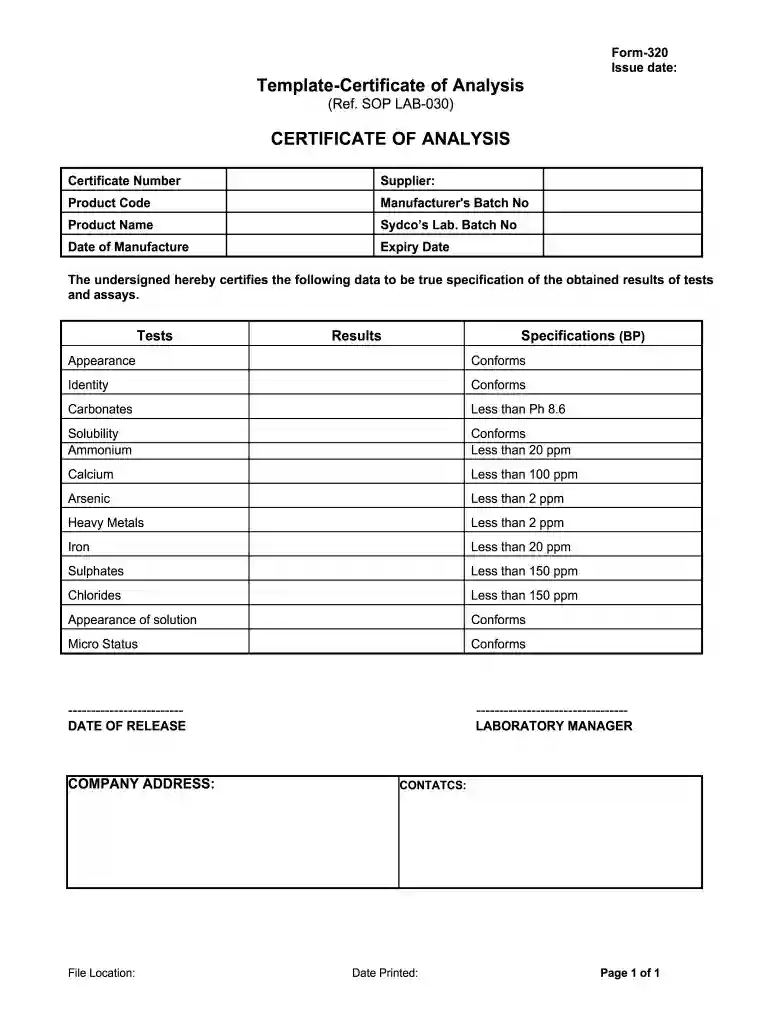
Type text, add images, blackout confidential details, add comments, highlights and more.

Draw your signature, type it, upload its image, or use your mobile device as a signature pad.

Send free certificate of analysis via email, link, or fax. You can also download it, export it or print it out.
A certificate of analysis (CoA) is a crucial document that serves to verify the quality and specifications of a product. It provides detailed information on the testing and assay results of various components within a product, ensuring compliance with predetermined standards. The CoA is especially significant in sectors such as pharmaceuticals, food production, and chemical manufacturing, where rigorous testing protocols are mandated to ensure safety and efficacy.
The document typically includes the following elements:
Without a certificate of analysis, stakeholders cannot be assured that a product meets specified criteria, leading to potential risks related to safety and effectiveness.
Understanding the critical components of a certificate of analysis facilitates better interpretation and utilization of the document. Here are the main elements:
The CoA includes comprehensive analysis results that reflect the product's quality. Common components tested include:
Certificates of analysis demonstrate compliance with industry standards, such as those established by the FDA or other regulatory bodies. This is particularly important in highly regulated sectors:
Each CoA should explicitly state which standards the product complies with, reinforcing its reliability.
Certificates of analysis are utilized in diverse situations across various industries. Here are primary use cases:
Organizations leverage CoAs to confirm that products meet specific quality thresholds. Before a product reaches the market:
If products are subject to governmental regulations, a CoA serves as a fundamental document that can facilitate compliance checks:
Certificates of analysis can differ significantly based on industry requirements or company standards. Here are common formats:
Regardless of industry, most CoAs include:
The certificate of analysis holds substantial legal weight in many contexts. Here’s how it is relevant:
In various industries, a CoA serves as an essential legal document that demonstrates compliance with safety and quality regulations. Entities may find themselves in disputes or litigation where the CoA may be referenced as proof of adherence to standards.
Regulatory agencies often require CoAs as part of a product's documentation for approval:
Ensuring all aspects of a CoA are precise and accurate is crucial to maintaining compliance and protecting against potential liabilities.
To receive a certificate of analysis, careful procedures must be followed. Each step ensures that the proper documentation reflects accurate test results.
Establish a system for tracking CoAs, especially for products that undergo frequent testing. Each CoA should be archived in an accessible location to facilitate future needs, including:
The effectiveness of a certificate of analysis in establishing product quality and compliance relies heavily on the accuracy and integrity of the processes leading to its issuance.
At DocHub, your data security is our priority. We follow HIPAA, SOC2, GDPR, and other standards, so you can work on your documents with confidence.
Oct 7, 2024 Industry Certificate Of Analysis: What is a COA? Thread starter GrownHealth; Start date 7th Oct, 2024 GrownHealth. Community Admin.Read more
CERTIFICATE OF ANALYSIS FOR. YOUR CANNABIS PRODUCT. A Certificate of Analysis (CoA) is a lab test report that provides information on the safety, quality, andRead more
Certificate of Analysis. Routine Air Test is in compliance with the air/gas quality portion of the specification: Oxygen Compatible Air-2010 (I) as analyzedRead more


