




01. Edit your fincen 114 form online
Type text, add images, blackout confidential details, add comments, highlights and more.

Type text, add images, blackout confidential details, add comments, highlights and more.

Draw your signature, type it, upload its image, or use your mobile device as a signature pad.

Send fincen form 114 via email, link, or fax. You can also download it, export it or print it out.
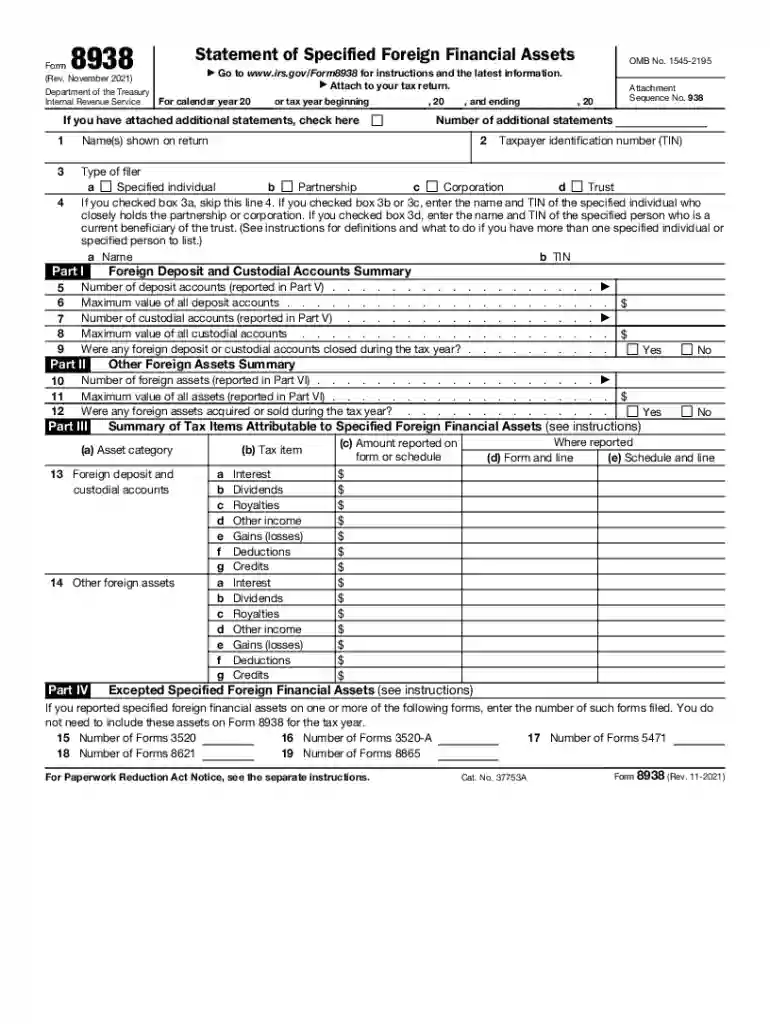
Form 8938, known as the "Statement of Specified Foreign Financial Assets," is required by the IRS for certain individuals, corporations, partnerships, and trusts to report their foreign financial assets. Only specified individuals, meaning U.S. citizens, resident aliens, and certain non-resident aliens who hold substantial foreign assets, are required to file this form. The purpose is to prevent tax evasion and ensure that all financial activities with foreign entities are disclosed.
Form 8938 demands comprehensive details about foreign deposit accounts, investment accounts, and any other foreign assets that meet particular thresholds. The form must be attached to the annual tax return of the filer.
Form 8938 mandates detailed reporting on a wide range of foreign financial assets. This includes foreign bank accounts, foreign investment accounts, and interests in foreign entities. Each reported asset must include specific details:
The filing thresholds for Form 8938 vary based on several factors, including filing status and place of residence (inside or outside the U.S.). These thresholds determine whether one needs to file:
Gather Financial Information: Collect all necessary details about your foreign financial assets, including account numbers, maximum values, and any related income.
Determine Filing Requirement: Check the asset thresholds and determine if you meet the requirement for filing the form.
Enter Asset Information: Provide all requested information on Form 8938, ensuring accuracy in the details reported.
Attach to Tax Return: Form 8938 must be attached to your annual federal income tax return.
Submit by Tax Deadline: Ensure that the form is submitted by the due date of your tax return, typically April 15, unless an extension has been granted.
Failure to file Form 8938 can lead to substantial penalties. The initial penalty for not filing the form is $10,000, with additional penalties up to $50,000 if non-compliance continues after IRS notice. Furthermore, a 40% penalty may apply to any understatement of tax attributable to non-disclosed foreign financial assets.
Primarily used by U.S. taxpayers who have foreign financial interests or assets meeting specific thresholds, including:


Certain entities, such as certain trusts or retirement plans, may be exempt from filing depending on their foreign asset exposure and structure.
The IRS provides specific instructions and guidance on how to accurately complete Form 8938. This includes:
Adhering strictly to these guidelines reduces errors and helps prevent potential penalties.
Form 8938 can be downloaded directly from the IRS website. Taxpayers can also acquire the form through tax software programs that integrate IRS forms, ensuring the most current version is used.
All specified foreign financial assets must be disclosed. This means providing comprehensive documentation for each account or asset:
For most taxpayers, Form 8938 is due with their federal tax return on April 15. If an extension for the tax return is granted, the deadline for Form 8938 extends accordingly.
Many tax preparation software packages support Form 8938, aiding in accurate completion and timely filing. Compatible software includes:
We've got more versions of the fincen 114 form form. Select the right fincen 114 form version from the list and start editing it straight away!
| Versions | Form popularity | Fillable & printable |
|---|---|---|
| 2021 | 4.8 Satisfied (53 Votes) | |
| 2020 | 4.4 Satisfied (75 Votes) | |
| 2019 | 4.2 Satisfied (96 Votes) | |
| 2018 | 4.3 Satisfied (56 Votes) | |
| 2017 | 4.4 Satisfied (63 Votes) | |
| 2016 | 4.3 Satisfied (48 Votes) | |
| 2015 | 4 Satisfied (59 Votes) | |
| 2014 | 4.3 Satisfied (66 Votes) | |
| 2013 | 4 Satisfied (36 Votes) | |
| 2012 | 4 Satisfied (51 Votes) | |
| 2011 | 4 Satisfied (35 Votes) |
At DocHub, your data security is our priority. We follow HIPAA, SOC2, GDPR, and other standards, so you can work on your documents with confidence.
Use Form 8938 to report your specified foreign financial assets if the total value of all the specified foreign financial assets in which you have an interestRead more
A specified person that has any interest in a specified foreign financial asset during the taxable year must attach Form 8938, Statement of Specified ForeignRead more
Form 8938 (FATCA) Threshold (living abroad): $200,000 end of year or $300,000 at any time What to report: Foreign accounts, foreign stocks, foreignRead more


