New York State Retirement and Social Security Law 211 2026

Get Form
new york state bill that allows the retirees to make over 30 000 Preview on Page 1

Here's how it works

01. Edit your new york state bill that allows the retirees to make over 30 000 online
Type text, add images, blackout confidential details, add comments, highlights and more.

02. Sign it in a few clicks
Draw your signature, type it, upload its image, or use your mobile device as a signature pad.

03. Share your form with others
Send section 212 nys retirement law via email, link, or fax. You can also download it, export it or print it out.

How to use or fill out New York State Retirement and Social Security Law 211 with our platform

Form edit decoration
9.5
Ease of Setup
DocHub User Ratings on G2
9.0
Ease of Use
DocHub User Ratings on G2
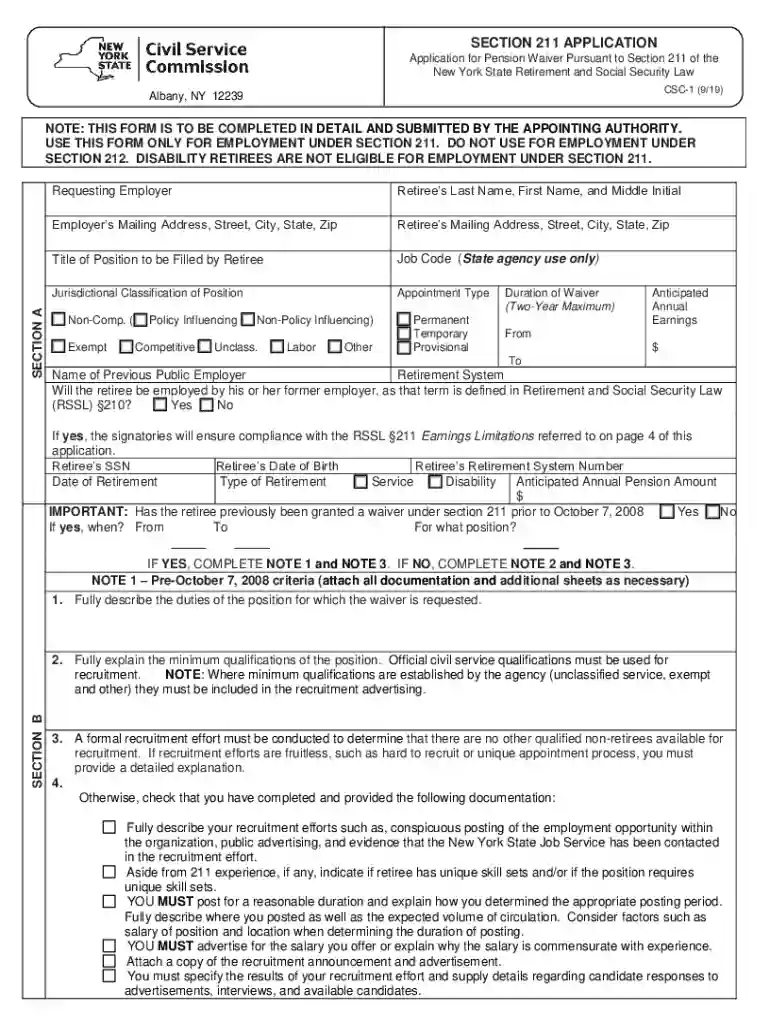
  1. Click ‘Get Form’ to open the New York State Retirement and Social Security Law 211 application in the editor.
  2. Begin by entering the retiree’s last name, first name, and middle initial in the designated fields. Ensure accuracy as this information is crucial for identification.
  3. Fill in the employer’s mailing address, including street, city, state, and zip code. This section helps establish where correspondence will be sent.
  4. Complete the retiree’s mailing address similarly. This ensures that all communications reach the correct individual.
  5. Specify the title of the position to be filled by the retiree and include any relevant job codes as required by your agency.
  6. In Section A, indicate the appointment type (Permanent, Temporary, Provisional) and provide details on anticipated annual earnings from and to amounts.
  7. Answer questions regarding previous employment with former employers and ensure compliance with RSSL §211 limitations.
  8. Complete all sections thoroughly, especially those requiring detailed explanations about recruitment efforts and qualifications for the position.

Start using our platform today to streamline your form completion process for free!

See more New York State Retirement and Social Security Law 211 versions

We've got more versions of the New York State Retirement and Social Security Law 211 form. Select the right New York State Retirement and Social Security Law 211 version from the list and start editing it straight away!
Versions Form popularity Fillable & printable
2019 4.8 Satisfied (58 Votes)
2013 4.4 Satisfied (168 Votes)
be ready to get more

Complete this form in 5 minutes or less

Get form

Got questions?

We have answers to the most popular questions from our customers. If you can't find an answer to your question, please contact us.
Contact us
Sections 211 and 212 of the Retirement and Social Security Law govern NYS public employment by service retirees under age 65. Working under Section 211 requires your employer to obtain a waiver. The current Section 212 earnings limit, determined by the state Legislature, is $35,000 per calendar year.
Section 211 (RSSL) Under Section 211, earnings from public employment are not limited for a retiree receiving a pension payment if: The retiree returns to work for a public employer that has obtained the necessary Section 211 approval (also referred to as a Section 211 waiver), and.
Earnings Limit Waiver Under RSSL Section 211, employers may employ you and waive the earnings limit if they get approval before hiring you. Approval is not automatic; it is based on the employers needs and your qualifications. In most cases, the New York State Department of Civil Service is the approving agency.
However, sections 211 and 212 of the Retirement and Social Security Law of New York State present exceptions to section 150. Section 212 allows a retired state or local government employee to earn up to $35,000 on a calendar year basis and continue to receive full pension benefits.
Cannot close the account: With 17 years of service, you cannot close or withdraw from your NYS pension account. The New York State and Local Retirement System (NYSLRS) typically does not allow members with 10 or more years of credited service to withdraw their contributions or close their accounts.