




01. Edit your form online
Type text, add images, blackout confidential details, add comments, highlights and more.

Type text, add images, blackout confidential details, add comments, highlights and more.

Draw your signature, type it, upload its image, or use your mobile device as a signature pad.

Send it via email, link, or fax. You can also download it, export it or print it out.
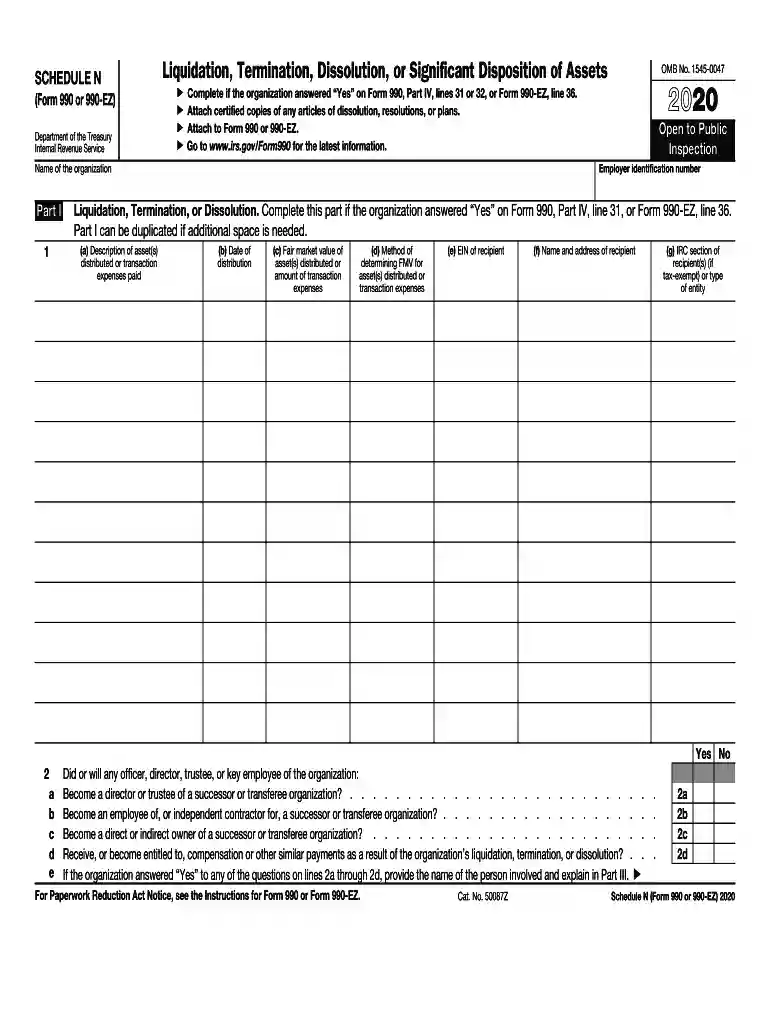
The Form 990 and the 990-EZ are integral to the reporting process for tax-exempt organizations in the United States. These forms are required by the Internal Revenue Service (IRS) to ensure transparency in financial operations and governance of exempt organizations, which include charities, non-profits, and other similar entities. The "990 990ez assets form" specifically refers to sections within these forms where organizations disclose detailed information about their assets. This is pivotal for maintaining compliance with IRS regulations and providing insight into an organization's financial health.
The assets section in Forms 990 and 990-EZ includes several critical components that organizations must complete accurately:
Organizations can obtain the Form 990 or 990-EZ directly from the IRS website, where the forms are available for download in PDF format. Additionally, organizations may use specialized tax preparation software that supports nonprofit filings and includes electronic versions of these forms. This option can streamline the process by integrating with accounting systems and offering e-filing capabilities.
The IRS provides comprehensive instructions for completing Forms 990 and 990-EZ, emphasizing accuracy and full disclosure of an organization's assets. These guidelines include:
Non-profit organizations must file the Form 990 or 990-EZ by the 15th day of the 5th month after the end of their fiscal year. For example, if an organization’s fiscal year ends on December 31, the filing deadline would be May 15. Extensions can be requested if additional time is needed, but adhering to deadlines is crucial for maintaining compliance.
Failing to file Forms 990 or 990-EZ on time can result in significant penalties depending on the organization's financial size. Smaller organizations might incur fines of $20 per day, while larger organizations could face penalties of $100 per day, capped at substantial amounts. Persistent non-compliance may risk losing the organization's tax-exempt status.
Many organizations utilize tax preparation software, such as TurboTax or QuickBooks, to assist with the completion of the 990 and 990-EZ forms. These tools are designed to streamline the filing process, offer integration with existing financial data, ensure accuracy, and provide e-filing capabilities, which can simplify compliance and reduce filing errors.
While the Form 990 and 990-EZ are federal forms, certain states may have additional reporting requirements for tax-exempt organizations operating within their jurisdictions. Organizations should consult with state tax authorities to understand any additional filing needs specific to their operations and ensure compliance with both federal and state regulations.
We've got more versions of the 990 990ez assets form form. Select the right 990 990ez assets form version from the list and start editing it straight away!
| Versions | Form popularity | Fillable & printable |
|---|---|---|
| 2025 | 4.2 Satisfied (31 Votes) | |
| 2024 | 4.9 Satisfied (26 Votes) | |
| 2023 | 4.7 Satisfied (22 Votes) | |
| 2022 | 4.6 Satisfied (43 Votes) | |
| 2021 | 4.8 Satisfied (133 Votes) | |
| 2020 | 4 Satisfied (38 Votes) | |
| 2019 | 4.4 Satisfied (127 Votes) | |
| 2018 | 4.4 Satisfied (264 Votes) | |
| 2017 | 4.3 Satisfied (120 Votes) | |
| 2016 | 4.3 Satisfied (142 Votes) | |
| 2015 | 4.4 Satisfied (58 Votes) |
At DocHub, your data security is our priority. We follow HIPAA, SOC2, GDPR, and other standards, so you can work on your documents with confidence.
Complete if the organization is a section 501(c)(3) organization or a section 4947(a)(1) nonexempt charitable trust. Attach to Form 990 or Form 990-EZ. Go toRead more
May 2, 2025 Net Assets 18. Excess or (deficit) for the year (subtract line 17 from line 9) . . . . . . . . . . . . 18. 19. Net assets or fund balances atRead more
Part II, Line 24: Other Assets - Includes $150 of accounts receivables, $544 of prepaid expenses, and $6,476 of inventory (150th anniversary books and JohnRead more


