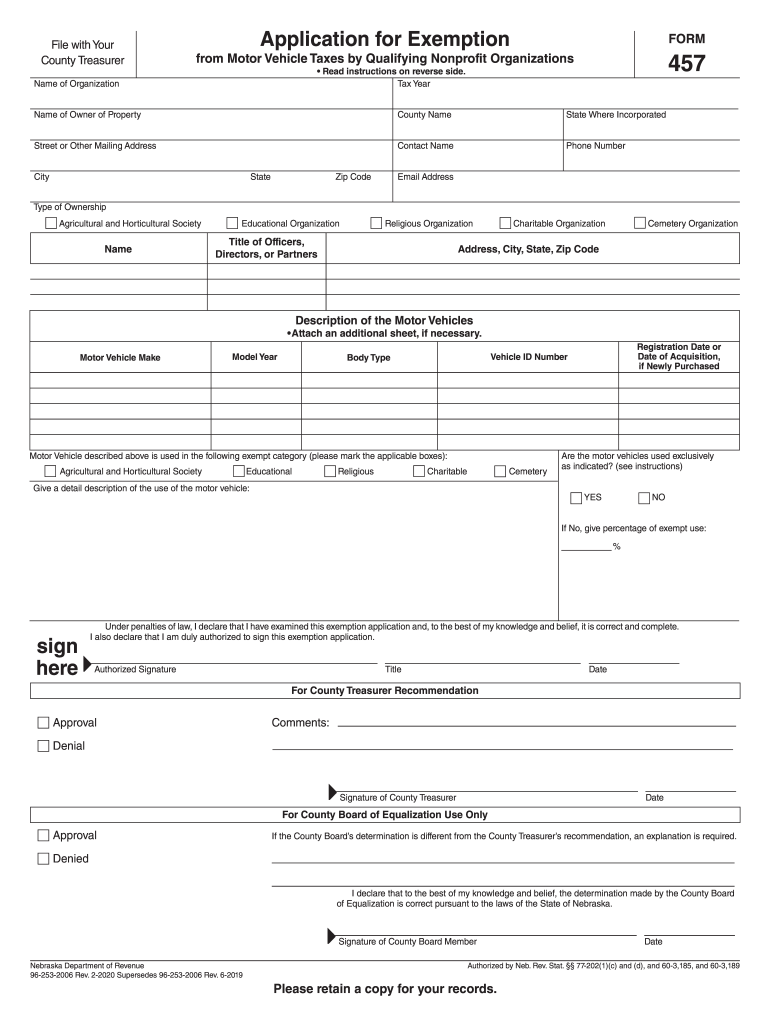
Form 457 application 2026

Get Form
nyc gov deferredcomp Preview on Page 1

Here's how it works

01. Edit your nyc gov deferredcomp online
Type text, add images, blackout confidential details, add comments, highlights and more.
02. Sign it in a few clicks
Draw your signature, type it, upload its image, or use your mobile device as a signature pad.
03. Share your form with others
Send it via email, link, or fax. You can also download it, export it or print it out.

How to use or fill out form 457 application with our platform

Form edit decoration
9.5
Ease of Setup
DocHub User Ratings on G2
9.0
Ease of Use
DocHub User Ratings on G2
  1. Click ‘Get Form’ to open the form 457 application in the editor.
  2. Begin by entering the name of your organization and the tax year in the designated fields. Ensure accuracy as this information is crucial for processing your exemption.
  3. Fill in the owner’s name, county name, and state where incorporated. Provide a complete mailing address including street, city, state, and zip code.
  4. In the 'Type of Ownership' section, select the appropriate category that describes your organization (e.g., Educational Organization, Charitable Organization).
  5. Describe each motor vehicle you are applying for exemption. Include details such as make, model year, vehicle ID number, and body type. If necessary, attach an additional sheet.
  6. Indicate whether the vehicles are used exclusively for exempt purposes by marking 'YES' or 'NO'. If 'NO', provide the percentage of exempt use.
  7. Finally, ensure that an authorized individual signs and dates the application before submission to maintain compliance with legal requirements.

Start filling out your form 457 application online for free today!

See more form 457 application versions

We've got more versions of the form 457 application form. Select the right form 457 application version from the list and start editing it straight away!
Versions Form popularity Fillable & printable
2021 4.8 Satisfied (196 Votes)
2020 4.2 Satisfied (58 Votes)
2019 4.3 Satisfied (265 Votes)
2018 4.3 Satisfied (87 Votes)
2011 4.4 Satisfied (407 Votes)
be ready to get more

Complete this form in 5 minutes or less

Get form

Got questions?

We have answers to the most popular questions from our customers. If you can't find an answer to your question, please contact us.
Contact us
457(b) plans are different from 401(k) plans, and they come with their own set of pros, like extra contributions for those nearing retirement. Some cons of 457(b) plans include the fact that employer contributions are rare and it can be hard to make a qualified withdrawal.
Who can establish a 457(b) plan? The organization must be a state or local government or a tax-exempt organization under IRC 501(c).
457(b) plans are tax-advantaged, employer-sponsored retirement plans offered to some government employees, as well as employees of certain tax-exempt organizations. 457(b) plans are split into 2 different categoriesgovernmental and non-governmentaldepending on whether you work for the government or not.
Cons of 457(b) plans: Fewer investing options than 401(k)s (Not as common today) Only available to certain employees employed by state or local governments or qualifying nonprofits. Employer contributions count toward the annual limit. Non-governmental 457(b) plans are riskier.
The 457(b) Plan is an employer-sponsored deferred compensation retirement plan for members who want to make retirement contributions in addition to a Tax-Deferred Retirement Account 403(b)/Roth 403(b) and/or Pension Plan.

Security and compliance

At DocHub, your data security is our priority. We follow HIPAA, SOC2, GDPR, and other standards, so you can work on your documents with confidence.

Learn more
ccpa2
pci-dss
gdpr-compliance
hipaa
soc-compliance

People also ask

Unlike 401(k) plans, which require employees to wait until age 59 before making qualified withdrawals, 457 plans allow withdrawals at whatever age the employee retires.

Related links