CriminalSuperior Court of California - County of San Francisco 2026

Get Form
san mateo superior court remote appearance Preview on Page 1

Here's how it works

01. Edit your san mateo superior court remote appearance online
Type text, add images, blackout confidential details, add comments, highlights and more.

02. Sign it in a few clicks
Draw your signature, type it, upload its image, or use your mobile device as a signature pad.

03. Share your form with others
Send san mateo remote appearance via email, link, or fax. You can also download it, export it or print it out.

How to use or fill out Criminal Superior Court of California - County of San Francisco with our platform

Form edit decoration
9.5
Ease of Setup
DocHub User Ratings on G2
9.0
Ease of Use
DocHub User Ratings on G2
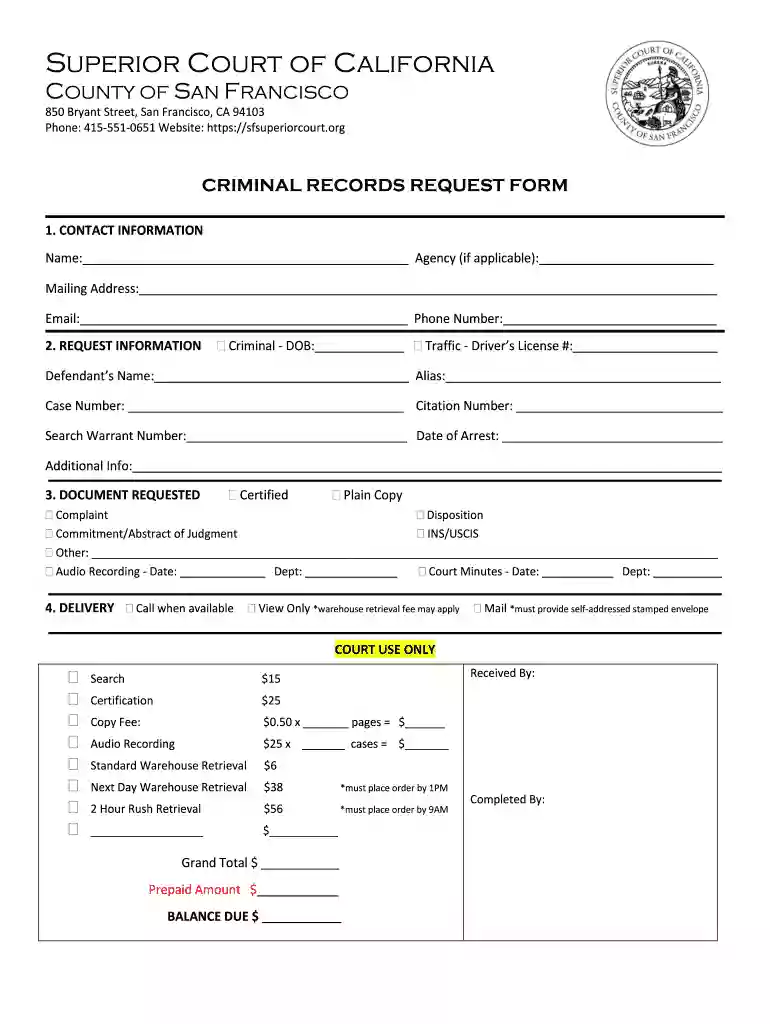
  1. Click ‘Get Form’ to open the Criminal Records Request Form in the editor.
  2. Begin by filling out your contact information in Section 1. Include your name, agency (if applicable), mailing address, email, and phone number.
  3. In Section 2, provide the request information. Specify whether it is a criminal or traffic request, and fill in the defendant's name, date of birth or driver's license number, case number, citation number, search warrant number, and date of arrest.
  4. For Section 3, select the type of document you are requesting. Options include certified copies, plain copies, complaints, dispositions, and more. Be sure to specify any additional details required.
  5. In Section 4, choose your preferred delivery method. Options include call when available, view only (with potential fees), or mail (ensure you provide a self-addressed stamped envelope).

Start using our platform today to streamline your form completion process for free!

See more CriminalSuperior Court of California - County of San Francisco versions

We've got more versions of the CriminalSuperior Court of California - County of San Francisco form. Select the right CriminalSuperior Court of California - County of San Francisco version from the list and start editing it straight away!
Versions Form popularity Fillable & printable
2021 4.8 Satisfied (115 Votes)
2018 4.3 Satisfied (50 Votes)
be ready to get more

Complete this form in 5 minutes or less

Get form

Got questions?

We have answers to the most popular questions from our customers. If you can't find an answer to your question, please contact us.
Contact us
Supreme Court. The Supreme Courts historic and primary focus is to decide civil appellate cases. Under Article 7 4 of the Oklahoma Constitution, the court has administrative responsibility for the entire Oklahoma judicial system.
Trial courts are also called superior courts. In the trial or superior court, a judge, and sometimes a jury, hears testimony and evidence and decides a case by applying the law to the facts of the case. Superior courts handle: All civil cases (family law, probate, juvenile, and other civil cases);
All Superior Courts in California have authority over a wide variety of case types: Civil Cases - Includes both limited civil cases ($35,000 or less) and unlimited civil cases (over $35,000). Criminal Cases - Both felony and misdemeanor crimes (including such offenses as driving under the influence).
Contact the County Clerk (415)554‐4950  If you need a Court Reporter Transcript, please call (415)551‐3778 or email transcriptrequests@sftc.org. You must include the date of the proceedings, the Department and the Court Reporters name in your request.
The District Court handles misdemeanors where the maximum sentence is 2 years in the House of Corrections. The Superior Court has authority over all crimes and most often handles major felony cases.

Security and compliance

At DocHub, your data security is our priority. We follow HIPAA, SOC2, GDPR, and other standards, so you can work on your documents with confidence.

Learn more
ccpa2
pci-dss
gdpr-compliance
hipaa
soc-compliance
be ready to get more

Complete this form in 5 minutes or less

Get form

People also ask

The federal court system has three main levels: district courts (the trial court), circuit courts which are the first level of appeal, and the Supreme Court of the United States, the final level of appeal in the federal system.
The hierarchy of courts are as follows 1) Supreme Court, 2) High Courts, 3) District Courts (other courts are mostly considered as subsidiaries of these courts).

Related links