Internal revenue form 1023-2025

Get Form
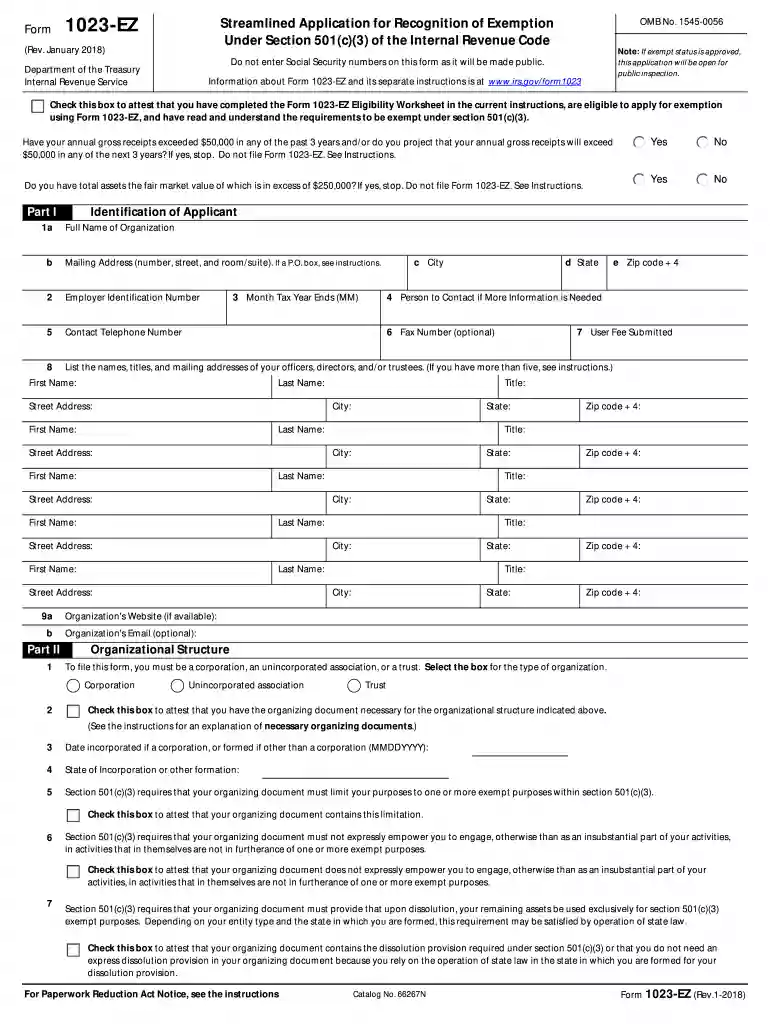
form 1023 ez Preview on Page 1

Here's how it works

01. Edit your form 1023 ez online
Type text, add images, blackout confidential details, add comments, highlights and more.

02. Sign it in a few clicks
Draw your signature, type it, upload its image, or use your mobile device as a signature pad.

03. Share your form with others
Send 1023 ez form via email, link, or fax. You can also download it, export it or print it out.

Understanding the Internal Revenue Form 1023

The Internal Revenue Form 1023 is essential for organizations seeking federal tax-exempt status under Section 501(c)(3) of the Internal Revenue Code. This form serves as the application for recognition of exemption as a nonprofit entity and requires comprehensive details regarding the organization’s structure, purpose, and programs.

Purpose and Importance of Form 1023

Form 1023 is structured to confirm that the applying organization operates exclusively for charitable, religious, educational, scientific, or literary purposes, and that it meets the criteria set forth by the IRS. Failure to file this form can result in a loss of tax-exempt status, making it critical for organizations to understand its requirements. By obtaining this designation, organizations can gain eligibility for public and private grants, as well as lower postal rates and exemption from federal income tax.

Key Eligibility Criteria for Form 1023

Certain qualifications must be met to successfully file Form 1023:

  • Organizational Structure: The organization must be a corporation, limited liability company, or unincorporated association.
  • Purpose: Activities must align with exempt purposes as specified in Section 501(c)(3).
  • Public Support: The organization must show that it receives a substantial part of its support from the public or governmental units.

The eligibility worksheet guides applicants in determining whether they qualify to file Form 1023 or the streamlined Form 1023-EZ, which is suitable for smaller entities.


decoration image ratings of Dochub

Required Documents for Submission

When completing Form 1023, the following documents are typically required:

  1. Organizing Documents: Articles of incorporation or organization, showing the nonprofit’s purpose and structure.
  2. Governing Documents: Bylaws that outline how the organization will operate.
  3. Financial Statements: Projected budgets for the next three years and statements of income and expenses from the past three years (if applicable).
  4. Conflict of Interest Policy: A documented policy to prevent conflicts of interest among board members or staff.

Submission Methods for Form 1023

Organizations can submit Form 1023 through various methods:

  • Online Submission: The IRS offers an online application through its website for efficiency and convenience.
  • Mail Submission: Applicants can print the form and mail it to the appropriate IRS address.
  • In-Person Submission: In rare cases, an organization may opt to submit documents in person at a designated IRS office.

It’s crucial to ensure that the form is complete and accurate to avoid any delays in processing, which can often take several months.

Potential Penalties for Non-Compliance

Failing to file the IRS Form 1023 can lead to significant consequences:

  • Tax Liabilities: Organizations that do not file may be subject to income tax on revenue.
  • Loss of Tax-Exempt Status: If exempt status is revoked, the organization must begin to pay federal income taxes.
  • Penalties: Additional fines may be imposed for late or incomplete filings, potentially impacting fundraising efforts.

Typical Use Cases for Form 1023

Form 1023 is commonly utilized by various types of organizations, including:

  • Charitable organizations focused on serving the public.
  • Educational institutions seeking a tax-exempt status for educational purposes.
  • Religious entities requiring support to further their spiritual missions.

Understanding these contexts can help organizations tailor their applications effectively.

Important Filing Deadlines for Form 1023

Timeliness is vital when submitting Form 1023. Organizations must file:

  • Within 27 months of formation to ensure they stay retroactively exempt from the date of incorporation.
  • Be aware of specific deadlines if applying for recognition after commencing operations.

Reviewing Form Variants: Form 1023 vs. 1023-EZ

While Form 1023 is the standard application, organizations may opt for Form 1023-EZ:

  • Criteria for Using the 1023-EZ: Smaller organizations with projected annual revenues under $50,000 and total assets of less than $250,000 can use the streamlined application.
  • Benefits of 1023-EZ: This form is shorter, requiring less documentation and fewer questions, which can facilitate quicker approval.

Comparing these variants allows organizations to choose the most appropriate tool for their needs.

See more internal revenue form 1023 versions

We've got more versions of the internal revenue form 1023 form. Select the right internal revenue form 1023 version from the list and start editing it straight away!
Versions Form popularity Fillable & printable
2014 4.8 Satisfied (234 Votes)
be ready to get more

Complete this form in 5 minutes or less

Get form

Got questions?

We have answers to the most popular questions from our customers. If you can't find an answer to your question, please contact us.
Contact us
Organizations must electronically file this form to apply for recognition of exemption from federal income tax under section 501(c)(3). Note. You may be eligible to file Form 1023-EZ, a streamlined version of the application for recognition of tax exemption.
The 1023 forms are used when a nonprofit is applying for official tax-exempt status under Section 501(c)3. It is also worth noting that these forms can be filled out online.
In order to be recognized as exempt from the organizations formation, the nonprofit should file Form 1023 within 27 months from the end of the month when it was formed. If filed a after 27 months since formation, the organization will only be considered as tax-exempt from the filing date.
Exemption requirements - 501(c)(3) organizations In addition, it may not be an action organization, i.e., it may not attempt to influence legislation as a substantial part of its activities and it may not participate in any campaign activity for or against political candidates.
These nonprofits may be considered public charities, private foundations, or private operating foundations, which well explain in more detail later.

People also ask

The 1023 forms are used when a nonprofit is applying for official tax-exempt status under Section 501(c)3.
The user fee for: Form 1023 is $600. Form 1023-EZ is $275.

1023 ez