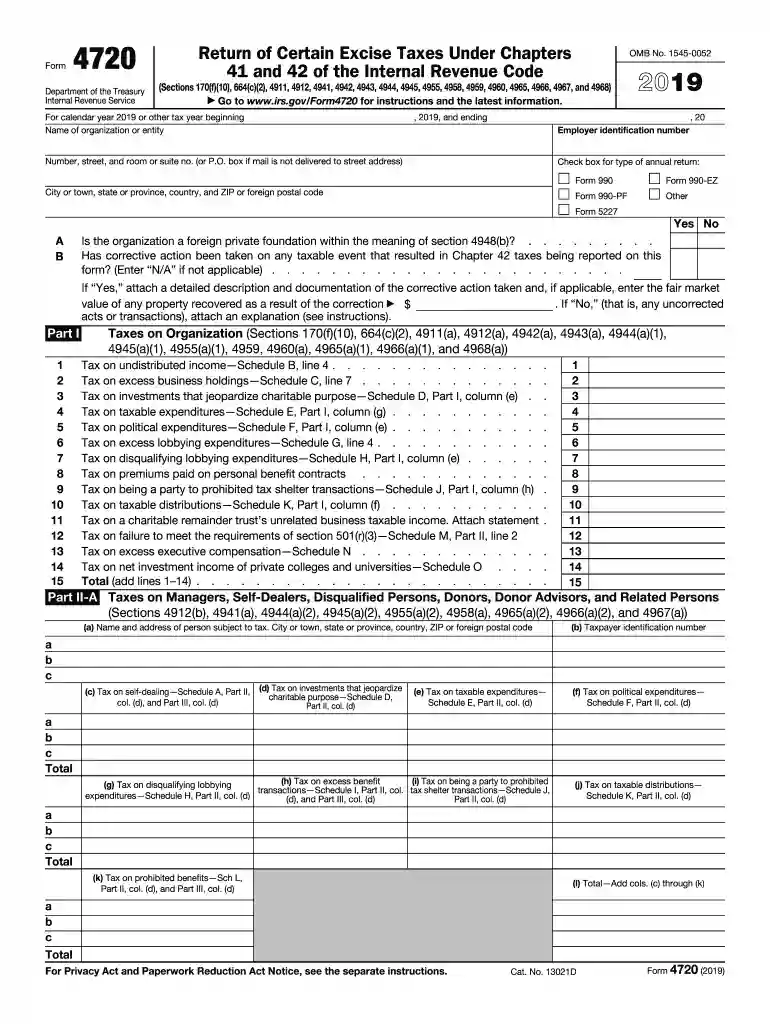
2019 Form 4720. Return of Certain Excise Taxes Under Chapters 41 and 42 of the Internal Revenue Code-2026

Get Form
form 4720 Preview on Page 1

Here's how it works

01. Edit your form 4720 online
Type text, add images, blackout confidential details, add comments, highlights and more.

02. Sign it in a few clicks
Draw your signature, type it, upload its image, or use your mobile device as a signature pad.

03. Share your form with others
Send form 4720 instructions via email, link, or fax. You can also download it, export it or print it out.

How to use or fill out 2019 Form 4720. Return of Certain Excise Taxes Under Chapters 41 and 42 of the Internal Revenue Code with DocHub

Form edit decoration
9.5
Ease of Setup
DocHub User Ratings on G2
9.0
Ease of Use
DocHub User Ratings on G2
  1. Click ‘Get Form’ to open it in the editor.
  2. Begin by entering the name of your organization and its Employer Identification Number (EIN) at the top of the form.
  3. Indicate the type of annual return by checking the appropriate box, such as Form 990 or Form 990-PF.
  4. In Part I, report any taxes on undistributed income and excess business holdings by filling in the corresponding lines with accurate figures from your records.
  5. Proceed to Part II-A, where you will list taxes applicable to managers and disqualified persons. Ensure all names and tax amounts are correctly entered.
  6. Complete all relevant schedules (A through O) based on your organization's activities during the tax year, ensuring each section is filled out accurately.
  7. Review all entries for accuracy before saving or submitting your completed form through our platform.

Start using our editor today to fill out your Form 4720 easily and for free!

See more 2019 Form 4720. Return of Certain Excise Taxes Under Chapters 41 and 42 of the Internal Revenue Code versions

We've got more versions of the 2019 Form 4720. Return of Certain Excise Taxes Under Chapters 41 and 42 of the Internal Revenue Code form. Select the right 2019 Form 4720. Return of Certain Excise Taxes Under Chapters 41 and 42 of the Internal Revenue Code version from the list and start editing it straight away!
Versions Form popularity Fillable & printable
2023 4.8 Satisfied (39 Votes)
2022 4.7 Satisfied (44 Votes)
2021 4.8 Satisfied (47 Votes)
2019 4.1 Satisfied (62 Votes)
be ready to get more

Complete this form in 5 minutes or less

Get form

Got questions?

We have answers to the most popular questions from our customers. If you can't find an answer to your question, please contact us.
Contact us
Organizations making political expenditures. All section 501(c)(3) organizations that make a political expenditure must file Form 4720 to report the liability and pay the tax (Schedule F). Organization managers may report any first-tier tax they owe on Schedule F of Form 4720.
Form 4626. If a corporation does not meet the CAMT safe harbor or was an applicable corporation in a prior tax year, it is required to file Form 4626. Form 4626 is used to determine whether a corporation is an applicable corporation and, if so, to calculate any CAMT owed.
Chapter 3 withholding under sections 1441-1443 generally applies a 30% statutory rate of withholding to payments of FDAP income or gains from U.S. sources but only if the payments are not effectively connected with a U.S. trade or business and are paid to a payee that is a foreign person.
Use this form to figure and pay certain excise taxes in chapters 41 and 42 of the Internal Revenue Code.
Section 7701(b) provides the basis for determining whether an alien individual is a resident of a United States possession or territory that administers income tax laws that are identical (except for the substitution of the name of the possession or territory for the term United States where appropriate) to those in

Security and compliance

At DocHub, your data security is our priority. We follow HIPAA, SOC2, GDPR, and other standards, so you can work on your documents with confidence.

Learn more
ccpa2
pci-dss
gdpr-compliance
hipaa
soc-compliance

People also ask

Lenders or creditors are required to issue Form 1099-C, Cancellation of Debt, if they cancel a debt owed to them of $600 or more. Generally, an individual taxpayer must include all canceled amounts (even if less than $600) on the Other Income line of Form 1040.

Related links