Arizona Do Not Resuscitate Form 2025

Get Form
dnr form arizona Preview on Page 1

Here's how it works

01. Edit your dnr form arizona online
Type text, add images, blackout confidential details, add comments, highlights and more.

02. Sign it in a few clicks
Draw your signature, type it, upload its image, or use your mobile device as a signature pad.

03. Share your form with others
Send arizona dnr form via email, link, or fax. You can also download it, export it or print it out.

Definition and Meaning of the Arizona Do Not Resuscitate Form

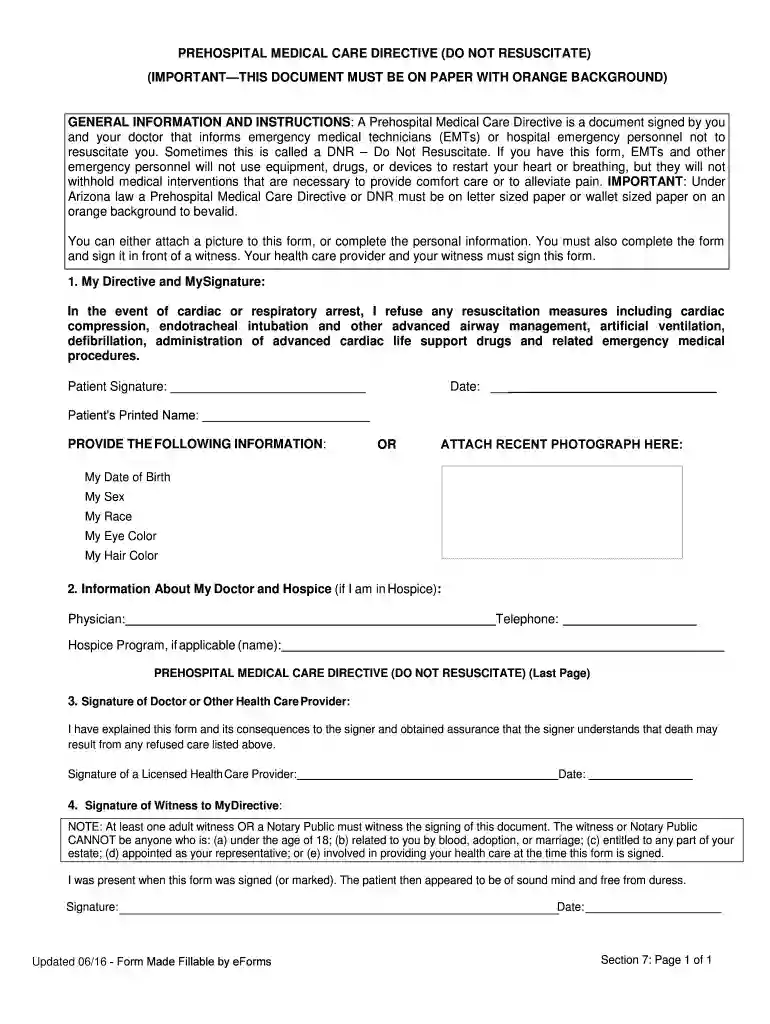
The Arizona Do Not Resuscitate Form, commonly referred to as a DNR order, is a legally recognized document that informs medical personnel not to initiate resuscitation measures in the event of cardiac or respiratory arrest. This form serves as a directive from the patient, indicating their preference regarding medical intervention when they are unable to communicate their wishes themselves.

In Arizona, the DNR order must be executed in a specific manner to hold legal weight, which includes signatures from both the patient and their attending physician. The document must be printed on distinctive orange paper to ensure it is immediately recognizable by emergency medical responders. This differentiation is crucial in high-stress emergency situations where time is of the essence.

Key Components of the Arizona DNR Form

  • Patient Information: Essential details such as the full name and date of birth of the patient.
  • Medical Provider Information: The name and contact information of the attending physician.
  • Signatures: Both the patient and physician must sign the form, along with a witness signature.
  • Visibility: Must be printed on orange paper, per Arizona state law.

How to Use the Arizona Do Not Resuscitate Form

The Arizona Do Not Resuscitate Form is utilized primarily in healthcare settings and emergency situations to guide medical decision-making. Once the form is completed and signed, it should be readily accessible for medical staff in emergencies. Patients are encouraged to discuss their DNR wishes with family members and healthcare providers to ensure understanding and compliance.

Further, it is advisable to inform emergency contacts or caregivers about the existence and location of the DNR form. This could include keeping a copy in a personal medical file, displaying it prominently in the home, or providing it to healthcare facilities where the patient receives regular care.

Practical Considerations for Use

  • Relevant Situations: Ideal for patients with terminal conditions, severe illnesses, or those who wish to avoid aggressive medical interventions.
  • Review and Update: Patients should periodically review their DNR status and amend the document if there are significant changes in their health or treatment preferences.

Steps to Complete the Arizona Do Not Resuscitate Form

Completing the Arizona DNR form involves several critical steps to ensure compliance with legal requirements. A completed form guarantees that the patient's wishes regarding resuscitation efforts are respected.

  1. Obtain the Form: The DNR form can be downloaded online or obtained from healthcare providers.
  2. Fill in Personal Information: Provide accurate details regarding the patient’s identity and medical circumstances.
  3. Consult with a Physician: Schedule a meeting with the patient’s healthcare provider to discuss the implications of having a DNR.
  4. Signatures: Both the patient and their physician must sign the form, and a witness (who is not involved in the patient's healthcare) should also sign.
  5. Distribute Copies: Keep a copy for personal records and distribute copies to family members, caregivers, and relevant medical facilities.

Important Notes

  • Physician Consultation: It is essential that the physician thoroughly explain the implications of the order to ensure the patient's understanding.
  • Witness Requirement: The witness for the signature cannot be an immediate family member or anyone who would benefit from the patient’s passing.

Legal Use of the Arizona Do Not Resuscitate Form

The Arizona DNR form is governed by specific state laws which outline its legal use and requirements. Understanding these regulations is crucial for both patients and healthcare providers.

  • Legal Validity: For the DNR order to be valid, it must follow Arizona's specific formatting rules, including the use of orange paper.
  • Binding Document: Once signed by both parties, the DNR order is legally binding in all prehospital scenarios. Emergency medical services must adhere to its directives.
  • Revocation: The patient has the right to revoke or amend the DNR order at any time, provided they communicate this clearly to their healthcare provider and emergency contacts.

Additional Legal Considerations

  • Conformity to Medical Standards: The presence of a DNR does not impede medical personnel's ability to provide comfort care as needed.
  • Emergency Situations: In situations where the DNR order might not be readily available, healthcare providers are instructed to base decisions on the patient’s known wishes or previously expressed preferences.

Who Typically Uses the Arizona Do Not Resuscitate Form

The Arizona Do Not Resuscitate Form is predominantly utilized by individuals facing serious health conditions. Understanding who may benefit from completing this form can guide patients, families, and providers in making informed decisions.


  • Patients with Terminal Illnesses: Individuals diagnosed with terminal cancer, advanced heart disease, or other life-limiting conditions may choose to establish a DNR order.
  • Elderly Patients: Older adults, especially those preferring to avoid aggressive medical interventions, frequently complete this form.
  • Individuals with Chronic Diseases: Patients with conditions such as COPD, advanced dementia, or other chronic illnesses may opt for a DNR to express their wishes concerning resuscitation.
decoration image ratings of Dochub

Considerations for Use

  • Patient Autonomy: The Arizona DNR form empowers patients to communicate their end-of-life preferences clearly.
  • Family Discussions: It is beneficial for families to engage in discussions about DNR orders to ensure that everyone involved understands the patient’s wishes.

Important Terms Related to the Arizona Do Not Resuscitate Form

Understanding the terminology associated with the Arizona Do Not Resuscitate Form is essential for both patients and healthcare providers. Familiarity with these terms helps facilitate effective communication regarding the patient's healthcare preferences.

  • DNR Order: A directive stating that resuscitation should not be attempted in the event of cardiac arrest.
  • Physician Orders for Life-Sustaining Treatment (POLST): A more comprehensive form that includes various treatment preferences beyond resuscitation efforts.
  • Advance Directive: A legal document that outlines a person's wishes regarding healthcare and medical treatment in instances where they are unable to communicate these decisions themselves.
  • Comfort Care: A form of care focused on relieving pain and discomfort without aggressive treatment options, often utilized alongside a DNR.

Importance of Understanding These Terms

  • Communication: Clear communication using the appropriate terminology ensures accurate understanding among medical staff, patients, and their families.
  • Legal Context: Familiarity with terms helps clarify patient rights and informs their decision-making processes regarding end-of-life care options.

See more Arizona Do Not Resuscitate Form versions

We've got more versions of the Arizona Do Not Resuscitate Form form. Select the right Arizona Do Not Resuscitate Form version from the list and start editing it straight away!
Versions Form popularity Fillable & printable
2018 4.9 Satisfied (33 Votes)
2016 4.3 Satisfied (34 Votes)
be ready to get more

Complete this form in 5 minutes or less

Get form

Got questions?

We have answers to the most popular questions from our customers. If you can't find an answer to your question, please contact us.
Contact us
Please note that the witness must be at least 18 years of age, cannot be family member (related by blood, adoption or marriage), cannot be in your will to receive part of your estate, cannot be appointed as your representative and cannot be one of your healthcare providers.
To create a do-not-resuscitate order, in most states, the patient will need to have the form signed between themselves, their physician, and witnesses (if required).
Before it is legally binding, in most states the DNR must be signed by a physician as well as docHubd by a notary public. Once these steps are completed, your document is recognized by the state.
While you do not typically need to have an attorney draft a DNR order for you, you may choose to consult with an attorney if you have any questions about the legal implications of a DNR order or if you want to discuss other advance directive options that may be available to you.