




01. Edit your 2019 5500 ez online
Type text, add images, blackout confidential details, add comments, highlights and more.

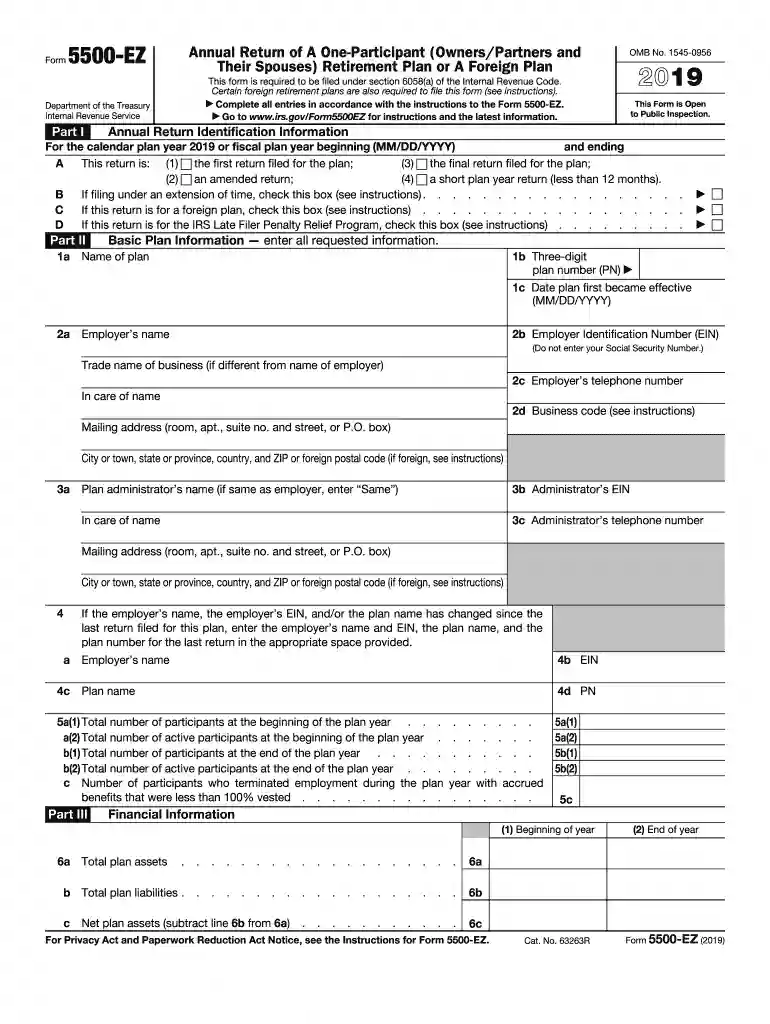
Type text, add images, blackout confidential details, add comments, highlights and more.

Draw your signature, type it, upload its image, or use your mobile device as a signature pad.

Send 2019 form 5500 sf via email, link, or fax. You can also download it, export it or print it out.
The Form 5500 is an essential document required for annual reporting of employee benefit plans. This form is mandated by the Employee Retirement Income Security Act of 1974 (ERISA) and is used to provide information about plan operations and conditions. It helps ensure that plans are managed in compliance with federal standards to protect participants. Typically, this form is associated with pension plans and welfare benefit plans, offering necessary transparency into plan finances and activities.
Completing the Form 5500 can be a meticulous process. Ensure you have all necessary details about your plan:
Make sure to review the completed form for accuracy before submission.
The Form 5500 plays a crucial role in maintaining transparency and accountability for benefit plans. Using this form ensures:
Employers and plan sponsors who fail to file or provide inaccurate information risk severe penalties.
Form 5500 is generally used by employers and administrators of employee benefit plans. This includes:
It is essential for ensuring that plan operations are consistent with legal standards and participant interests are protected.


Several critical components should be completed when filing the Form 5500:
Including these elements accurately helps in maintaining compliance and avoiding penalties.
It is crucial to adhere to specific deadlines associated with the Form 5500:
Staying informed about important dates ensures compliance and avoids potential fines.
Before filling out the Form 5500, prepare these documents:
Having these documents ready helps streamline the filing process.
The Form 5500 serves a regulatory function:
Submitting accurate and complete forms maintains legal compliance and mitigates enforcement actions.
Non-compliance with Form 5500 filing requirements can result in significant penalties:
Avoiding these penalties requires timely and accurate filing of the form.
We've got more versions of the 2019 5500 ez form. Select the right 2019 5500 ez version from the list and start editing it straight away!
| Versions | Form popularity | Fillable & printable |
|---|---|---|
| 2025 | 4.2 Satisfied (51 Votes) | |
| 2024 | 4.3 Satisfied (56 Votes) | |
| 2023 | 4.9 Satisfied (57 Votes) | |
| 2022 | 4.1 Satisfied (25 Votes) | |
| 2021 | 4.8 Satisfied (111 Votes) | |
| 2020 | 4.4 Satisfied (118 Votes) | |
| 2019 | 4.4 Satisfied (65 Votes) | |
| 2018 | 4.3 Satisfied (102 Votes) | |
| 2017 | 4.3 Satisfied (99 Votes) | |
| 2016 | 4.4 Satisfied (423 Votes) | |
| 2015 | 4.1 Satisfied (45 Votes) | |
| 2014 | 4.3 Satisfied (8329 Votes) | |
| 2013 | 4.1 Satisfied (37 Votes) | |
| 2012 | 4.3 Satisfied (71 Votes) | |
| 2011 | 4.3 Satisfied (41 Votes) |
At DocHub, your data security is our priority. We follow HIPAA, SOC2, GDPR, and other standards, so you can work on your documents with confidence.
The purpose of this report is to provide a summary of. Technical Impracticability (TI) waivers that have been issued by U.S. Environmental Protection Agency.Read more
Form 5500, Annual Return/Report of. Employee Benefit Plan, must be filed annually for each plan with 100 or more participants at the beginning of the plan year.Read more
The Form 5500 Series is an important compliance, research, and disclosure tool for the Department of Labor, a disclosure document for plan participants andRead more


