




01. Edit your gst certificate sample online
Type text, add images, blackout confidential details, add comments, highlights and more.

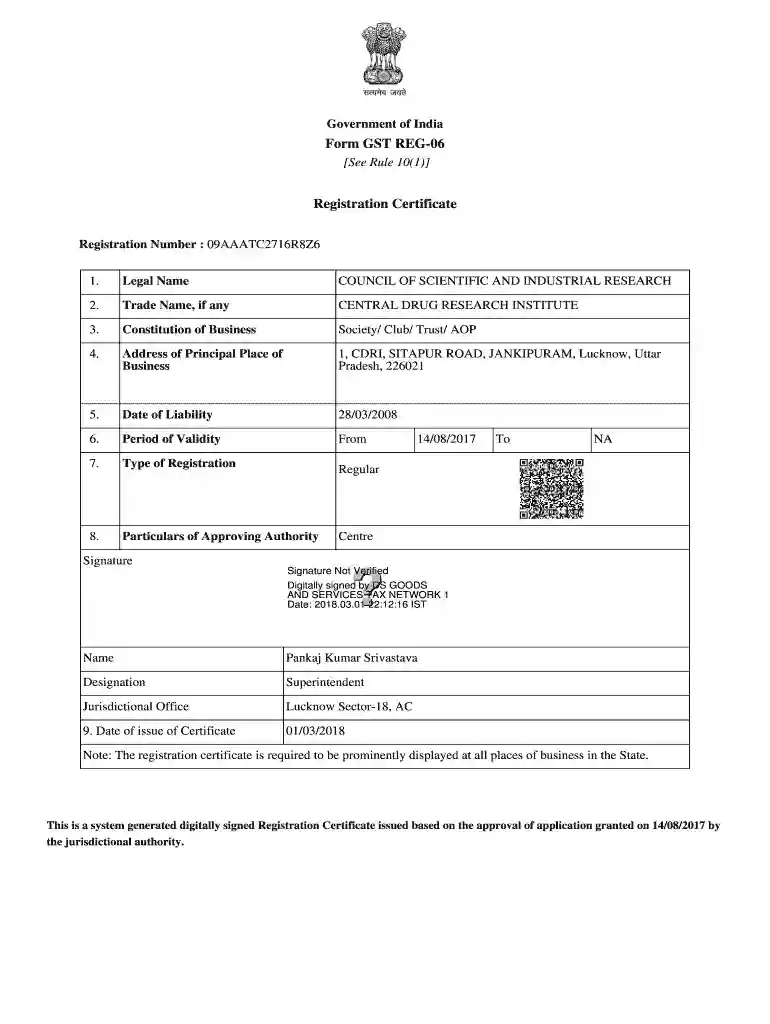
Type text, add images, blackout confidential details, add comments, highlights and more.

Draw your signature, type it, upload its image, or use your mobile device as a signature pad.

Send gst certificate image via email, link, or fax. You can also download it, export it or print it out.
A GST certificate is an official document issued by the appropriate tax authority that confirms a business is registered under the Goods and Services Tax (GST) system. This certificate serves as proof of the business's GST registration and includes essential information such as the GSTIN (Goods and Services Tax Identification Number), legal name of the business, trade name, type of business entity, address, and the date of registration. The GST certificate is crucial for compliance with tax regulations and is necessary for businesses to collect tax from consumers and claim input tax credits.
Understanding the significance of the GST certificate is vital for business operations in the United States. It ensures compliance with federal tax regulations and allows businesses to operate legally within the allowed framework. Without a valid GST certificate, businesses may face penalties or issues with tax authorities.
The process for obtaining a GST certificate involves several key steps designed to ensure compliance with tax regulations. Here’s a breakdown of the procedure:
Determine Eligibility: Before applying, a business must assess its eligibility for GST registration. Generally, businesses with a turnover exceeding a specified threshold are required to register.
Gather Required Documents: Essential documentation includes:
Complete the Application Form: Businesses need to fill out the GST application form, also known as GST REG-01, accurately, ensuring that all information is complete to avoid delays.
Submit the Application: The completed form, along with the essential documents, should be submitted to the respective state GST office. This can often be done online through the tax authority's website.
Receive GSTIN and Certificate: After processing the application, the tax authority will issue a GSTIN and provide the GST certificate via email. This certificate must be printed and displayed at the business premises.
Staying organized and ensuring every detail is accurate will help streamline the process of obtaining a GST certificate.
A GST certificate is composed of several critical elements that provide essential details regarding the business's tax status. Understanding these components is crucial for effective compliance and record-keeping. The primary elements include:
Each of these elements plays a crucial role in business operations, ensuring adherence to tax obligations and facilitating smooth interactions with customers and suppliers.
The legal use of the GST certificate encompasses a range of obligations and rights for businesses registered under GST.
Collecting GST: A registered business has the authority to collect GST from customers on taxable supplies, which is evident through the issuance of tax invoices that reference the GST number.
Claiming Input Tax Credits: Businesses can use their GST certificate to claim input tax credits for taxes paid on inputs used for providing taxable supplies, thus allowing for cost recovery.
Compliance with Tax Authorities: The GST certificate serves as official proof of registration, which businesses must present during audits or inspections.
Bidding for Government Contracts: Many government contracts require bidders to show a valid GST certificate as part of the documentation to ensure compliance with tax laws.
Correctly utilizing the GST certificate is essential for maintaining a legal standing in the marketplace and assuring customers of adherence to tax laws.
A variety of business entities and individuals benefit from having a GST certificate, primarily:
Small and Medium Enterprises (SMEs): These often constitute the backbone of the economy and must register to compete effectively in markets, ensuring they can collect and remit taxes.
Freelancers and Self-Employed Individuals: Professionals who provide taxable services may need to obtain a GST registration to legitimize their work and comply with regulations.
Businesses Engaged in Online Sales: E-commerce platforms often involve numerous transactions that require GST compliance.
Registered Corporations: Larger corporations must hold a GST certificate for operational legitimacy and tax compliance.
Understanding the diverse users of the GST certificate can assist businesses in recognizing the importance of adhering to GST regulations.


At DocHub, your data security is our priority. We follow HIPAA, SOC2, GDPR, and other standards, so you can work on your documents with confidence.
The General Service Technician I certificate is designed to provide you with knowledge and skills that are essential building blocks in the field of AutomotiveRead more
This 5-Day Instructor Certification. Course is coming to Lafayette, Indiana. Click here to learn more about the GST System. GST LEVEL 1 INSTRUCTOR CERTIFICATION.Read more
2 days ago Visit gst.gov.in Track Application Status enter your 15-digit ARN (Application Reference Number). New GST registration SLA: 3-7 working daysRead more


