
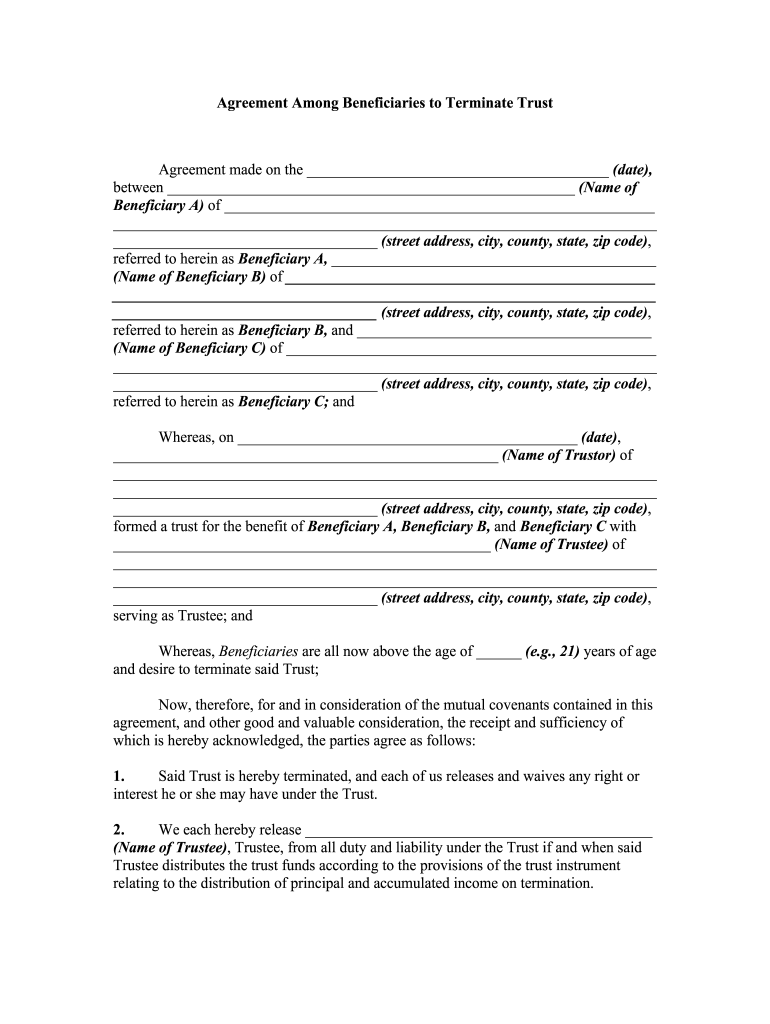







Definition and Overview of Trust Dissolution Form
A trust dissolution form serves as a legal document that facilitates the termination of a trust. This form is essential for ensuring that all parties involved, including beneficiaries and trustees, agree on the dissolution and understand the implications. The trust dissolution process entails various steps; hence, having a comprehensive form helps simplify complex procedures.
Key Terms and Concepts
- Trust: A fiduciary arrangement allowing a third party, or trustee, to hold assets on behalf of beneficiaries.
- Dissolution: The act of formally terminating a trust, thereby releasing the trustee of any obligation to manage the trust assets.
- Beneficiaries: Individuals or entities entitled to receive benefits from the trust.
Understanding these terms helps ensure that all involved parties have a clear grasp of the trust dissolution process and their respective roles.
Steps to Complete the Trust Dissolution Form
Completing a trust dissolution form requires careful attention to detail. The steps involved generally include:
-
Gather Required Information:
- Collect all pertinent details about the trust, including the trust's name, date of establishment, and trustee and beneficiary information.
-
Confirm Consent:
- Obtain written consent from all beneficiaries involved in the trust dissolution. This step is crucial, as it ensures that no party can claim they were unaware of the termination.
-
Fill in the Form:
- Accurately complete the trust dissolution form, providing all required information. Ensure that the form adheres to state-specific guidelines, as requirements can vary significantly.
-
Review and Sign:
- Have all parties review the completed form for accuracy. Once confirmed, each party should sign the document.
-
Notarization (if required):
- In some states, notarization of signatures may be necessary for the form to be considered valid.
-
File the Form:
- Submit the completed form to the relevant legal authority, such as a local court or state agency, as dictated by state laws.
Each of these steps is essential in ensuring that the dissolution is legally binding and properly executed.
Important Considerations for Trust Dissolution
When considering the dissolution of a trust, several factors must be taken into account:
-
State-Specific Rules: Laws governing trusts vary by state. Ensure the trust dissolution form complies with local regulations to avoid any complications.
-
Tax Implications: The dissolution of a trust may carry tax consequences for both the trust and its beneficiaries. Consulting with a tax professional is advisable to fully understand the implications.
-
Property Transfer: Upon dissolution, the ownership of trust assets may need to be transferred to beneficiaries. Clear instructions should be provided to avoid disputes regarding asset distribution.
Understanding these considerations enhances the effectiveness of the trust dissolution process, ensuring a smoother experience for all parties involved.
Legal Use of the Trust Dissolution Form
The trust dissolution form is legal documentation for formally ending a trust. Its proper usage ensures that all steps are followed according to legal standards.
-
Binding Agreement: The signed form acts as a binding agreement among the parties involved, confirming that they have agreed to dissolve the trust and all associated terms.
-
Record Keeping: This form also serves as an official record of the dissolution, which may be necessary for future reference, especially in legal or tax matters.
Complying with legal standards when using the trust dissolution form reduces the likelihood of disputes and enhances trust among involved parties.
Examples of Trust Dissolution Situations
Several real-world scenarios necessitate the use of a trust dissolution form. These may include:
-
Change in Circumstances: If significant life changes occur, such as divorce or the death of a beneficiary, the trust may no longer serve its intended purpose.
-
End of Trust Term: Some trusts are established for a specific duration. Upon expiration, a trust dissolution form is used to terminate the trust formally.
-
Consolidation of Trusts: When multiple trusts exist, beneficiaries may choose to consolidate them into a single trust, requiring the dissolution of the previous trust forms.
These scenarios illustrate the diverse situations where a trust dissolution form is not only beneficial but occasionally necessary.
How to Obtain Trust Dissolution Forms
Obtaining a trust dissolution form can be straightforward, as several options are available:
-
Internal Documents: Often, the trust document itself will outline the dissolution process and include a template for the dissolution form.
-
Legal Websites: Many legal websites provide downloadable templates or forms, often for free or a nominal fee.
-
Attorney Services: Consulting with an attorney who specializes in trust and estate law can provide access to professionally tailored dissolution forms that meet specific needs.
Utilizing these resources ensures that necessary legal documents are accessible and appropriately prepared for the dissolution process.




