Arizona deed beneficiary 2026

Get Form
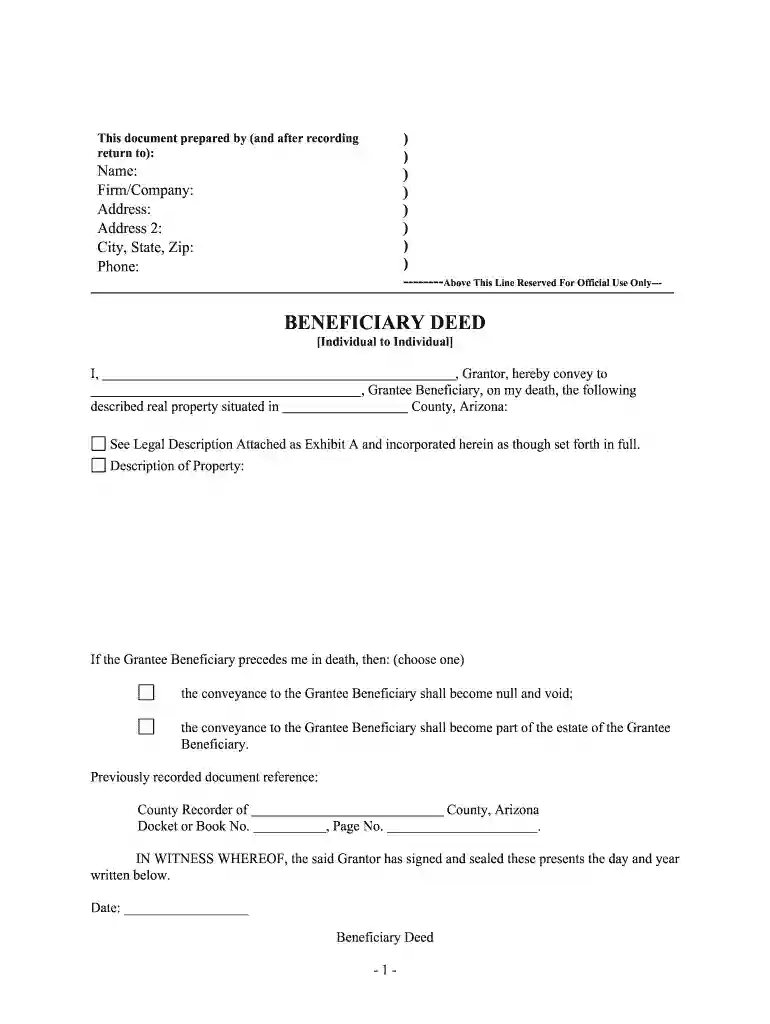
arizona maricopa county beneficiary deed form Preview on Page 1

Here's how it works

01. Edit your arizona maricopa county beneficiary deed form online
Type text, add images, blackout confidential details, add comments, highlights and more.

02. Sign it in a few clicks
Draw your signature, type it, upload its image, or use your mobile device as a signature pad.

03. Share your form with others
Send maricopa county beneficiary deed via email, link, or fax. You can also download it, export it or print it out.

Definition and Meaning of the Arizona Deed Beneficiary

The Arizona deed beneficiary is a legal document that allows a property owner, referred to as the Grantor, to designate an individual or individuals—known as Grantee Beneficiaries—to receive the property upon the Grantor's death. This method of transferring property avoids the lengthy probate process, allowing for a seamless transition of ownership to the designated beneficiaries. The beneficiary deed ensures that the property is automatically transferred without the need for court intervention, preserving both time and resources.

The beneficiary deed in Arizona functions under the guidelines established by state legislation. This form must be executed in accordance with specific state rules to ensure its validity and effectiveness. Importantly, the form must be appropriately notarized and filed with the Maricopa County Recorder's Office, or the equivalent authority in other Arizona counties, to be enforceable. Once recorded, the deed serves as a legally binding instrument that delineates the future ownership of the property.

Steps to Complete the Arizona Deed Beneficiary

Completing an Arizona deed beneficiary involves a series of meticulous steps to ensure that the document is legally sound and accurately reflects the Grantor's intentions. The following checklist outlines the essential steps:

  1. Obtain the Beneficiary Deed Form:

    • You can find the Arizona beneficiary deed form at the Maricopa County Recorder's Office or on their official website. It may also be advisable to consult a legal professional to obtain the correct form.
  2. Gather Necessary Information:

    • Compile the property details, including the legal description and address.
    • Identify the Grantee Beneficiaries, including their full names and addresses.
  3. Complete the Form:

    • Fill out the beneficiary deed form with accurate information, ensuring that all required sections are addressed.
    • Include clear instructions indicating that the deed should not take effect until the Grantor's death.
  4. Sign and Notarize the Document:

    • The Grantor must sign the deed in the presence of a notary public. Notarization is crucial for the document's legal standing.
    • Some jurisdictions may require witnesses to the signature.
  5. File the Deed with the County Recorder:

    • Submit the completed and notarized deed to the Maricopa County Recorder’s Office. A filing fee may apply.
    • Obtain a copy of the recorded deed for your records.
  6. Inform Your Beneficiaries:

    • While not legally required, informing the designated beneficiaries can prevent confusion regarding their future inheritance.

Important Terms Related to the Arizona Deed Beneficiary

Understanding key terminology associated with the Arizona deed beneficiary is essential for proper utilization and compliance. The following terms are pivotal:

  • Grantor: The individual who owns the property and executes the beneficiary deed.
  • Grantee Beneficiary: The person or persons designated to receive the property upon the Grantor's death.
  • Notarization: The process of having a document officially certified by a notary public, which assures its authenticity.
  • Probate: The legal process of administering the estate of a deceased person, often involving delays and costs; beneficiary deeds aim to bypass this.
  • Property Description: A detailed description of the property being conveyed, which is critical for legal clarity.
  • Maricopa County Recorder: The official responsible for maintaining public records, including property deeds in Maricopa County, Arizona.
  • Transfer on Death (TOD) Deed: Another common term for a beneficiary deed that specifies the transfer of property upon the death of the Grantor.

Legal Use of the Arizona Deed Beneficiary

The Arizona deed beneficiary serves as a legally accepted method for property transfer upon death, complying with state-specific requirements. This legal document is particularly significant for estate planning, providing a clear framework for asset distribution without subjecting the estate to the probate process.

In Arizona, this type of deed is enacted under the transfer-on-death law. It permits the Grantor to retain full control and ownership of the property during their lifetime while providing peace of mind that the property will pass directly to the specified beneficiaries once the Grantor passes away. This provision effectively sidesteps the complexities and potential conflicts that often accompany traditional testamentary provisions.

Key Elements of the Arizona Deed Beneficiary

Several essential components must be included in the beneficiary deed to ensure that it is valid and effective. Here are the key elements to consider:

  • Clear Identification of Grantor: The full name and address of the property owner should be detailed.
  • Designated Grantee Beneficiaries: Names and addresses of those who will inherit the property must be clearly indicated.
  • Property Description: A thorough description of the property, including tax parcel numbers and legal descriptions, is mandatory to avoid any ambiguity.
  • Effective Date Clause: This clause specifies that the transfer of property will occur only upon the death of the Grantor.
  • Notary Public Acknowledgment: A notary's signature serves as verification that the Grantor signed the document willingly and under no duress.
  • Recording Data: The deed must be filed with the county recorder’s office to be enforceable.

These elements form the foundation for a valid beneficiary deed in Arizona and ensure that the transfer of property occurs as intended by the Grantor.

be ready to get more

Complete this form in 5 minutes or less

Get form

Got questions?

We have answers to the most popular questions from our customers. If you can't find an answer to your question, please contact us.
Contact us
One of the main advantages is the ability to avoid probate. Probate is a legal process that can be time-consuming and expensive. By using a beneficiary deed, the property is transferred directly to the beneficiary upon your death, bypassing the probate process. Another benefit is the flexibility it offers.
Arizona has no state estate or inheritance tax. Beneficiaries assume the tax obligations after inheritance for income-earning assets like rental properties, investment accounts, or business interests.
In Arizona, a beneficiary deed works by allowing you to name a beneficiary who will inherit your real estate property upon your death. Your beneficiary would have no legal rights to the property until your death.
$30.00 per document What are the fees for recording? The standard fee to record most documents is $30.00 per document. FAQs - the Maricopa County Recorders Office maricopa.gov information faqs maricopa.gov information faqs
If the property needs to go through the probate court process, the house can stay in a decedents name until the probate process has been completed and ownership of the property has been transferred. As soon as the probate court has determined the new owner, they must file a new deed for the house in their name.

Security and compliance

At DocHub, your data security is our priority. We follow HIPAA, SOC2, GDPR, and other standards, so you can work on your documents with confidence.

Learn more
ccpa2
pci-dss
gdpr-compliance
hipaa
soc-compliance
be ready to get more

Complete this form in 5 minutes or less

Get form

People also ask

If you have made a will or previous beneficiary deed that leaves the property to someone, your new beneficiary deed will override it. Your rights. You keep complete ownership of, and control over, the real estate while youre alive. You pay the taxes on it, and its not protected from your creditors.
A TOD deed doesnt affect property taxes during the owners lifetime. Upon transfer, the beneficiary may pay capital gains taxes if they decide to sell the property, depending on how much profit they make from the sale. They may also be subject to estate taxes and property tax reassessment.

beneficiary deed maricopa county