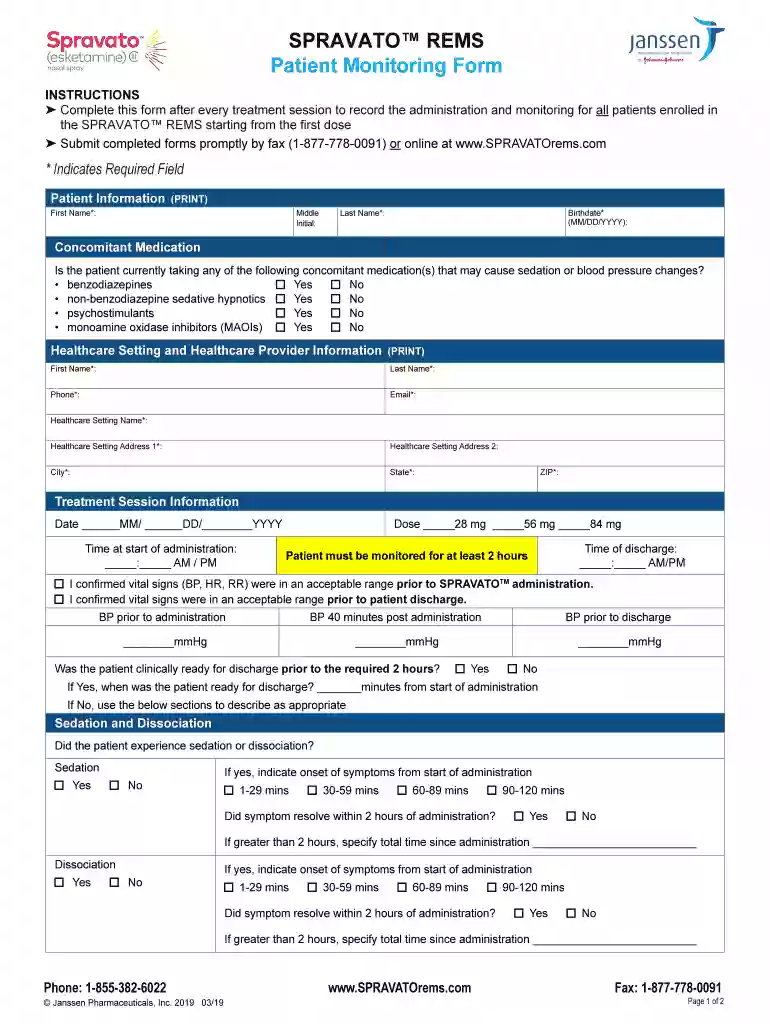
Patient Monitoring Form 2026

Get Form
remote patient monitoring documentation template Preview on Page 1

Here's how it works

01. Edit your remote patient monitoring documentation template online
Type text, add images, blackout confidential details, add comments, highlights and more.

02. Sign it in a few clicks
Draw your signature, type it, upload its image, or use your mobile device as a signature pad.

03. Share your form with others
Send patient monitoring form via email, link, or fax. You can also download it, export it or print it out.

How to use or fill out Patient Monitoring Form with our platform

Form edit decoration
9.5
Ease of Setup
DocHub User Ratings on G2
9.0
Ease of Use
DocHub User Ratings on G2
  1. Click ‘Get Form’ to open the Patient Monitoring Form in the editor.
  2. Begin by filling out the 'Patient Information' section. Enter the patient's first name, middle initial, last name, and birthdate in the required fields.
  3. In the 'Concomitant Medication' section, indicate whether the patient is taking any medications that may affect sedation or blood pressure by selecting 'Yes' or 'No' for each listed medication.
  4. Complete the 'Healthcare Setting and Healthcare Provider Information' section with your details, including first name, last name, phone number, email, and healthcare setting address.
  5. Fill in the 'Treatment Session Information' by entering the date and time of administration, dose given, and time of discharge. Ensure to confirm vital signs were acceptable before administration and discharge.
  6. Address any occurrences of sedation or dissociation experienced by the patient during treatment. Record onset times and resolution status as applicable.
  7. Finally, report any serious adverse events that occurred during this session or since the last treatment session by checking relevant boxes and providing necessary details.

Start using our platform today to easily complete your Patient Monitoring Form online for free!

be ready to get more

Complete this form in 5 minutes or less

Get form

Got questions?

We have answers to the most popular questions from our customers. If you can't find an answer to your question, please contact us.
Contact us
What are Patient Monitor used for? Patient monitors are used for continuous measurement of patient parameters such as heart rate and rhythm, respiratory rate, blood pressure, blood-oxygen saturation and many other parameters to take care of critically ill patients.
A: The Niscomed 5 Para Monitor is a medical device that measures 5 vital signs of a patient: SpO2 (oxygen saturation), heart rate (HR), non-invasive blood pressure (NIBP), ECG (electrocardiogram), and respiration (RESP) rate. It also measures two temperature readings.
Heart Rate Monitors These track the beats of a patients heart per minute through a wearable device. It can help to determine the levels of exercise your patient should be doing as well as the amount of medication they need to take.
Remote patient monitoring is the use of digital devices to monitor a patients health. Using remote patient monitoring (RPM), patients and providers can manage acute and chronic conditions by collecting and sharing health information.
Pulse Oximeter The pulse oximeter is a non-invasive clip that is attached to the patients finger (or occasionally earlobe) to measure light wavelengths that determine blood oxygen levelhow much oxygen is circulating in the patients red blood cells. Additionally, the pulse oximeter records a patients pulse.

Security and compliance

At DocHub, your data security is our priority. We follow HIPAA, SOC2, GDPR, and other standards, so you can work on your documents with confidence.

Learn more
ccpa2
pci-dss
gdpr-compliance
hipaa
soc-compliance
be ready to get more

Complete this form in 5 minutes or less

Get form

People also ask

Requirements for RPM include: Remote physiologic monitoring, but not RTM, requires an established patient relationship. Remote physiologic monitoring service must monitor an acute or chronic condition. Remote physiologic monitoring must be collected for at least 16 days out of 30 days.
Key benefits types of RPM devices Examples of these devices include at-home blood pressure monitors, pulse oximeters, and remote ECG devices. They aid chronic condition management and can help patients in case there is a risk of medical accident that may endanger patients lives.
Remote patient monitoring is the use of digital devices to monitor a patients health. . Some of the benefits include ongoing monitoring of the patients health, data sharing between the patient and provider, and patient engagement.

patient workup template pharmacy