
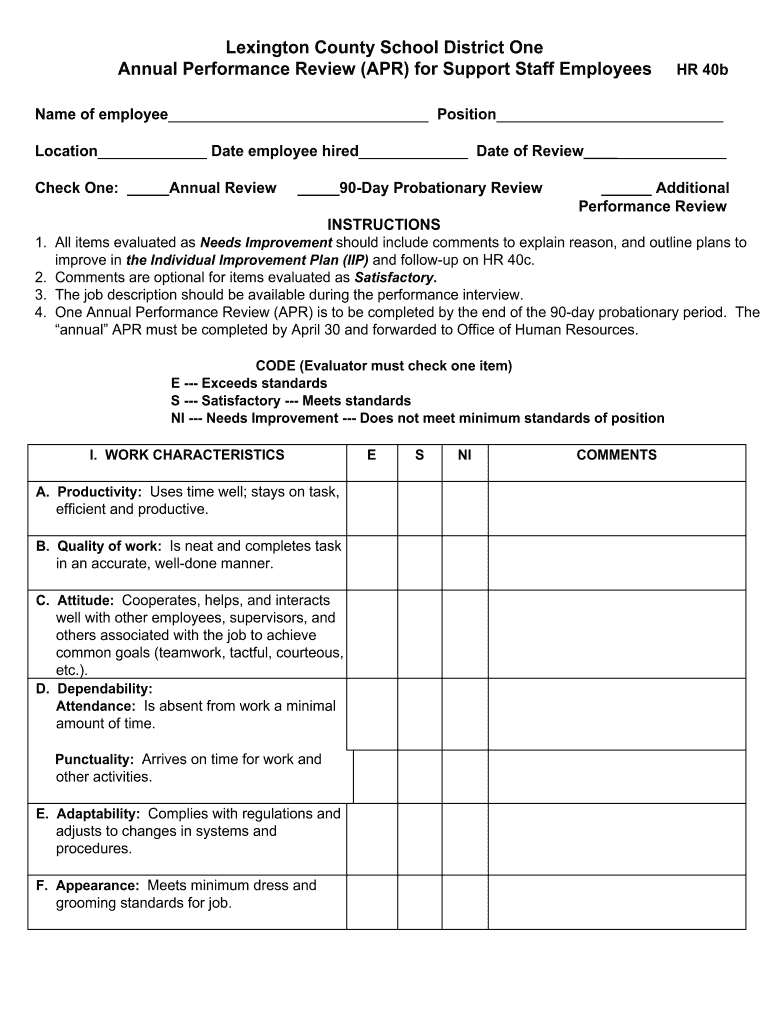







Definition and Meaning of the Staff Evaluation Form
The staff evaluation form is a systematic tool used by organizations to assess employee performance and productivity. This form typically encompasses various metrics that gauge employee effectiveness, including but not limited to job knowledge, work quality, teamwork, and adherence to organizational standards.
- Performance metrics: Common performance indicators may include productivity levels, quality of work, attitude, and overall job knowledge.
- Purpose: The primary objective is to provide structured feedback, facilitate professional development, and support personnel decisions regarding promotions, training needs, or potential disciplinary actions.
Understanding this form's purpose is crucial as it serves as a formal record of employee performance, significant for both the organization and the employee in terms of career development and satisfaction.
Key Elements of the Staff Evaluation Form
The staff evaluation form comprises several critical components that contribute to a comprehensive assessment of an employee's performance. Each element plays a vital role in ensuring the evaluation process is thorough and fair.
- Employee information: Details such as name, position, and evaluation period create a clear record for the evaluation.
- Performance criteria: These are the specific factors or areas being evaluated, such as:
- Job performance
- Attendance
- Collaboration and teamwork
- Initiative and problem-solving skills
- Rating scale: This component often includes numerical ratings or descriptive categories to assess each criterion, such as "Exceeds Expectations," "Meets Expectations," and "Needs Improvement."
- Comments section: A critical aspect for providing qualitative feedback on strengths and areas for potential growth.
- Signatures: Collecting signatures from both the evaluator and the employee confirms that the evaluation was discussed and understood.
Together, these elements enable a structured and comprehensive approach to employee performance evaluations.
Steps to Complete the Staff Evaluation Form
Completing the staff evaluation form can be a straightforward process when approached step by step. Here’s a breakdown of the essential stages in filling out the form effectively.
- Gather necessary information: Before starting, compile relevant performance data, feedback from supervisors, and any prior evaluations for reference.
- Assess performance against criteria: Carefully evaluate the employee's performance in each area defined in the evaluation criteria. Use specific examples to support your ratings.
- Complete the rating scale: Assign ratings based on the established criteria. Be as objective as possible, ensuring that recommendations align with the employee's documented performance.
- Provide detailed comments: Enter constructive feedback in the comments section, noting both strengths and areas for improvement. Specific examples can enhance the clarity and impact of your feedback.
- Review the completed form: Double-check for accuracy and completeness, ensuring that all sections are filled and that your feedback is constructive and fair.
- Discuss with the employee: Schedule a meeting to discuss the evaluation with the employee, addressing any questions or concerns they might have.
- Obtain signatures: Collect the necessary signatures to finalize the evaluation, signifying that both parties have engaged in the review process.
These steps ensure a thoughtful and fair evaluation process while clarifying expectations for future performance.
Examples of Using the Staff Evaluation Form
The application of the staff evaluation form can vary across different contexts and job roles, making it a versatile tool for performance assessment. Here are some practical examples of how various organizations might use the staff evaluation form effectively.
- Annual performance appraisals: Most commonly, the form can be utilized in structured annual reviews, where supervisors evaluate employees based on their performance throughout the year.
- Probationary evaluations: In situations where new employees are on probation, the form can be adapted to assess their suitability for permanent positions based on their initial performance.
- Team evaluations: For team-focused roles, collective evaluations can aggregate individual assessments to provide feedback on the group dynamics and collaboration.
- Skill assessments for training needs: Organizations may employ the form to identify areas where employees require further training or development, guiding both training initiatives and career advancement discussions.
These examples illustrate the form's flexibility in addressing varied evaluation needs within an organization.
Legal Use of the Staff Evaluation Form
The legal context in which a staff evaluation form is utilized encompasses several critical considerations that organizations must observe to ensure compliance and fairness.
- Documentation of performance: Proper use and maintenance of evaluation forms contribute to legal protection against wrongful termination claims by creating a documented history of employee performance.
- Fairness and consistency: It is crucial that all employees are subjected to the same evaluation standards, promoting fairness and reducing the risk of discrimination or bias claims.
- Confidentiality: Handling and storing evaluation forms securely ensures that sensitive employee information is protected in compliance with data privacy laws.
- Dispute resolution: The evaluation form can serve as a reference point in cases where employees contest their evaluations or decisions based upon them, providing a procedural backbone to legal inquiries.
Adhering to these legal considerations enhances the integrity of the evaluation process while safeguarding the organization against potential legal repercussions.




