




01. Edit your form online
Type text, add images, blackout confidential details, add comments, highlights and more.

Type text, add images, blackout confidential details, add comments, highlights and more.

Draw your signature, type it, upload its image, or use your mobile device as a signature pad.

Send it via email, link, or fax. You can also download it, export it or print it out.
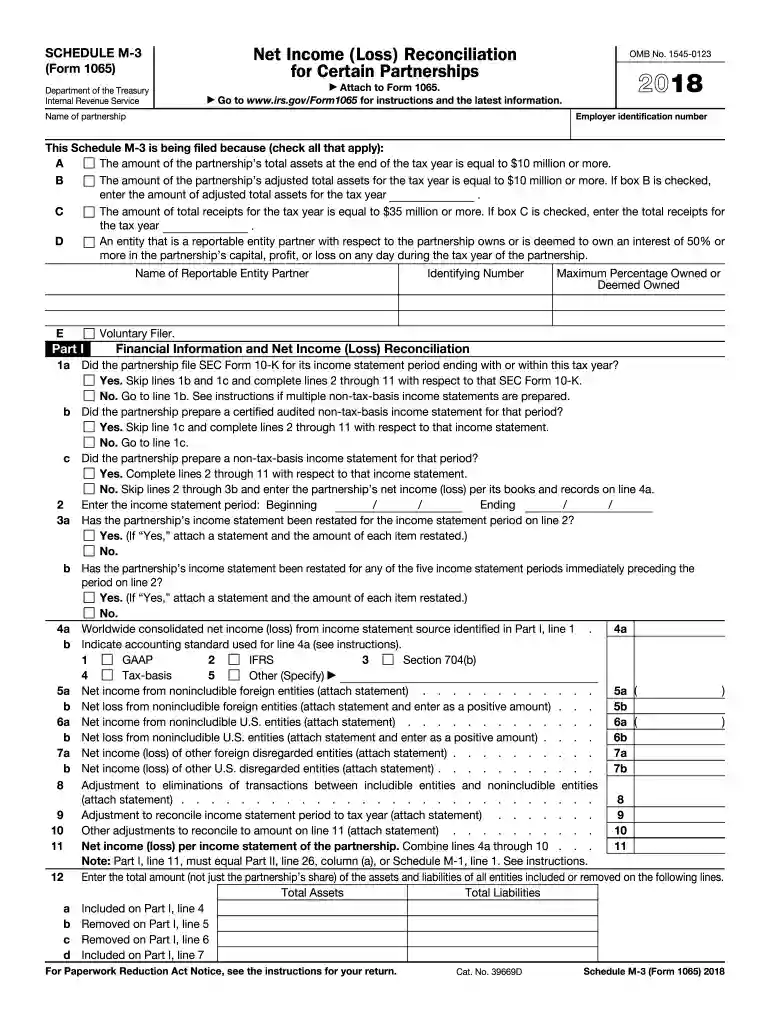
Schedule M-3 (Form 1065) is used by partnerships to reconcile financial statement net income with taxable income as reported to the IRS. It offers a clearer view of income discrepancies attributed to different accounting methods, ensuring accurate reporting. Created to increase transparency, this form is mandatory for partnerships with substantial assets or receipts, promoting compliance and reducing audit risks. Through Schedule M-3, these entities can align financial statement figures with tax return items, providing detailed insights into income and expense reporting.
Using Schedule M-3 involves several steps designed to provide clarity and accuracy in tax filings. It requires detailed entries and comparisons between book and tax data. Start by gathering financial statements and tax records. Review each section carefully; the form is divided into parts that address income, adjustments, and reconciliations. Utilize the adjustment section for income or deductions discrepancies. Ensure all figures align with supporting documentation prior to submission, and maintain meticulous records for future reference. Proper usage facilitates transparent tax reporting and compliance.
The Schedule M-3 must be used in compliance with U.S. tax regulations. It provides a standardized method for reporting and reconciling income, highlighting areas where tax and book accounting differ. Proper legal use mandates accurate reporting and justifications for adjustments, aligning tax filing with IRS requirements. Key legal purposes include the accurate bridging of accounting methods and the avoidance of punitive actions from inaccuracies or omissions during filing.
The IRS provides specific instructions for Schedule M-3, outlining completion, submission, and consistent application. These guidelines ensure that partnerships adhere to regulations governing income reporting. It's crucial to follow these to mitigate audit risks and penalties. The IRS emphasizes transparency and accuracy in reporting, requiring entities to provide a full account of financial and taxable income likenesses and differences.
Schedule M-3, as part of Form 1065, follows the annual partnership tax filing deadlines. Generally due March 15, extensions may be available to September 15. Timely filing is crucial to avoid penalties, emphasizing the importance of maintaining an updated calendar. Monitor IRS announcements for possible changes affecting submission dates.
Non-compliance with Schedule M-3 reporting can result in penalties, including fines and an increased likelihood of IRS audits. Penalties vary based on the degree of non-compliance, from failure to file to inaccuracies in reporting. Engaging a tax professional or using compliant software can help partnerships meet IRS regulations and avoid financial repercussions.
Filing Schedule M-3 can be done digitally or on paper, with e-filing as the preferred method due to its efficiency and error reduction. Digital filing offers quicker processing and acknowledgment from the IRS, while paper filing requires precise mailing procedures. Regardless of the method, maintaining a back-up of the submitted forms is advisable for organizational records and potential audits.
Businesses engaging in complex transactions or those with substantial income variations benefit most from Schedule M-3. Partnerships and large corporations who face significant discrepancies between reportable book and tax income find it essential for revealing and justifying these differences. Utilizing Schedule M-3 enhances transparency and supports accurate tax compliance for entities dealing with assorted income and adjustment structures.
We've got more versions of the 2017 schedule m 3 form. Select the right 2017 schedule m 3 version from the list and start editing it straight away!
At DocHub, your data security is our priority. We follow HIPAA, SOC2, GDPR, and other standards, so you can work on your documents with confidence.
You may claim a modification of up to $8,000 of your income by completing line 52 of Schedule M and carrying the total from line 55, schedule M to line 3 of the.Read more
1 Income (loss) from equity method foreign corporations. 2 Gross foreign dividends not previously taxed . . . 3 Subpart F, QEF, and similar income inclusions .Read more
The partnership may be required to file Schedule M-3 (see instructions). 1. Net income (loss) per books . . . . 2. Income included on Schedule K, linesRead more


