Type text, add images, blackout confidential details, add comments, highlights and more.
02. Sign it in a few clicks
Draw your signature, type it, upload its image, or use your mobile device as a signature pad.
03. Share your form with others
Send ecers score sheet example via email, link, or fax. You can also download it, export it or print it out.
How to use or fill out ecers score sheet with our platform
Ease of Setup
DocHub User Ratings on G2
Ease of Use
DocHub User Ratings on G2
Click ‘Get Form’ to open the ecers score sheet in the editor.
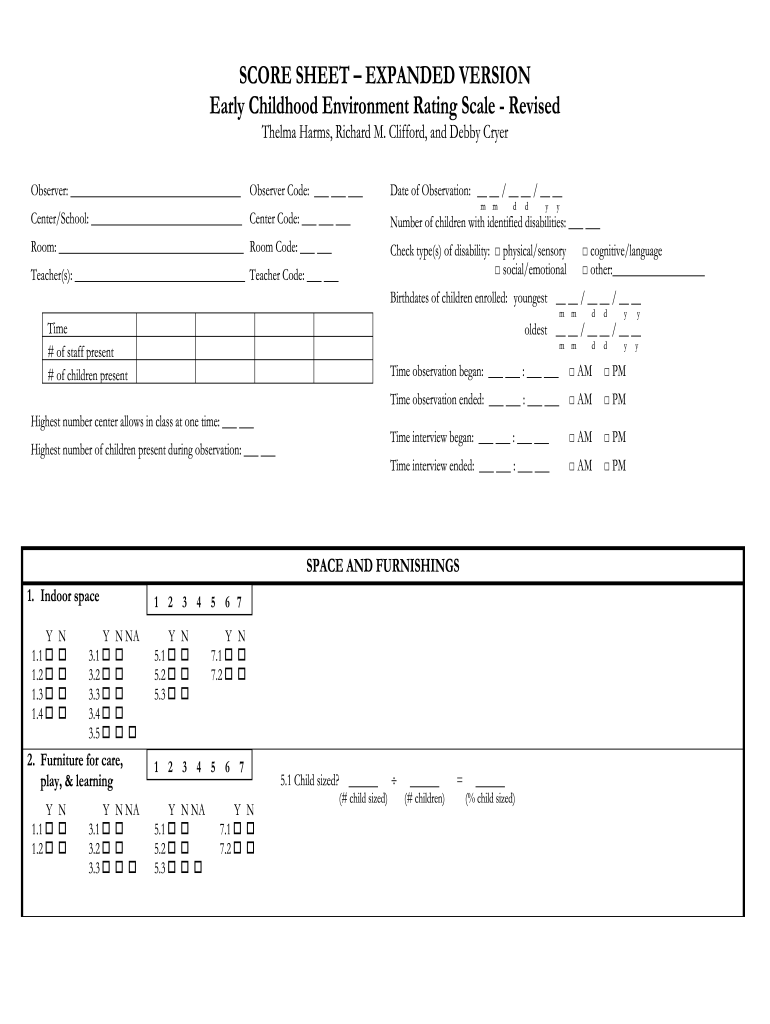
Begin by filling in the observer's name and code, along with the date of observation. This information is crucial for tracking and referencing your evaluations.
Next, enter details about the center/school and room, including codes. Specify the number of children with identified disabilities and check their types in the designated fields.
Proceed to document staff presence and child attendance during observation. Record times for various activities such as meals, naps, and interviews in the respective sections.
For each evaluation item under categories like Space and Furnishings or Personal Care Routines, mark 'Y' for Yes, 'N' for No, or 'NA' for Not Applicable as you assess each aspect.
Finally, review your entries for accuracy before saving or sharing your completed score sheet directly from our platform.
Start using our platform today to streamline your ecers score sheet completion!
In terms of construct validity, research has indicated that the ECERS-R can be broken down into two subscale constructs: one related to caregiver-child interaction, and the other related to the quality of activities and facilities (Scarr, Eisenberg, Deater-Deckhart, 1994; Sylva et al., 1999; Sylva et. al, 2006).
What is the ECE rating scale?
The widely used Early Childhood Environment Rating Scale (ECERS-3) is designed for use in preschools and kindergarten. ECERS-3 assesses both environmental provisions and teacher-child interactions that affect the broad developmental needs of young children ages 3 to 5, as well as health and safety.
What is the ECERS summary?
The ECERS is a classroom assessment tool designed to measure the quality of group programs for infants and toddlers (birth to age 3) by collecting data through classroom observations and a staff interview. The assessment is a 43-item rating scale organized into seven environmental subscales.
How many subscales are there in the FCCers R?
The 38 items are organized into seven subscales: Space and Furnishings, Personal Care Routines, Listening and Talking, Activities, Interaction, Program Structure, and Parents and Provider.
What are the seven subscales of the family child care environment rating scale?
The subscales for FCCERS are: Space and Furnishings, Personal Care Routines, Language and Books, Activities, Interaction and Program as well as Structure.
Percentage breakdown of ECERS-R scores by quality level in the EPPE and SEED studies. Quality is classified as Inadequate (
What are the 7 subscales of ECERS?
Theses are organized into 7 (seven) different subscales based on what is most likely to be found under similar circumstances. The subscales for SACERS are: Space and Furnishings, Health and Safety, Activities, Interactions, Program Structure, Staff Development and Special Needs Supplementary Items.
ecers score sheet expanded
Infant/Toddler (ITERS-3) and Early Childhood (ECERS-3)
Oct 17, 2022 The completed Environment Rating Scales self-assessment will guide next steps for a Quality Action Plan (with help from a Step Up to Quality.Read more
by T Harms SCORE SHEET EXPANDED VERSION. Early Childhood Environment Rating Scale - Revised. Thelma Harms, Richard M. Clifford, and Debby Cryer. ObserverRead more
Cookie consent notice
This site uses cookies to enhance site navigation and personalize your experience.
By using this site you agree to our use of cookies as described in our Privacy Notice.
You can modify your selections by visiting our Cookie and Advertising Notice.