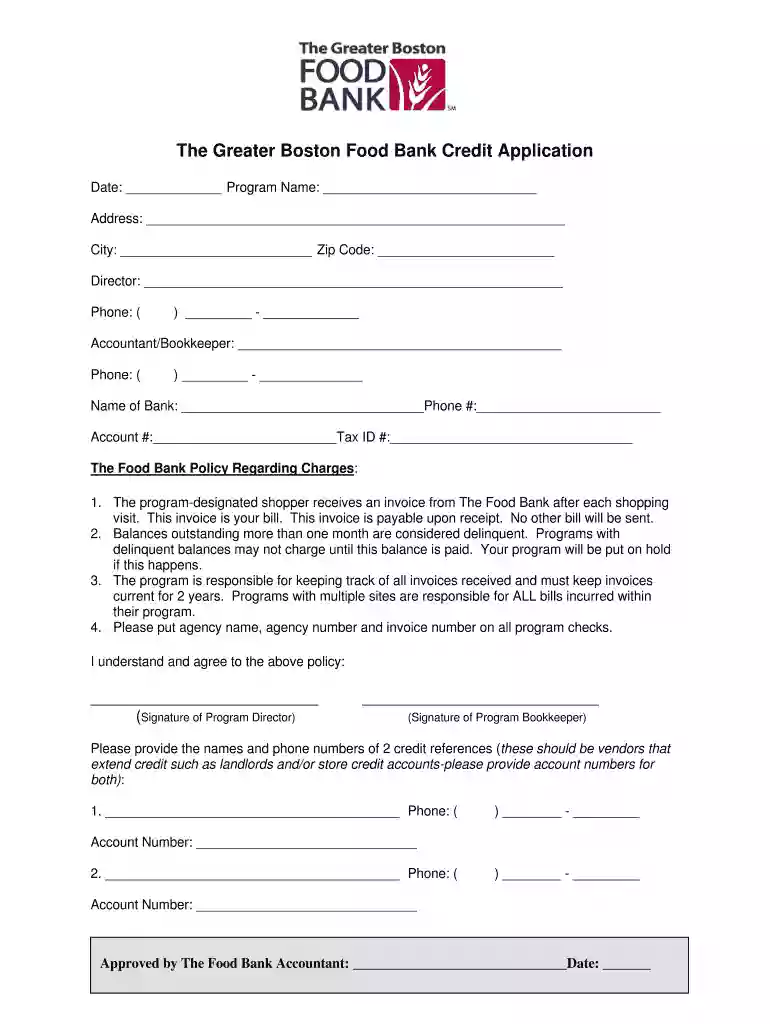
The Greater Boston Food Bank Credit Application 2026

Get Form
The Greater Boston Food Bank Credit Application Preview on Page 1

Here's how it works

01. Edit your form online
Type text, add images, blackout confidential details, add comments, highlights and more.

02. Sign it in a few clicks
Draw your signature, type it, upload its image, or use your mobile device as a signature pad.

03. Share your form with others
Send it via email, link, or fax. You can also download it, export it or print it out.

How to use or fill out The Greater Boston Food Bank Credit Application with our platform

Form edit decoration
9.5
Ease of Setup
DocHub User Ratings on G2
9.0
Ease of Use
DocHub User Ratings on G2
  1. Click ‘Get Form’ to open it in the editor.
  2. Begin by entering the date at the top of the form. This is essential for record-keeping.
  3. Fill in the Program Name, Address, City, and Zip Code fields accurately to ensure proper identification.
  4. Provide the Director's name and phone number. This information is crucial for communication regarding your application.
  5. Next, enter the Accountant/Bookkeeper's name and phone number. This helps streamline financial communications.
  6. Complete the banking information section by providing the Name of Bank, Phone Number, Account Number, and Tax ID Number.
  7. Review The Food Bank Policy Regarding Charges carefully. Ensure you understand it before signing.
  8. Sign and date where indicated for both the Program Director and Bookkeeper to confirm agreement with the policy.
  9. Lastly, provide two credit references along with their phone numbers and account numbers as required.

Start using our platform today to fill out your application online for free!

be ready to get more

Complete this form in 5 minutes or less

Get form

Got questions?

We have answers to the most popular questions from our customers. If you can't find an answer to your question, please contact us.
Contact us
The Greater Boston Food Bank operates from our 117,000-square-foot Yawkey Distribution Center in South Boston. This is where 109 million pounds of healthy food passes through before being distributed across Eastern Massachusetts through more than 600 partner agencies and direct distribution sites such as: Food Pantries.
Check your local area for any feeding America based food banks. They usually get big donations of meat and other foods from grocery stores and tend to offer frozen meats along with canned varieties like tuna, chicken and sometimes salmon.
(and 3 things to avoid) Peanut Butter. Liked by both kids and adults, and high in protein, peanut butter is the most requested item by food banks. Canned Proteins. Canned Beans. Pasta Pasta Sauce. Pantry Staples. Canned Vegetables. Cooking Essentials, like olive oil and spices. Formula.
Anyone who needs extra help affording food can visit a food pantry or meal program. Some pantries or programs may have additional requirements, like living in a certain area.
Specifically, food banks often need items like: Peanut butter. Canned soup. Canned fruit. Canned vegetables. Canned stew. Canned fish. Canned beans. Pasta (most prefer whole grain)

Security and compliance

At DocHub, your data security is our priority. We follow HIPAA, SOC2, GDPR, and other standards, so you can work on your documents with confidence.

Learn more
be ready to get more

Complete this form in 5 minutes or less

Get form

People also ask

Go to GBFB.org and click on Need Food. You can search by zip code, see hours of operation etc. call 211 or go to 211.org for additional resources. You can apply for SNAP benefits through GBFB - also on the need for page.
(and 3 things to avoid) Canned Proteins. Canned Beans. Pasta Pasta Sauce. Pantry Staples. Canned Vegetables. Cooking Essentials, like olive oil and spices. Formula. Baby Food. For the same reason, you should donate formula, its a good idea to donate any unused baby foods that may be hiding in your pantry.
1 in 3 food bank users are children More than a quarter of all clients were newcomers who have lived in Canada for less than a decade a figure that has doubled since 2016. Racialized people accounted for nearly 40 per cent of the food banks client base, up from 32 per cent the year before.

Related links