




01. Edit your form online
Type text, add images, blackout confidential details, add comments, highlights and more.

Type text, add images, blackout confidential details, add comments, highlights and more.

Draw your signature, type it, upload its image, or use your mobile device as a signature pad.

Send it via email, link, or fax. You can also download it, export it or print it out.
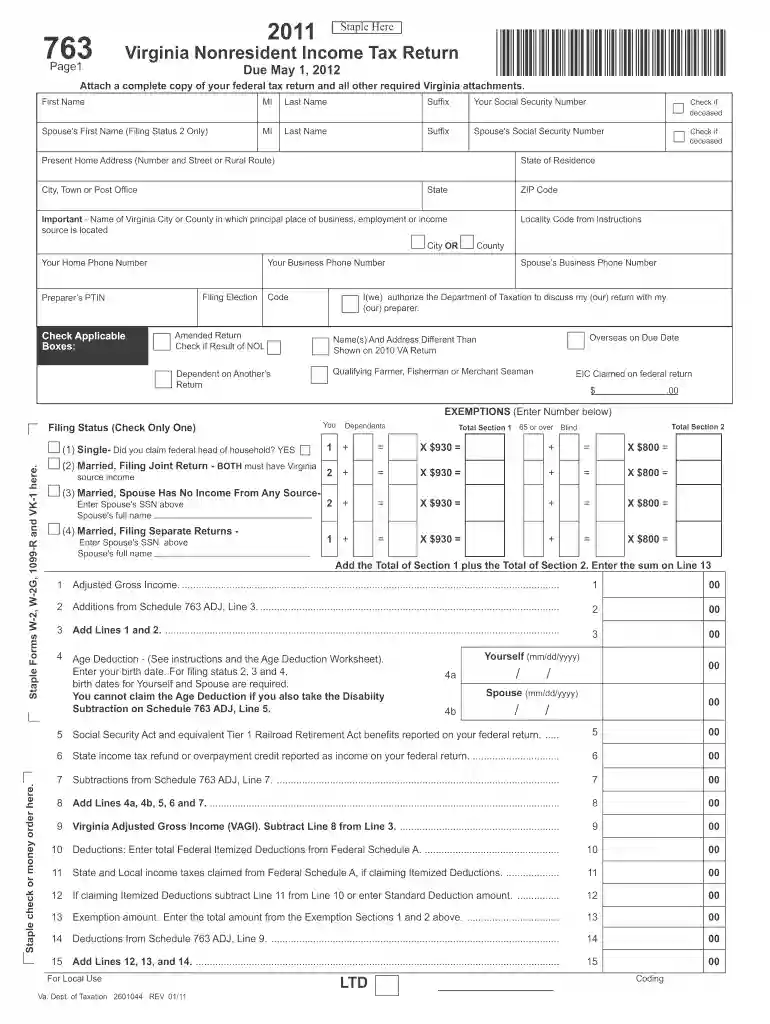
The 2011 763 form is a specific tax document used by nonresidents of Virginia to file income taxes for the 2011 tax year. This form is essential for individuals who have income from Virginia sources but reside outside the state. It primarily helps in determining the correct amount of Virginia income tax owed, ensuring compliance with state tax laws.
Understanding the purpose and appropriate use of the 2011 763 form can significantly impact your tax compliance process and ensure you meet state obligations efficiently.
Acquiring the 2011 763 form involves several accessible methods, ensuring taxpayers can obtain the necessary documents without undue inconvenience. Here are some common ways to obtain this specific form:
These methods ensure that taxpayers have various options based on their preferences, whether they prefer digital downloads or physical copies.
Accurately completing the 2011 763 form requires attention to detail across several sections. The process generally encompasses the following steps:
Each step is critical for ensuring that your tax liability is calculated correctly, and all required fields on the form are completed correctly.
Filing the 2011 763 form necessitates several supporting documents to verify income and deductions, which are integral to the process:
These documents provide the substantiation necessary for income and deduction claims and support the accurate completion of the form.
Timely submission of the 2011 763 form is crucial to avoid penalties and interest. Important dates to consider include:
Understanding these timelines is essential to maintain compliance and ensure any tax payments are made promptly, avoiding additional penalties.
The legal framework governing the 2011 763 form ensures it is used correctly for tax reporting purposes among nonresidents of Virginia:
Taxpayers are encouraged to be comprehensive in their submissions, given the significant legal implications of incorrect or incomplete filings.
Digital tools ease preparation of the 2011 763 form. Compatibility with software applications makes tax filing more efficient:
These resources simplify the filing process and help ensure accuracy, providing taxpayers with user-friendly methods to organize and submit their tax recordings.
Non-compliance with filing requirements of the 2011 763 form can attract penalties, impacting nonresident taxpayers financially:
Understanding the penalties can motivate timely and accurate submission, ensuring taxpayers avoid unintended financial liabilities.
We've got more versions of the 2011 763 form form. Select the right 2011 763 form version from the list and start editing it straight away!
| Versions | Form popularity | Fillable & printable |
|---|---|---|
| 2025 | 4.2 Satisfied (33 Votes) | |
| 2024 | 4.4 Satisfied (59 Votes) | |
| 2023 | 4.8 Satisfied (37 Votes) | |
| 2022 | 4.6 Satisfied (42 Votes) | |
| 2021 | 4.8 Satisfied (61 Votes) | |
| 2020 | 4.3 Satisfied (140 Votes) | |
| 2019 | 4.2 Satisfied (70 Votes) | |
| 2018 | 4.3 Satisfied (124 Votes) | |
| 2016 | 4.3 Satisfied (146 Votes) | |
| 2014 | 4.4 Satisfied (497 Votes) | |
| 2013 | 4.2 Satisfied (48 Votes) | |
| 2011 | 4 Satisfied (46 Votes) | |
| 2010 | 4.3 Satisfied (61 Votes) |
At DocHub, your data security is our priority. We follow HIPAA, SOC2, GDPR, and other standards, so you can work on your documents with confidence.
You may be eligible for a refund based on your household income (see Tips and Definitions) and the property taxes paid on your primary residence inRead more
According to the rules of ERA, the members of the guideline development group completed a centralized Declaration of Interest form that is available online atRead more
FORM 763 (2011) Page 2. NONRESIDENT ALLOCATION PERCENTAGE. Enter negative numbers in brackets. A - All Sources. B - Virginia Sources. 1 Wages, salaries, tips


