



01. Edit your form 8332 online
Type text, add images, blackout confidential details, add comments, highlights and more.

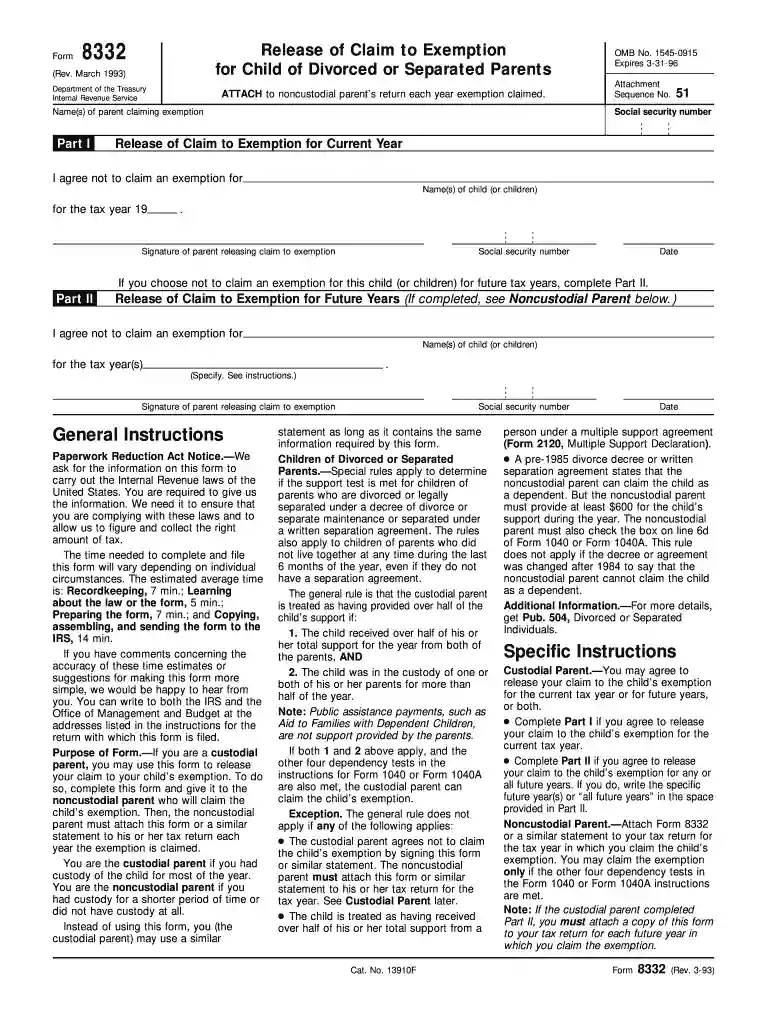
Type text, add images, blackout confidential details, add comments, highlights and more.
Draw your signature, type it, upload its image, or use your mobile device as a signature pad.
Send 8332 form via email, link, or fax. You can also download it, export it or print it out.
Form 8332 is a document issued by the Internal Revenue Service (IRS) that enables custodial parents to release their claim to a child's tax exemption, allowing the noncustodial parent to claim the exemption on their tax returns. This form is essential for parents who are separated or divorced, as it serves as an official declaration permitting one parent to take advantage of tax benefits typically reserved for the custodial parent. The release can be for the current tax year or for future years, depending on the agreement between both parties.
To effectively use Form 8332, the custodial parent must complete the necessary sections to officially release their right to claim the child as a dependent. This involves filling out the child's information, selecting the tax years for which the exemption is released, and the custodial parent's signature. Once completed, the noncustodial parent attaches the form to their tax return to validate their claim for the exemption. If the release is for multiple years, a copy of Form 8332 must be included with each relevant year's tax return.
You can obtain Form 8332 directly from the IRS website, where it is available as a downloadable PDF. This ensures that you are using the most current version of the form. Alternatively, it may be available through tax preparation software or from a tax advisor. Once downloaded, you can print and fill out the form manually, or use a digital tool like DocHub to complete it electronically, which simplifies the process and allows for digital signatures if needed.
Enter Parent and Child Information: Begin by entering the custodial parent's information and the child's name and Social Security number.
Release of Claim to Exemption: Specify whether the form is releasing the claim for the current year or for future years by checking the appropriate box.
Signature: The custodial parent must sign the form to confirm the release.
Provide a Copy to the Noncustodial Parent: The custodial parent should provide a completed and signed copy to the noncustodial parent, who will then attach it to their tax return.
Typically, Form 8332 is used by separated or divorced parents who need to establish which parent can claim a child as a dependent on their federal tax return. In most cases, the custodial parent, generally the one with whom the child resides most of the year, would be entitled to this claim. However, situations may arise where it is more beneficial for the noncustodial parent to claim the child, requiring the use of Form 8332.


Legally, Form 8332 must be used to document the release of a dependency claim from the custodial parent to the noncustodial parent. The procedure is bound by specific IRS guidelines and tax laws to prevent unauthorized claims and tax fraud. Failure to use the form properly can result in IRS penalties and the disallowance of the dependency claim for the noncustodial parent.
According to IRS guidelines, the custodial parent generally has the automatic right to claim the child as a dependent unless Form 8332 is used to release this right. This form acts as a formal agreement in compliance with IRS protocols to ensure clear and legal allocation of tax benefits between parents. IRS also stipulates that the noncustodial parent must include Form 8332 with their tax return each year they claim the exemption.
Form 8332 should be completed and exchanged before the filing of the respective year's tax return. As tax deadlines approach, typically April 15, the form should be ready to avoid any last-minute issues or delays in processing the tax return. It's advisable to complete this process well in advance of the tax filing season to allow time for any necessary adjustments or agreements between the parents.
To complete Form 8332, you will need:
Having these documents at hand facilitates accurate and complete entry of information on the form.
Different taxpayer scenarios can impact the decision to use Form 8332:
Self-Employed: May benefit from claiming the exemption to decrease taxable income.
Retired: Typically have fixed incomes, so adjustment of exemptions might not affect as much unless significant income is still earned.
Students: Often don't have tax liabilities impacted by dependencies unless also working; however, they need to correctly manage dependency claims to avoid audits.
By considering these nuances, taxpayers can make informed decisions about utilizing Form 8332 in ways that optimize their tax situations while remaining compliant with legal requirements.

We've got more versions of the form 8332 form. Select the right form 8332 version from the list and start editing it straight away!
At DocHub, your data security is our priority. We follow HIPAA, SOC2, GDPR, and other standards, so you can work on your documents with confidence.
Properly Executed IRS Form 8332 is Key to Releasing Dependency Exemption and Trumps State Court Orders. Date of decision: March 13, 2014. In this caseRead more
Oct 10, 2019 275.2 Items Not Eligible for Deposit or Pickup. [Revise the text to read as follows:] A customer must present the following eligible Free Matter.Read more
Jan 22, 2026 Note: This form applies to certain tax benefits, including the child tax credit, additional child tax credit, and credit for other dependents.Read more


