




01. Edit your 03 669 8606 online
Type text, add images, blackout confidential details, add comments, highlights and more.

Type text, add images, blackout confidential details, add comments, highlights and more.

Draw your signature, type it, upload its image, or use your mobile device as a signature pad.

Send 8606 formar instrucciones via email, link, or fax. You can also download it, export it or print it out.
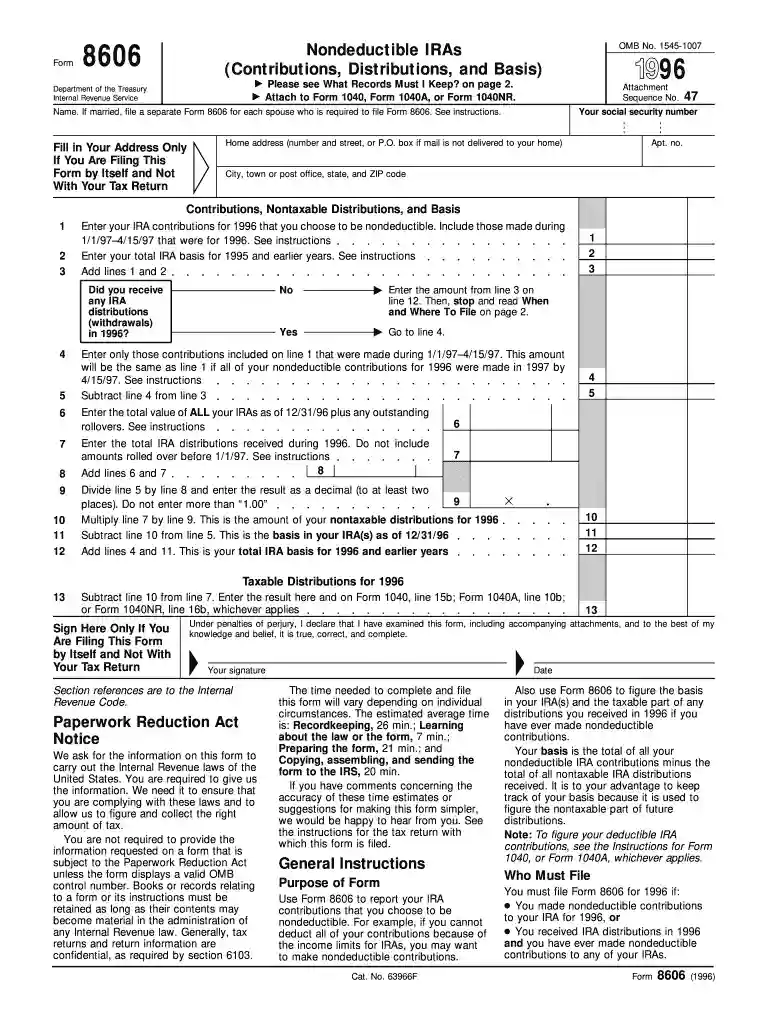
Form 8606 is a crucial document used to report nondeductible contributions to Individual Retirement Accounts (IRAs). The 1996 version of this form was specifically designed to facilitate the detailed reporting of such contributions, as well as to calculate the basis of IRAs and taxable portions of distributions received that year. Understanding the nuances of Form 8606 is essential for taxpayers seeking to accurately report their financial activities related to IRAs, especially those involving nondeductible contributions or distributions. It serves as an official record of all nondeductible contributions made to Traditional IRAs, ensuring proper tax treatment by distinguishing them from deductible contributions.
Using Form 8606 requires careful attention to detail. Taxpayers who made nondeductible contributions to IRAs during 1996 must fill out this form to report the specifics of these transactions. The form guides users through the process of calculating the taxable and nontaxable portions of IRA distributions. In practical use, it involves a step-by-step method of inputting relevant data, such as the amount of contributions and distributions, into designated sections. Tax professionals often emphasize the importance of this form for maintaining accurate and compliant records, particularly as it affects the computation of taxes owed or refunds due.
Acquiring a copy of the 1996 Form 8606 can be done through several channels. Historically, the form would have been available via mail delivery from the IRS upon request. While digital access to historical forms has improved over time, taxpayers may also find archived versions in public records or through financial advisors who maintain historical tax documents. Certain online platforms specializing in financial documentation might offer downloads of the form, facilitating the process for individuals needing documentation for previous tax years.
Filling out Form 8606 involves several precise steps:
Identify Nondeductible Contributions: Start by determining the amount of any nondeductible IRA contributions made in 1996. This figure forms the basis for subsequent calculations.
Calculate the Basis: Use the instructions on the form to calculate the IRA basis, which is crucial for determining taxable amounts.
Report Distributions: If any distributions were received in 1996, these must be accurately reported to establish their correct tax treatment.
Complete All Required Sections: Each section of the form addresses different elements of IRA contributions and distributions, requiring a detailed approach for completion.
The form is vital for ensuring proper tax compliance. By accurately reporting nondeductible IRA contributions and distributions, taxpayers help prevent discrepancies in tax reporting that could lead to audits or penalties. For those with IRAs, the form contributes to the larger financial picture by tracking the basis of contributions, thus providing clarity on future tax liabilities. It essentially acts as a bridge between annual contributions and tax filings, ensuring consistency across tax years.
Typically, the form is used by individuals with IRAs who have made nondeductible contributions or received distributions. This includes taxpayers transitioning between different types of IRAs or those making strategic financial decisions impacting their retirement accounts. Specifically, individuals seeking to segregate nondeductible contributions from the deductible ones use this form to prevent overpayment of taxes on distributed amounts.


The IRS provides strict guidelines regarding the completion and submission of Form 8606. One key rule is that taxpayers must file the form for any tax year in which they contribute nondeductible amounts to an IRA or receive distributions. Failing to file or inaccuracies in filing can lead to penalties or additional taxes. The IRS’s instructions offer specific line-by-line guidance to help users accurately complete each section, preventing common mistakes that could affect tax outcomes.
Form 8606 must be filed with the taxpayer's standard annual return, adhering to the typical April tax filing deadline unless extended by formal IRS policy that year. When extensions on tax returns are granted, the filing deadline for the form similarly extends, allowing taxpayers additional time for completion. Keeping track of these deadlines is essential to avoid penalties associated with late filings or misreporting of retirement contributions and distributions.
We've got more versions of the 03 669 8606 form. Select the right 03 669 8606 version from the list and start editing it straight away!
| Versions | Form popularity | Fillable & printable |
|---|---|---|
| 2025 | 4.8 Satisfied (42 Votes) | |
| 2024 | 4.6 Satisfied (45 Votes) | |
| 2023 | 4.2 Satisfied (42 Votes) | |
| 2022 | 4.8 Satisfied (44 Votes) | |
| 2021 | 4.8 Satisfied (139 Votes) | |
| 2020 | 4.3 Satisfied (160 Votes) | |
| 2019 | 4.4 Satisfied (64 Votes) | |
| 2018 | 4.3 Satisfied (153 Votes) | |
| 2017 | 4.3 Satisfied (107 Votes) | |
| 2016 | 4.3 Satisfied (175 Votes) | |
| 2015 | 4 Satisfied (50 Votes) | |
| 2014 | 4 Satisfied (58 Votes) | |
| 2013 | 4 Satisfied (44 Votes) | |
| 1997 | 4.2 Satisfied (38 Votes) | |
| 1996 | 4 Satisfied (49 Votes) |
At DocHub, your data security is our priority. We follow HIPAA, SOC2, GDPR, and other standards, so you can work on your documents with confidence.
Also use Form 8606 to figure the basis in your IRA(s) and the taxable part of any distributions you received in 1996 if you have ever made nondeductible.Read more
Apr 15, 1976 Increased section 179 deduction dollar limits. The maximum amount you can elect to deduct for most sec- tion 179 property you placed inRead more


