




01. Edit your form online
Type text, add images, blackout confidential details, add comments, highlights and more.

Type text, add images, blackout confidential details, add comments, highlights and more.

Draw your signature, type it, upload its image, or use your mobile device as a signature pad.

Send it via email, link, or fax. You can also download it, export it or print it out.
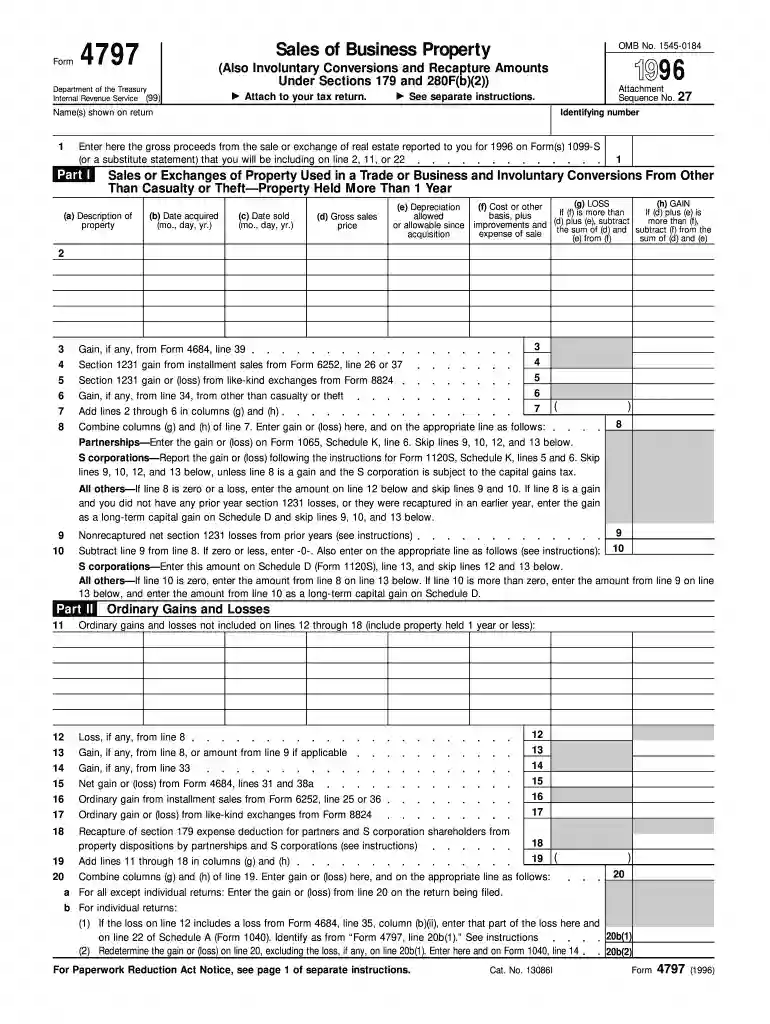
Form 4797, specifically from the year 1996, is a document used by taxpayers to report the sales and exchanges of business properties. It plays a crucial role in detailing gains or losses from transactions involving business assets. The form also encompasses involuntary conversions and recapture amounts under specific Internal Revenue Code sections.
Form 4 primarily applies to property used in a trade or business. It allows individuals and businesses to calculate gains or losses accurately, which is vital for determining tax liabilities. This form ensures compliance with federal tax regulations by serving as the official record for these specific types of transactions.
Using Form 4797 from 1996 involves several steps to ensure accurate reporting of property transactions. Here’s how to navigate this form:
Identify Transactions: Determine which sales or exchanges of property need to be reported on Form 4797. This typically includes business assets and property involuntarily converted.
Gather Details: Collect all necessary information about the transaction, including the original purchase price, sale proceeds, and any associated costs or depreciation.
Complete Sections:
Calculate Totals: Ensure that the calculations of gains and losses are accurate before transferring final amounts to your main tax return forms.
Submit Form: Attach the completed Form 4797 to your income tax return and submit by the due date to comply with IRS guidelines.
Understanding the structure of Form 4 is essential for accurate completion:
Each section of the form is crucial for accurately capturing all necessary financial details. Properly understanding these elements ensures correct reporting and helps avoid underpayment or overpayment of taxes.
Filing Form 4797 involves several steps:
Collect Documents: Gather relevant documents like purchase agreements, invoices, and past tax returns with similar deductions or claims.
Fill Out Sections: Start by entering personal and business information, followed by transaction details in the specified sections.
Perform Calculations: Use appropriate worksheets to calculate gains/losses, considering depreciation and basis adjustments. Consult IRS publications if necessary.
Review and Verify: Double-check all entries for accuracy. Mistakes in calculation or data entry can lead to penalties or delays.
Attach and Submit: Include Form 4797 with your federal tax return. Submit electronically using IRS-approved software or mail a paper copy, ensuring it reaches the IRS by the filing deadline.
The IRS provides specific guidelines for accurately completing and submitting Form 4797 to mitigate errors:
Familiarity with key terms is essential for correctly completing Form 4797:
These terms help ensure that taxpayers apply the correct rules for their specific situations while completing the form.
Typical users of Form 4797 include:
These groups regularly navigate Form 4797 to ensure they meet the IRS requirements for reporting specific financial transactions.
Failure to comply with Form 4797's reporting requirements may lead to IRS penalties:
Understanding these penalties underscores the importance of diligent and accurate completion of Form 4.
We've got more versions of the form 4797 1996 form. Select the right form 4797 1996 version from the list and start editing it straight away!
| Versions | Form popularity | Fillable & printable |
|---|---|---|
| 2025 | 4.1 Satisfied (26 Votes) | |
| 2024 | 4.9 Satisfied (25 Votes) | |
| 2023 | 4.6 Satisfied (38 Votes) | |
| 2022 | 4.7 Satisfied (33 Votes) | |
| 2021 | 4.8 Satisfied (71 Votes) | |
| 2020 | 4.4 Satisfied (199 Votes) | |
| 2019 | 4.4 Satisfied (79 Votes) | |
| 2018 | 4.1 Satisfied (80 Votes) | |
| 2017 | 4.2 Satisfied (65 Votes) | |
| 2016 | 4.3 Satisfied (185 Votes) | |
| 2015 | 4 Satisfied (54 Votes) | |
| 2014 | 4 Satisfied (47 Votes) | |
| 2013 | 4.3 Satisfied (67 Votes) | |
| 2012 | 4.1 Satisfied (26 Votes) | |
| 2011 | 4.1 Satisfied (56 Votes) |
At DocHub, your data security is our priority. We follow HIPAA, SOC2, GDPR, and other standards, so you can work on your documents with confidence.
Use Form 4797 to report: ○ The sale or exchange of property used in your trade or business; depreciable and amortizable property; oil, gas, geothermal, or otherRead more
Aug 26, 2012 Form 4797 is used to report the following activity.1. 1. The sale or exchange of: a. Property used in a trade or business; b. Depreciable andRead more
Apr 15, 1976 Use Form 4797,. Part IV, to figure the recapture amount. Report the recap- ture amount as other income on the same form or sched- ule onRead more


