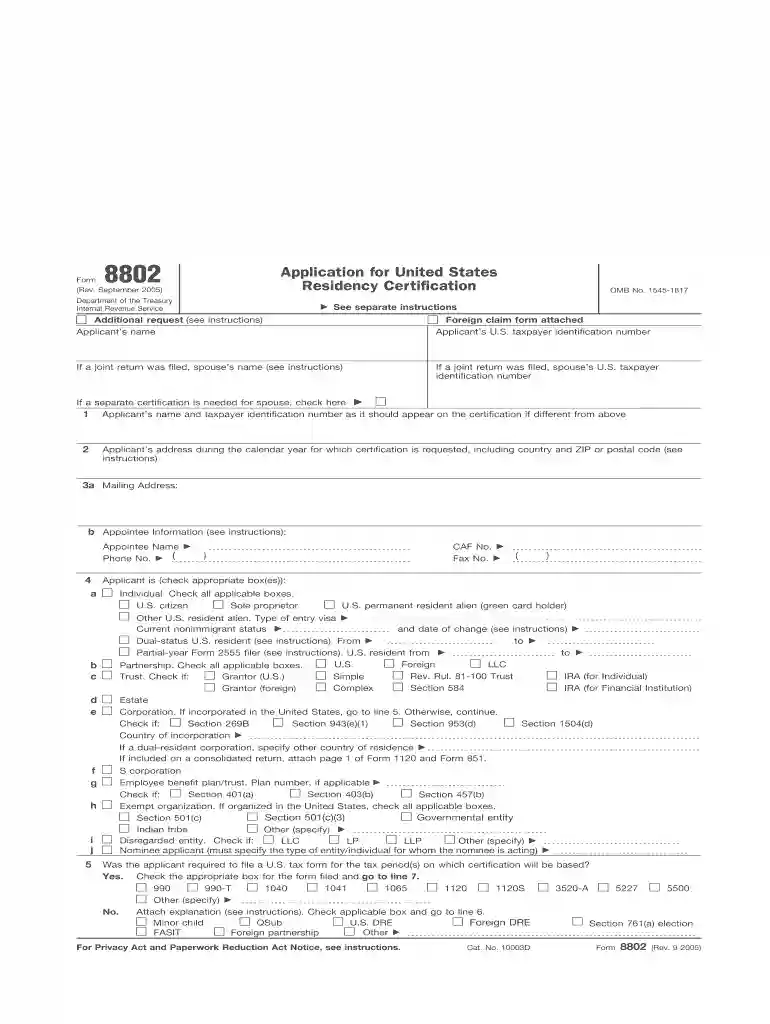
Overview of Form 8802
Form 8802, also known as the application for United States Residency Certification, is utilized primarily for the purpose of certifying U.S. residency for tax-related matters. This form is issued by the Internal Revenue Service (IRS) and serves as a crucial document for individuals and entities looking to verify their residency status for international tax compliance. By obtaining this certification, applicants can avoid double taxation and ensure proper tax treatments in foreign jurisdictions.
Steps to Complete Form 8802
Filling out Form 8802 requires care and attention to detail. The following outlines the essential steps for accurately completing the form:
-
Gather Required Information:
- Personal identifying information, including your name, address, and taxpayer identification number (TIN).
- Details regarding tax residency, including the years for which certification is needed and the specific foreign country involved.
-
Complete Section 1:
- Provide your name and contact information. Ensure that the information matches your IRS records correctly.
-
Complete Section 2:
- Indicate whether the application is for an individual or an entity. If applying as an entity, include the entity's TIN and legal name.
-
Complete Sections 3 & 4:
- For each year of residency you wish to certify, enter the appropriate tax year and the foreign jurisdiction. This information is used to determine your residency status for that period.
-
Sign and Date the Form:
- The applicant must sign the form, confirming that the information provided is accurate and complete.
-
Submit the Form:
- File the completed form with the appropriate IRS office. Be sure to keep a copy for your personal records.
Example of Step-by-Step Process:
-
Example 1: If you're applying as an individual for the years 2021 and 2022, you would fill out your name and TIN in Section 1, mark “Individual” in Section 2, list “2021” and “2022” under the applicable years in Section 3, and indicate the foreign country (e.g., Canada) in Section 4.
-
Example 2: For a corporation seeking certification for tax years 2019 and 2020, you would enter the corporation's legal name and TIN in Section 1, mark “Entity” in Section 2, and list the years along with the respective foreign jurisdiction (e.g., United Kingdom) in subsequent sections.
Important Terms Related to Form 8802
Understanding key terminology is critical for navigating Form 8802 effectively:
- Residency Certification: The formal recognition by the IRS asserting one's residency within U.S. tax jurisdiction.
- Tax Identification Number (TIN): A unique number assigned to individuals or businesses for tax purposes, used in the application.
- Foreign Jurisdiction: The country or area outside the U.S. where the applicant is claiming residency for tax purposes.
Legal Use of Form 8802
Form 8802 must be used strictly for the purposes outlined by the IRS—specifically to certify residency status for tax withholding and reporting purposes. Misuse, including providing false information, can lead to penalties and scrutiny from tax authorities.
- Compliance: The form should be accurately filled out and submitted to prevent issues with international taxation.
- Documentation: Keep all supporting documents ready, as the IRS may request additional evidence to support your residency claim.
IRS Guidelines on Form 8802
The IRS provides specific instructions and guidelines for completing Form 8802. Some key points include:
- Submission Method: Forms can typically be submitted via mail, which is the most common method.
- Response Time: The IRS generally processes these forms within six weeks, but timelines can vary based on the volume of applications.
- Filing Deadlines: Be aware of seasonal deadlines associated with tax filings, as this may impact the timely submission of Form 8802.
Required Documents for Form 8802
Submitting Form 8802 often necessitates additional documentation. Commonly required documents include:
- Proof of Residency: This could be copies of tax returns filed under your name or any documentation that indicates you’ve been residing in the U.S.
- Passport or Identification: To verify identity, it may be required to include a government-issued photo ID.
Examples of Required Documents:
- Tax returns from previous years
- Utility bills or lease agreements as proof of residency
- Identification documents like a driver's license or passport
Completion Tips for Efficient Filing
Improving your chances of a successful application includes attention to detail and thoroughness:
- Double-Check Information: Ensure names, addresses, and TINs are accurate and consistent with existing IRS records to avoid delays.
- Utilize IRS Resources: Refer to the IRS website for the most current version of Form 8802, including the official instructions.
- Consider Professional Assistance: If there are complexities in your residency claims, consulting a tax professional may provide clarity and assistance.
By following these steps and adhering to the guidelines set forth by the IRS, you can effectively navigate the completion of Form 8802 for your residency certification needs.