
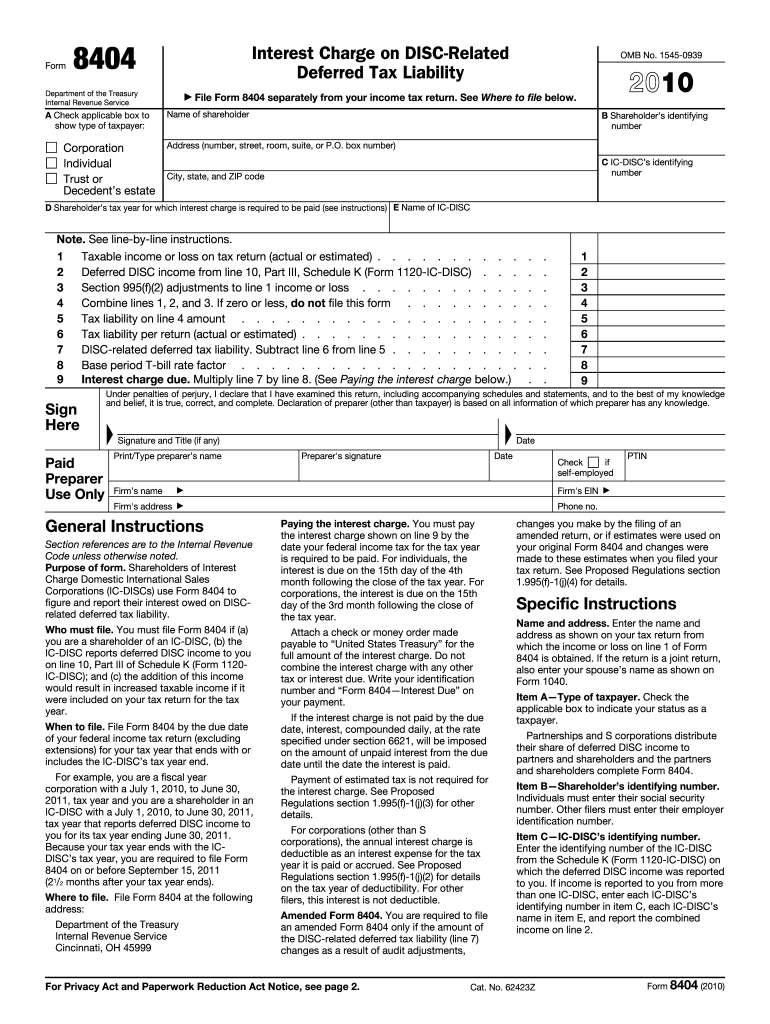







Definition and Meaning of Form 8404
Form 8404 is a tax document specifically designed for shareholders of Interest Charge Domestic International Sales Corporations (IC-DISCs). These entities are used to defer certain tax liabilities, and Form 8404 is crucial in calculating and reporting the interest owed on these deferred liabilities. Shareholders must provide detailed information regarding their tax status, shareholder data, and the specific IC-DISC they are involved with.
How to Use Form 8404 for Tax Reporting
Correct usage of Form 8404 involves gathering information about the taxpayer type, shareholder identification, and the specific IC-DISC details. Taxpayers need to input precise financial data to determine the interest owed on deferred taxes. Following the IRS guidelines for this form is essential for accurate calculations and compliance.
Steps for Filling Out Form 8404
- Gather Required Information: Collect all necessary shareholder and IC-DISC details.
- Identify Deferred Liabilities: Determine the amount of deferred tax liabilities related to IC-DISC.
- Calculate Interest: Use the instructions on the form to calculate the interest owed.
- Review for Accuracy: Double-check all entries to ensure they are correct and complete before submission.
Who Typically Uses Form 8404
Form 8404 is predominantly used by shareholders who have interests in IC-DISCs. These shareholders are typically involved in international trade businesses utilizing IC-DISCs for tax deferral benefits. Understanding the requirements and obligations of this form is essential for these shareholders.
Business Entities and Form 8404
- Corporations: Often use IC-DISCs for export-related tax benefits.
- Partnerships and LLCs: Could be pass-through entities needing to report shareholder interests in IC-DISCs.
Key Elements of Form 8404
The form requires accurate details about the taxpayer, the IC-DISC, and specific financial components related to deferred tax liabilities. Other critical elements include the taxpayer's filing status and any relevant financial transactions during the tax year.
IRS Guidelines for Form 8404
The IRS provides comprehensive instructions on how to complete Form 8404. They detail how to properly calculate interest on deferred taxes, the tax year requirements, and how amended filings should be handled. Understanding and following these guidelines is crucial for compliance.
Filing Deadlines and Important Dates
Form 8404 must be filed as part of the taxpayer's annual tax return. The deadline aligns with the taxpayer's regular tax filing date, typically April 15 for individuals and entities operating on a calendar fiscal year. Timely filing is crucial to avoid potential penalties and interest.
Required Documents for Form 8404 Submission
- Taxpayer Identification Documents: Such as Social Security Numbers or Employer Identification Numbers.
- IC-DISC Financial Statements: To accurately reflect the deferred liabilities and calculations.
- Previous Tax Return Records: To ensure consistency and accuracy in reporting.
Penalties for Non-Compliance with Form 8404
Failure to file Form 8404 accurately or within the IRS deadlines may result in penalties, interest charges, or additional scrutiny of tax returns. In severe cases, non-compliance can lead to audits or legal action from the IRS.
Digital vs. Paper Version of Form 8404
Taxpayers can choose to submit Form 8404 via digital or traditional paper methods. Digital filing through the IRS e-file system offers benefits such as convenience, speed, and immediate confirmation of receipt. Paper filings may require additional postal handling time and physical storage concerns.
Benefits of Digital Filing
- Speed and Efficiency: Immediate submission and processing.
- Reduced Errors: Digital systems often include error-checking algorithms.
- Confirmation of Receipt: Instant acknowledgement from the IRS.
Form Submission Methods: Online, Mail, and In-Person
Taxpayers have multiple options for submitting Form 8404. The most efficient is electronic submission through the IRS e-file system. Alternatively, forms can be mailed directly to IRS processing centers. For personal assistance, taxpayers may choose to file in-person at designated IRS offices. Each method offers varying benefits depending on the preparer's preference for convenience, speed, and direct interaction.


