




01. Edit your form online
Type text, add images, blackout confidential details, add comments, highlights and more.

Type text, add images, blackout confidential details, add comments, highlights and more.

Draw your signature, type it, upload its image, or use your mobile device as a signature pad.

Send it via email, link, or fax. You can also download it, export it or print it out.
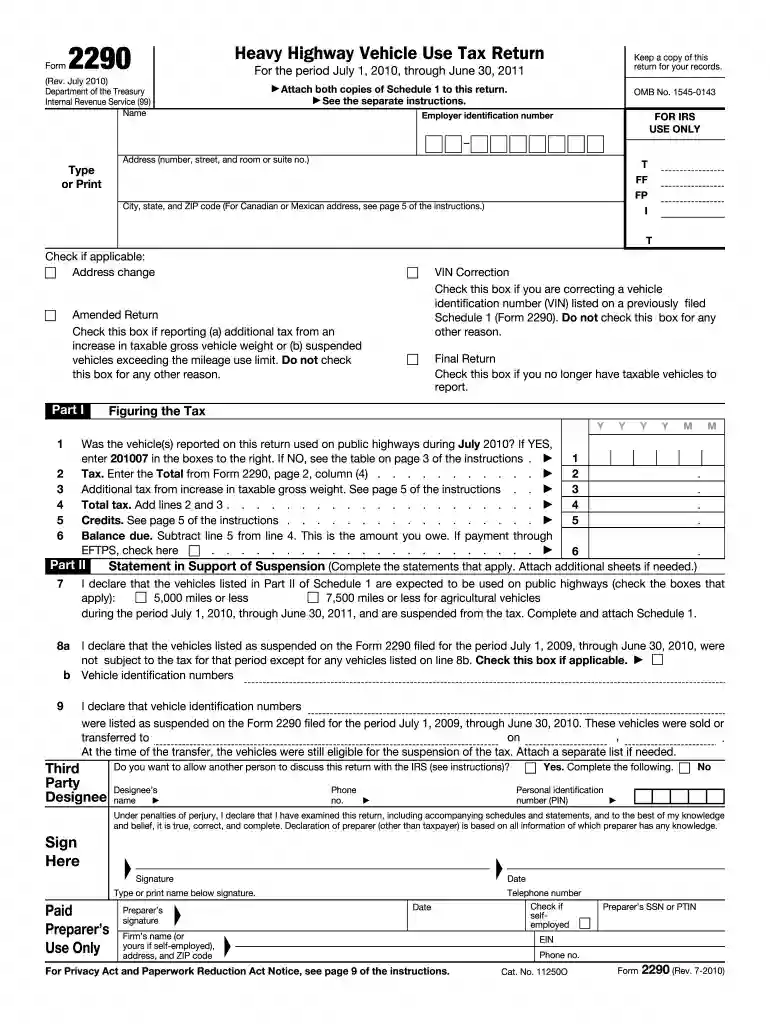
Form 2290, officially called the Heavy Highway Vehicle Use Tax Return, is utilized primarily to report and pay the Heavy Vehicle Use Tax (HVUT) in the United States. This tax applies to vehicles with a gross weight of 55,000 pounds or more, such as trucks, truck tractors, and buses used on public highways. Each tax period spans from July 1, 2010, to June 30, 2011, for the 2010 form. The purpose of this form is to collect tax from commercial vehicles to fund highway maintenance and construction projects. Key fillable sections require entering vehicle identification numbers (VIN) and the computation of taxes based on vehicle weight and mileage.
The form consists of several crucial components that need to be filled accurately:
You can obtain Form 2290 from several sources:
Filling out Form 2290 involves the following steps:
The form is predominantly used by:


Adhering to IRS directives is crucial for compliance:
The choice between digital or paper submission varies based on preference and necessity:
Comprehensive understanding and accurate completion are essential for successful filing of the 2010 Form 2290, avoiding potential penalties, and ensuring compliance with federal tax laws.
We've got more versions of the 2010 form 2290 form. Select the right 2010 form 2290 version from the list and start editing it straight away!
| Versions | Form popularity | Fillable & printable |
|---|---|---|
| 2025 | 4.2 Satisfied (37 Votes) | |
| 2024 | 4.8 Satisfied (56 Votes) | |
| 2023 | 3.2 Satisfied (48 Votes) | |
| 2022 | 4.4 Satisfied (60 Votes) | |
| 2021 | 4.8 Satisfied (181 Votes) | |
| 2020 | 4.4 Satisfied (108 Votes) | |
| 2019 | 4.3 Satisfied (93 Votes) | |
| 2018 | 4.3 Satisfied (63 Votes) | |
| 2017 | 4.2 Satisfied (130 Votes) | |
| 2016 | 4.2 Satisfied (65 Votes) | |
| 2015 | 4.4 Satisfied (50 Votes) | |
| 2014 | 4 Satisfied (43 Votes) | |
| 2013 | 4 Satisfied (27 Votes) | |
| 2012 | 3.7 Satisfied (35 Votes) | |
| 2011 | 4 Satisfied (52 Votes) |
At DocHub, your data security is our priority. We follow HIPAA, SOC2, GDPR, and other standards, so you can work on your documents with confidence.
Form 2290, Heavy Highway Vehicle Use Tax Return. Up to four Form 1040-ES Additionally, the 2010 Form 944 includes lines for small employers to claimRead more
7. I declare that the vehicles listed in Part II of Schedule 1 are expected to be used on public highways (check the boxes that apply):. 5,000 miles or less.Read more
The property was eventually put up for sale, for approximately $1.3 million, and was sold in 2010 for $900,000 and converted to office and retail space.Read more


