




01. Edit your 1120 schedule l online
Type text, add images, blackout confidential details, add comments, highlights and more.

Type text, add images, blackout confidential details, add comments, highlights and more.

Draw your signature, type it, upload its image, or use your mobile device as a signature pad.

Send it via email, link, or fax. You can also download it, export it or print it out.
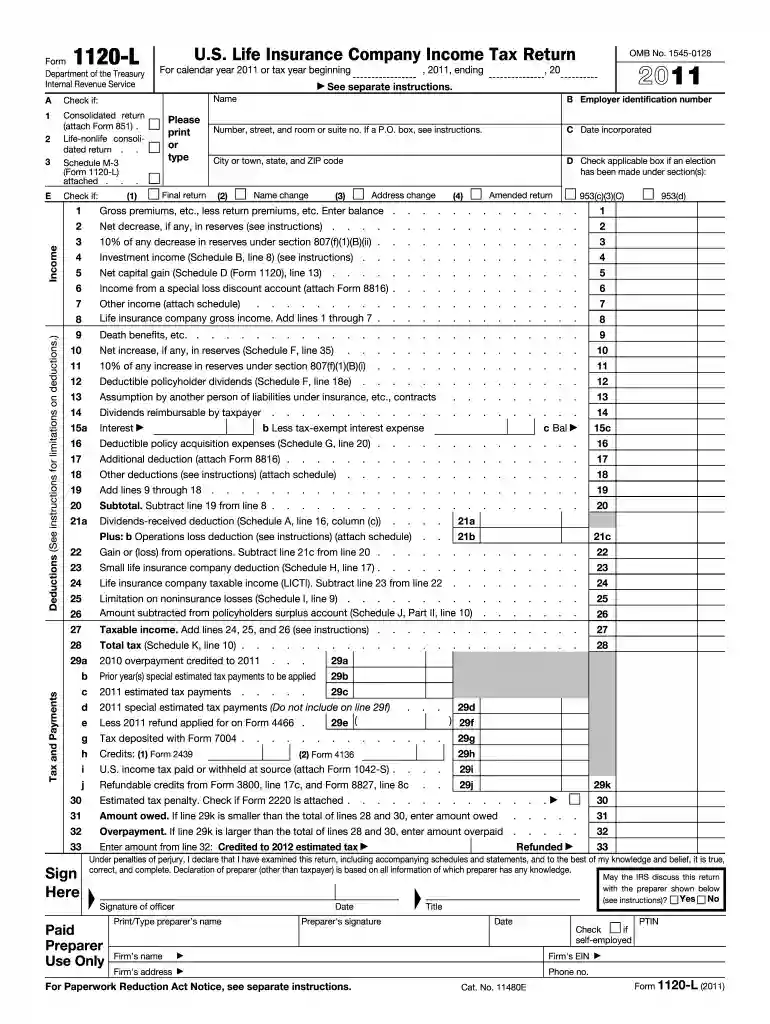
Form 1120-L, officially known as the U.S. Life Insurance Company Income Tax Return, is used by life insurance companies to report income, deductions, and tax calculations relevant to their operations. This form is specifically designed for the 2011 tax year and includes sections for detailing various aspects of financial performance such as gross premiums and policyholder dividends. Its primary aim is to ensure these entities remain compliant with federal tax obligations.
Gather Necessary Financial Data: Collect financial records including gross premiums, reserve information, and investment income.
Fill Out Income Details: Begin by entering information about gross premiums, along with any additional income such as investment returns or gains from policyholder transactions.
Calculate Deductions: Deduct relevant expenses like underwriting costs, dividends to policyholders, and any allowable business expenses.
Determine Tax Liability: Use the provided tax rate schedules to calculate the proper tax amount based on net income after deductions.
Complete Remaining Sections: Finalize additional sections dealing with specific tax credits or penalties, if applicable.
Review and Submit: Double-check the completed form for accuracy before submission to avoid errors that could delay processing or incur penalties.
Form 1120-L is primarily utilized by life insurance companies operating within the United States. These entities are required to use this form to report their financial activities accurately to the Internal Revenue Service (IRS). It applies exclusively to life insurers, as opposed to other types of insurance companies like property and casualty insurers, highlighting its specialized function within the insurance sector.
Eligibility: Only life insurance companies, as defined by Section 801 of the IRS Code, are eligible to file Form 1120-L.
Filing Deadline: The form is generally due by the 15th day of the fourth month following the end of the company's tax year. For most calendar year filers, this is April 15.
Amendments and Corrections: If errors are discovered after submission, an amended return should be filed using Form 1120-X.
Gross Premiums and Considerations: Detailed reporting of all collected premiums.
Deductions for Dividends: Documentation of dividends paid or credited to policyholders.
Investment Income: Inclusion of interest, rental income, and capital gains.
Reserves: Accounting of the increases or decreases in life insurance reserves.
Annual Statement Details: Include detailed information typically provided in the company's annual financial reports.
Policyholder and Reserve Information: Provide specifics regarding outstanding policyholder liabilities and reserve adjustments.
Investment Records: Document income from securities or other investment practices relevant to the business operations.
Digital Filing: The IRS offers electronic filing options for corporations, which can simplify the submission process and expedite processing times.
Paper Filing: Alternatively, companies may choose to file a paper version, mailed to the IRS. This method, while traditional, may result in longer processing durations and additional manual checks.
Failure to file Form 1120-L accurately and on time can result in significant penalties. The IRS may impose fines or interest on underpaid taxes, emphasizing the importance of thorough and precise completion of the form. Additionally, discrepancies discovered during audits can lead to increased scrutiny and further financial liabilities.
We've got more versions of the 1120 schedule l form. Select the right 1120 schedule l version from the list and start editing it straight away!
| Versions | Form popularity | Fillable & printable |
|---|---|---|
| 2025 | 4.1 Satisfied (46 Votes) | |
| 2024 | 4.2 Satisfied (51 Votes) | |
| 2023 | 4.5 Satisfied (38 Votes) | |
| 2022 | 4.1 Satisfied (50 Votes) | |
| 2021 | 4.9 Satisfied (49 Votes) | |
| 2020 | 4 Satisfied (25 Votes) | |
| 2019 | 4.1 Satisfied (26 Votes) | |
| 2018 | 4.4 Satisfied (223 Votes) | |
| 2017 | 4.3 Satisfied (143 Votes) | |
| 2016 | 4.4 Satisfied (180 Votes) | |
| 2015 | 4.2 Satisfied (70 Votes) | |
| 2014 | 4 Satisfied (37 Votes) | |
| 2013 | 4.3 Satisfied (65 Votes) | |
| 2012 | 4 Satisfied (54 Votes) | |
| 2011 | 4.2 Satisfied (39 Votes) |
At DocHub, your data security is our priority. We follow HIPAA, SOC2, GDPR, and other standards, so you can work on your documents with confidence.
Transcripts are only available for the following returns: Form 1040 series,. Form 1065, Form 1120, Form 1120-A, Form 1120-H, Form 1120-L, and Form 1120S.Read more
Form 1120-L (2011). Page 2. Schedule A. Dividend Income and Dividends-Received Deduction If Yes, complete and attach Schedule UTP. Form 1120-L (2011)Read more


