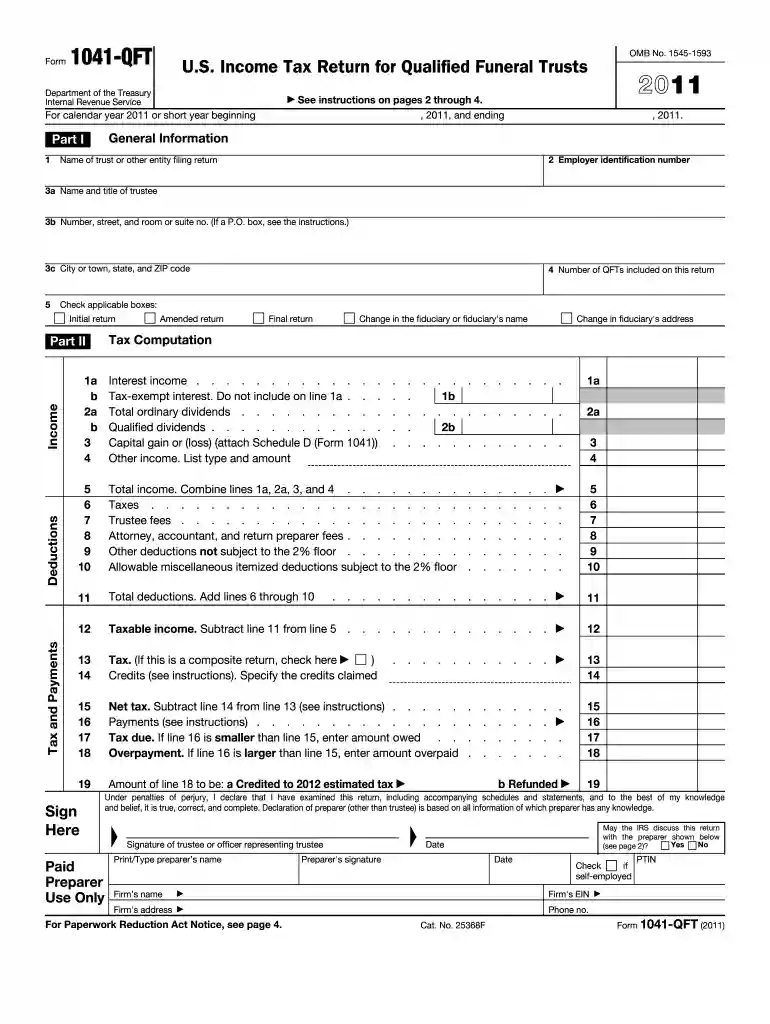
Form 1041 qft 2011-2026

Get Form
form 1041 qft 2011 Preview on Page 1

Here's how it works

01. Edit your form online
Type text, add images, blackout confidential details, add comments, highlights and more.

02. Sign it in a few clicks
Draw your signature, type it, upload its image, or use your mobile device as a signature pad.

03. Share your form with others
Send it via email, link, or fax. You can also download it, export it or print it out.

Definition and Meaning of Form 1041-QFT

Form 1041-QFT is the U.S. Income Tax Return specifically designed for Qualified Funeral Trusts (QFTs). This tax form is utilized by trustees to report the income, deductions, and tax liabilities associated with qualified funeral trusts for the calendar year 2011. A trust qualifies as a QFT when it meets specific Internal Revenue Service (IRS) criteria, mainly focused on the intent to fund funeral expenses for the trust beneficiaries. This form outlines the qualifications necessary for a trust to obtain QFT status and governs how income generated by the trust should be taxed.

Key elements defined within Form 1041-QFT include the following:

  • Purpose of the Trust: Ensuring that the funds are earmarked for funeral expenses, distinguishing it from other trusts primarily aimed at wealth accumulation.
  • Tax Implications: Highlighting how income, gains, and distributions from the trust are taxed, including formulations of any applicable tax rates.
  • Filing Requirements: Trustees must adhere to stringent reporting stipulations as set by the IRS to maintain compliance and avoid penalties.

This form serves an essential function in regulating and facilitating funeral trusts, offering vital information for both trustees and beneficiaries regarding fiduciary responsibilities and tax implications.

How to Use the Form 1041-QFT

Using Form 1041-QFT involves multiple systematic steps that trustees must diligently follow to ensure compliance and accuracy. The form is meant to encapsulate all relevant financial activity from the QFT for a given tax year.

  1. Obtain the Form: Trustees must first acquire the appropriate form from the IRS website or authorized tax professionals.
  2. Gather Required Information: Collect necessary documents that outline all income generated by the trust, including interest, dividends, or other taxable income.
  3. Complete the Form: Fill in the required fields, detailing the trust's income, deductions, and any distributions made to beneficiaries throughout the tax year.
  4. Calculate Tax Obligations: Assess any tax liabilities based on the income reported and applicable deductions. This section requires careful attention as mistakes can lead to penalties.
  5. File the Form: Submit the completed form either electronically or via mail to ensure it is received by the IRS before the filing deadline.

Trustees need to maintain meticulous records as part of this process, ensuring all monetary transactions related to the QFT are accurately reflected in the submission.

Important Terms Related to Form 1041-QFT

Understanding the terminology associated with Form 1041-QFT is crucial for both trustees and beneficiaries to navigate their obligations effectively. Below are some of the essential terms:

  • Qualified Funeral Trust (QFT): A specific type of trust that qualifies under IRS guidelines to manage funds specifically allocated for funeral expenses.
  • Tax Identification Number (TIN): An essential identification number required for the trust, necessary for filing taxes and reporting income.
  • Distributions: Refers to payments made from the trust to beneficiaries for covering funeral-related expenses or other needs.
  • Deductions: Specific allowable expenses that can reduce the taxable income of the trust, such as administrative fees or the cost of services rendered for the funeral.
  • Fiduciary Duty: A legal obligation that imposes a requirement on the trustee to act in the best interests of the beneficiaries of the trust.

Understanding these terms empowers trustees and beneficiaries to better grasp the complexities of managing a funeral trust and fulfilling their tax obligations.

Filing Deadlines for Form 1041-QFT

Adhering to filing deadlines for Form 1041-QFT is critical to avoid late penalties and ensure timely processing of tax returns. For the tax year 2011, crucial deadlines include:

  • Original Filing Deadline: Form 1041-QFT is generally due on the fifteenth day of the fourth month following the end of the tax year. For a trust using the calendar year, this means the form must be submitted by April 15 of the following year.
  • Extension Requests: Trustees may request an extension for filing the form if additional time is needed. This extension could provide an additional six months, pushing the deadline to October 15.
  • Late Filing Penalties: Failure to file by the established deadlines can result in substantial penalties imposed by the IRS, which can affect the trust's financial standing and its beneficiaries.

Keeping track of these deadlines will help trustees maintain compliance and avoid unnecessary financial repercussions.

Steps to Complete Form 1041-QFT

Completing Form 1041-QFT accurately involves a series of detailed steps ensuring all necessary information is thoroughly reported. A systematic approach can prevent errors that might attract penalties.

  1. Identify the Basics: Enter the trust's name, address, and TIN at the top of the form.
  2. Report Income: This section requires listing all income the trust has received during the year, such as interest income, dividends, and capital gains. Each entry must be substantiated with supporting documentation.
  3. Catalog Deductions: List out allowable deductions such as costs directly related to the funeral arrangements, trustee fees, and any legal expenses incurred.
  4. Distributions: Specify amounts distributed to beneficiaries during the tax year. Detail how those funds align with the trust's purpose of reimbursing funeral costs.
  5. Calculate Tax: Use the provided guidelines to compute the total tax liability based on net income after deductions.
  6. Sign and Date: Ensure that both the trustee signature and date are included on the form before submission.

By following these steps closely, trustees can mitigate risks of errors and ensure that the return is prepared in a clear, organized manner.

See more form 1041 qft 2011 versions

We've got more versions of the form 1041 qft 2011 form. Select the right form 1041 qft 2011 version from the list and start editing it straight away!
Versions Form popularity Fillable & printable
2023 4.4 Satisfied (58 Votes)
2022 4.9 Satisfied (38 Votes)
2021 4.8 Satisfied (59 Votes)
2020 4.2 Satisfied (44 Votes)
2019 4.1 Satisfied (69 Votes)
2018 4.2 Satisfied (79 Votes)
2017 4.2 Satisfied (95 Votes)
2016 4.4 Satisfied (573 Votes)
2015 4.1 Satisfied (74 Votes)
2014 4 Satisfied (27 Votes)
2013 4 Satisfied (23 Votes)
2012 4.3 Satisfied (43 Votes)
2011 4 Satisfied (34 Votes)
2010 4.3 Satisfied (54 Votes)
be ready to get more

Complete this form in 5 minutes or less

Get form

Got questions?

We have answers to the most popular questions from our customers. If you can't find an answer to your question, please contact us.
Contact us
Income tax on income generated by assets of the estate of the deceased. If the estate generates more than $600 in annual gross income, you are required to file Form 1041, U.S. Income Tax Return for Estates and Trusts. An estate may also need to pay quarterly estimated taxes.
The trustee of a trust that has elected to be taxed as a qualified funeral trust (QFT) files Form 1041-QFT to report the income, deductions, gains, losses, etc., and income tax liability of the QFT.
If youre wondering when to file 1041 Forms, you should file it each year the estate is open. As long as the estate exists, a Form 1041 should be filed. The due date for filing a 1041 falls on tax day.
Late Filing of Return The law provides a penalty of 5% of the tax due for each month, or part of a month, that the return isnt filed up to a maximum of 25% of the tax due.
The IRS requires the filing of an income tax return for trusts and estates on Form 1041formerly known as the fiduciary income tax return. This is because trusts and estates must pay income tax on their income just like you report your own income on a personal tax return each year.
be ready to get more

Complete this form in 5 minutes or less

Get form

People also ask

The fiduciary of a domestic decedents estate, trust, or bankruptcy estate files Form 1041 to report: The income, deductions, gains, losses, etc. of the estate or trust. The income that is either accumulated or held for future distribution or distributed currently to the beneficiaries.
Qualified Funeral Trust (QFT) The sole purpose of the trust is to hold, invest, and reinvest funds in the trust and to use those funds solely to pay for funeral or burial services or property to provide such services for the benefit of the beneficiaries of the trust.

Related links