







Definition & Meaning
The 2008 Form 990 is an Internal Revenue Service (IRS) form used primarily by tax-exempt organizations, non-exempt charitable trusts, and section 527 political organizations to report information about their financial activities. It is a vital document that serves dual purposes: ensuring these organizations comply with federal tax laws and maintaining transparency about their operations. The form enables the IRS to evaluate an organization's activities and finances to safeguard the tax-exempt status.
Key Purposes
- Compliance Monitoring: Ensures adherence to IRS regulations.
- Transparency: Provides detailed public records of financial standings and operations.
- Operational Review: Assesses management and governance practices.
Steps to Complete the 2008 Form 990
Completing the 2008 Form 990 involves several steps, each requiring careful attention to detail.
-
Gather Necessary Information:
- Financial statements, including income, expenditure, and balance sheets.
- Details of major donors and fundraising events.
-
Fill Out Organizational Details:
- Include organization name, EIN, and address.
- Provide information on any changes to the governing documents.
-
Report Financial Information:
- Detail revenue categories such as contributions, grants, and program service revenue.
- Explain functional expenses: program service, management, and fundraising costs.
-
Outline Program Service Accomplishments:
- Describe significant accomplishments and how funds are utilized.
-
Provide Schedule Information:
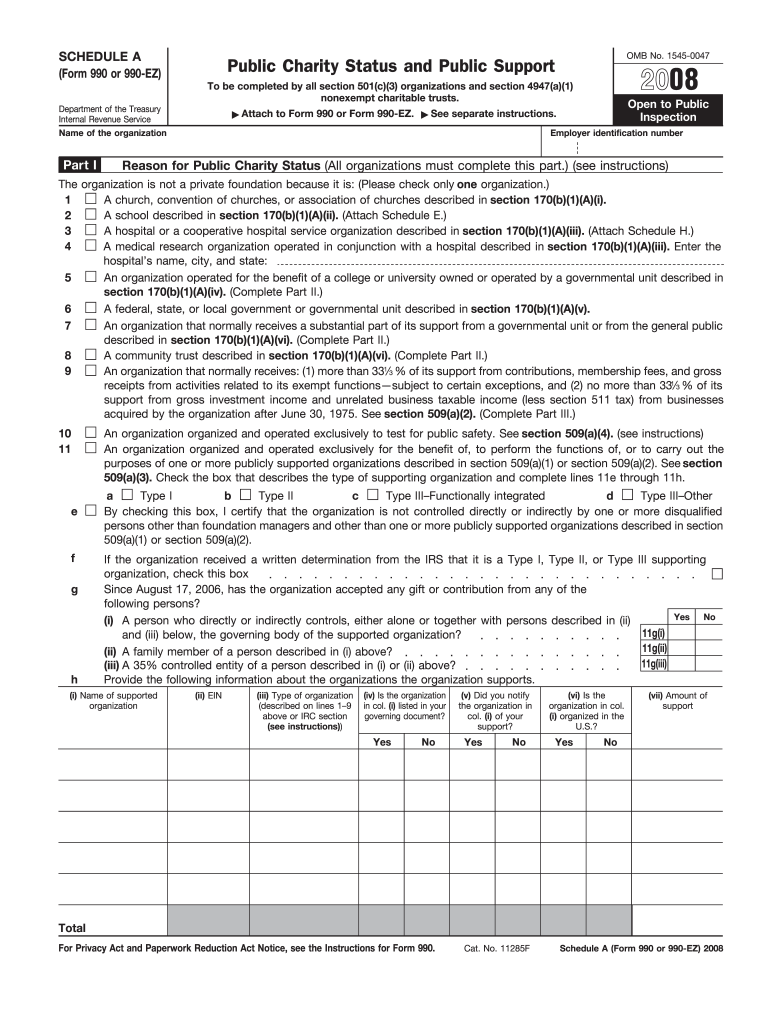
- Complete additional schedules as applicable (e.g., Schedule A for public charity status).
Tips for Accuracy
- Double-check all calculations.
- Be consistent in reporting figures across corresponding sections.
How to Obtain the 2008 Form 990
Obtaining the 2008 Form 990 is straightforward, with several accessible options for organizations.
- IRS Website: The form can be downloaded directly in PDF format from the IRS website.
- Mail Request: Organizations can request a physical copy by contacting the IRS.
Considerations
- Ensure the form version matches the corresponding tax year.
- Verify form availability for compatibility with digital tax preparation software.
Who Typically Uses the 2008 Form 990
The users of the 2008 Form 990 include a wide scope of tax-exempt entities. It caters to the specific reporting requirements of each organization type.
- Nonprofit Organizations: These may include educational institutions, charities, and cultural organizations.
- Section 501(c)(3) Entities: Organizations engaging in charitable, religious, or educational activities.
- Political Organizations: Groups organized under section 527 primarily for influencing elections.


Typical Filing Entities
- Museums
- Community foundations
- Health organizations
IRS Guidelines
The IRS provides detailed guidelines on how to correctly complete and file Form 990.
- Filing Instructions: The IRS instructions are comprehensive, covering each part of the form in detail.
- Amendments: Guidelines for amending previous submissions to correct errors.
Key Points
- Adherence to IRS guidelines is essential to avoid penalties.
- Verify all the latest updates on reporting and filing requirements from the IRS.
Penalties for Non-Compliance
Non-compliance with the filing requirements of the 2008 Form 990 can result in significant penalties.
- Daily Penalties: The IRS imposes monetary fines for late or incomplete submissions, depending on the organization's size.
- Loss of Tax-Exempt Status: Persistent failure to file Form 990 can lead to revocation of tax-exempt status.
Preventive Measures
- Implement a diligent filing calendar.
- Assign a responsible officer to oversee the timely submission.
Important Terms Related to 2008 Form 990
Understanding the specialized vocabulary associated with the Form 990 is crucial for accurate completion.
- EIN (Employer Identification Number): A unique identifier for tax purposes.
- Exempt Purpose: The mission and activities qualifying an organization for tax-exempt status.
- Fiscal Year: The 12-month period used for accounting purposes.
Clarifications
- These terms are defined in IRS publications for detailed reference.
- Ensures accurate and compliant form preparation.
Versions or Alternatives to the 2008 Form 990
Besides the standard Form 990, there are simplified versions tailored for smaller organizations.
- Form 990-EZ: A shorter version for organizations with gross receipts less than $200,000 and total assets under $500,000.
- Form 990-N (e-Postcard): For very small organizations with gross receipts under $50,000.
Strategic Use
- Choosing the correct form version can simplify reporting and reduce preparation time.
- Understand thresholds and eligibility to take advantage of simpler forms.




