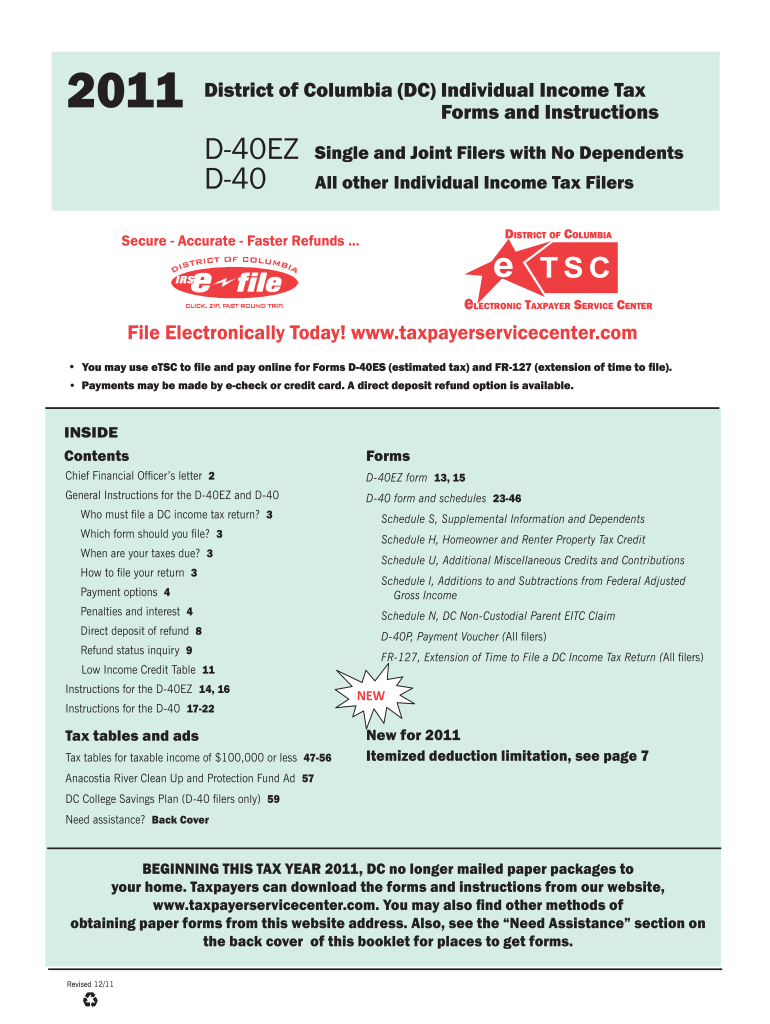







Definition and Purpose of the 2011 DC Tax Forms
The 2011 DC Tax Forms refer to the official documents required for filing individual income tax returns in the District of Columbia for the year 2011. These forms are essential for taxpayers to report their income, calculate taxes owed, and claim any applicable deductions or credits. They include a variety of forms such as the D-40EZ and D-40, each tailored to different filing scenarios. Understanding these forms is crucial for accurate tax reporting and compliance with state tax regulations.
Steps to Complete the 2011 DC Tax Forms
To efficiently complete the 2011 DC Tax Forms, follow these steps:
-
Gather Required Documentation:
- Collect all income-related documents, including W-2s, 1099s, and any other taxable income records.
- Compile documents for deductions and credits, such as mortgage interest statements and education expenses.
-
Select the Appropriate Form:
- Choose the right form based on your filing status and income level. The D-40EZ is typically for simpler returns, while D-40 can accommodate more complex situations.
-
Complete Personal Information:
- Carefully fill out your personal information, including your name, address, and Social Security Number, ensuring accuracy to avoid processing delays.
-
Report Income:
- Enter all relevant income details. Ensure all amounts match your income statements.
-
Calculate Deductions and Credits:
- List all eligible deductions and credits to lower taxable income.
- Pay attention to specific state credits available for DC residents.
-
Compute Tax Liability:
- Use the tax tables provided to compute the amount of taxes owed.
-
Review and Sign:
- Double-check all entries for accuracy before signing the form. Unintentional errors can lead to penalties.
-
Submit the Form:
- Follow the proper submission method as outlined in the form instructions, either by mail or electronically.
Important Terms Related to 2011 DC Tax Forms
Understanding specific terms is crucial when dealing with the 2011 DC Tax Forms. Here are key terms:
- Taxable Income: The portion of an individual’s or entity’s income used to determine how much tax is owed.
- Deductions and Credits: Amounts that reduce taxable income (deductions) or directly lower the tax owed (credits).
- Tax Year 2011: Refers to the calendar year for which the tax is being filed, affecting income reported and regulations followed.
How to Obtain the 2011 DC Tax Forms
Obtaining the 2011 DC Tax Forms can be straightforward with the right methods:
-
Online Access:
- Visit the official website of the DC Office of Tax and Revenue to download the forms directly. This is often the fastest method.
-
Local Tax Offices:
- Forms are available for collection at local DC tax offices, providing a direct way to obtain physical copies.
-
Request by Mail:
- Taxpayers can request physical copies through the mail by contacting the Office of Tax and Revenue.
Using these channels ensures access to the necessary documentation for completing tax obligations.
Filing Deadlines and Important Dates
Adhering to deadlines is critical for filing the 2011 DC Tax Forms:
-
Primary Deadline:
- Tax forms for 2011 were due on April 15, 2012.
-
Extensions:
- Taxpayers could apply for an extension, typically granting an additional six months to file their return without incurring late filing penalties.
Missing these dates can result in penalties and interest on any taxes owed.
Penalties for Non-Compliance with 2011 DC Tax Forms
Failure to comply with the filing requirements of the 2011 DC Tax Forms can lead to various penalties:
-
Late Filing Penalty:
- A percentage of owed taxes is charged monthly until the return is filed.
-
Late Payment Penalty:
- Additional charges on unpaid taxes if not paid by the deadline.
-
Failure to File:
- Non-compliance can result in enforcement actions from the DC Office of Tax and Revenue.
Maintaining compliance helps in avoiding these financial consequences.
Digital vs. Paper Versions of the 2011 DC Tax Forms
Taxpayers have the choice between digital and paper versions of the 2011 DC Tax Forms, each with its advantages:
-
Digital:
- Offers speedy submission and processing. Enables integration with tax preparation software for accuracy.
-
Paper:
- Preferrable for those who prefer handwritten forms or do not have access to digital resources. Requires mailing to the appropriate tax office.
Both methods require following specific guidelines to ensure successful submission and processing.
Taxpayer Scenarios: Who Uses the 2011 DC Tax Forms?
Different taxpayer scenarios apply when utilizing the 2011 DC Tax Forms:
-
Single Filers:
- Commonly use the D-40EZ for straightforward filing.
-
Married Couples:
- May file jointly or separately, depending on tax implications, typically using the D-40 form.
-
Head of Household:
- Special status for qualifying taxpayers, offering particular deductions and filing requirements.
Understanding these situations aids in selecting the correct form and filing method.