
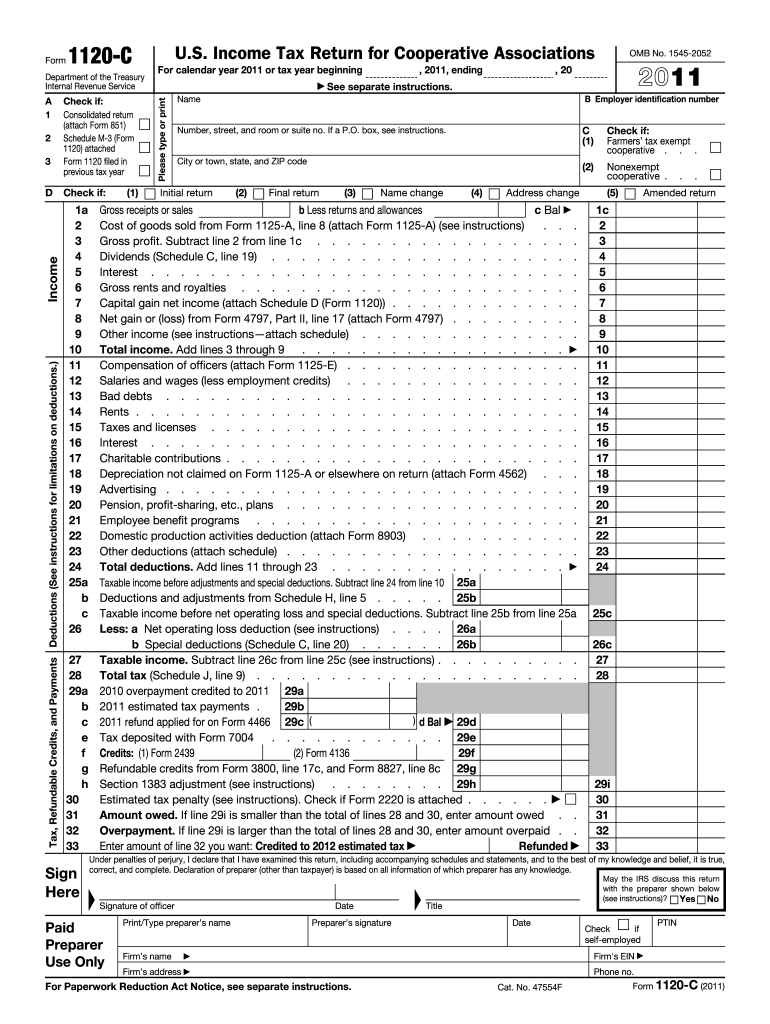







Definition and Purpose of the 2011 Form 1120-C
Form 1120-C, officially known as the U.S. Income Tax Return for Cooperative Associations, is a crucial document for cooperative associations in the United States. For the tax year 2011, this form is used to report income, deductions, and credits applicable to cooperative entities. The form encompasses sections covering gross receipts, cost of goods sold, and calculations for taxable income. It also includes schedules for dividends and patronage income. Cooperative associations use this form to ensure compliance with federal tax requirements while taking advantage of specific provisions available to cooperatives, allowing accurate reporting and optimal tax positioning.
Key Elements of the 2011 Form 1120-C
The 2011 Form 1120-C contains several vital sections to aid in detailed financial reporting:
- Income Reporting: Captures the cooperative's total income, including gross receipts and any adjustments.
- Deductions: Includes authorized deductions like business expenses that can be subtracted from total income.
- Credits: Outlines any credits the cooperative is eligible for, reducing overall tax liability.
- Schedule J: Focuses on tax computation and reconciliation of net income with tax due.
- Dividend and Patronage: Encompasses reporting of any profits returned to members of the cooperative.
Each of these components provides a structured means for cooperatives to account for their financial activities comprehensively.
How to Obtain the 2011 Form 1120-C
Cooperatives can access the 2011 Form 1120-C through several methods:
- IRS Website: Download the form directly from the Internal Revenue Service (IRS) official site.
- Tax Software: Use reliable tax software that supports business forms to populate and file the form electronically.
- Tax Professional: Consult with accountants or tax advisors who can provide copies and guidance on completion of the form.
Utilizing these avenues ensures that the cooperative has ready access to the needed documentation and the latest instructions.
Steps to Complete the 2011 Form 1120-C
Completing the 2011 Form 1120-C requires attention to detail:
- Collect Financial Data: Gather all necessary income statements, expenditure records, and previous tax documents.
- Report Income: Enter all income sources within the designated sections.
- Calculate Deductions and Credits: Deduct legitimate business expenses and apply any relevant tax credits.
- Tax Computation: Use Schedule J to calculate total tax due by reconciling the net income and tax credits.
- Review and Submit: Double-check all entries for accuracy and completeness before submitting to the IRS through selected methods.
These steps provide a clear path to accurately complete this tax form, minimizing errors and potential penalties.
Who Typically Uses the 2011 Form 1120-C
The 2011 Form 1120-C is primarily intended for:
- Cooperative Associations: Entities structured as cooperatives must file this form as part of their tax obligations.
- Agricultural Co-ops: Often apply due to specific income and membership structures inherent to their operations.
- Utility Cooperatives: Engage in tax reporting using this form due to their unique governance and revenue models.
This form serves as the foundational tax document for cooperatives requiring federal acknowledgment of their economic activities.


IRS Guidelines for the 2011 Form 1120-C
The IRS provides explicit instructions designed to aid in the proper usage and submission of the 2011 Form 1120-C:
- Filing Deadline: This form must be filed by the 15th day of the third month following the end of the cooperative’s tax year.
- Electronic Filing: Encouraged to ensure faster processing and fewer errors, but paper submission is also accepted.
- Accuracy Requirements: The IRS mandates complete accuracy; discrepancies may result in penalties or the need for amendments.
These guidelines are integral for ensuring compliance and mitigating any legal or financial repercussions.
Penalties for Non-Compliance
Failing to correctly file the 2011 Form 1120-C can result in several penalties:
- Late Filing Penalty: Applies if the form is submitted past the due date without valid extension acknowledgment.
- Accuracy-Related Penalties: Triggered by substantial understatements of income or negligence.
- Failure to Pay: Interest and penalties accrue on any unpaid tax due after the deadline.
Understanding these penalties underscores the importance of timely and accurate filing practices to avoid unnecessary financial burdens.
Legal Use and Compliance
The 2011 Form 1120-C is governed by specific legal requirements:
- Adherence to ESIGN Act: Electronic submissions comply with digital signature regulations for legitimacy.
- Accountability: Cooperatives use this form to maintain federal compliance, declare financial activities properly, and utilize cooperative-specific tax benefits.
- Confidentiality: All reported information is subjected to confidentiality agreements, ensuring data security and privacy.
Compliance is paramount to retaining cooperative status and ensuring accurate federal engagements.




