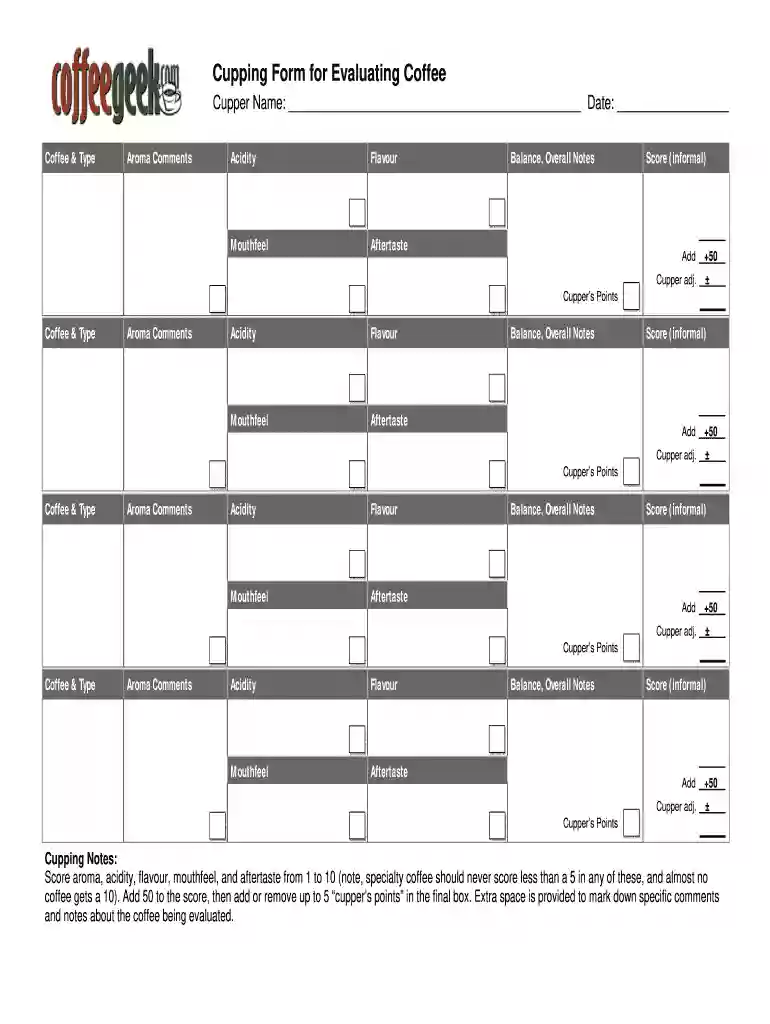
coffee tasting notes template Preview on Page 1

Coffee tasting notes template 2026

Here's how it works

  • 01. Edit your coffee tasting notes template online

    Type text, add images, blackout confidential details, add comments, highlights and more.

  • 02. Sign it in a few clicks

    Draw your signature, type it, upload its image, or use your mobile device as a signature pad.

  • 03. Share your form with others

    Send coffee tasting notes pdf via email, link, or fax. You can also download it, export it or print it out.

How to use or fill out coffee tasting notes template with our platform

Form edit decoration
9.5
Ease of Setup
DocHub User Ratings on G2
9.0
Ease of Use
DocHub User Ratings on G2
  1. Click ‘Get Form’ to open the coffee tasting notes template in the editor.
  2. Begin by entering your name and the date at the top of the form. This personalizes your evaluation.
  3. In the 'Coffee & Type' section, specify the coffee you are tasting. This helps in tracking different evaluations.
  4. For each sensory attribute—Aroma, Acidity, Flavour, Mouthfeel, Balance, and Aftertaste—rate them from 1 to 10. Remember that specialty coffee should score no less than a 5.
  5. Use the 'Aroma Comments' field to jot down specific observations about the aroma of the coffee.
  6. After scoring, add or remove up to 5 'cupper’s points' in the final box for a more personalized score.
  7. Utilize the extra space provided for any additional comments or notes regarding your tasting experience.

Start using our platform today to enhance your coffee tasting experience for free!

See more coffee tasting notes template versions

We've got more versions of the coffee tasting notes template form. Select the right coffee tasting notes template version from the list and start editing it straight away!

VersionsForm popularityFillable & printable
20044 Satisfied (30 Votes)

be ready to get more

Complete this form in 5 minutes or less

Got questions?

We have answers to the most popular questions from our customers. If you can't find an answer to your question, please contact us.

Pay attention to the order of the flavor notes. Flavor notes tend to go in the order of the coffee drinking experience. This means the first flavor note likely references fragrance/aroma, the middle notes reference the actual flavor, body, acidity and/or sweetness, and the last notes reference the aftertaste/finish.
While they may not be able to put a name to the notes, the classic, understood flavors of coffee are cocoa, nutty, and perhaps a bit of graham . These are all common, hard-to-mess-up flavors, and are the end point of many coffees before they become burnt.
If youre just exploring how to truly taste your coffee, its worth learning these four important steps: smell, slurp, locate, and describe.
Baked Coffee that is flat, dull and very boring. Bitter A harsh, sour and even unpleasant taste that is noticed mostly in the back of the tongue. Bouquet The aroma of coffee that has been freshly ground. Bready Coffee with a grain-like aroma that reminds one of bread.
Good coffee should be sweet. Usually either fruity (bright and acidic, but in a good way, not a sour way) or chocolatey (sweet in a darker, more complex way than the fruity sweetness).

Security and compliance

At DocHub, your data security is our priority. We follow HIPAA, SOC2, GDPR, and other standards, so you can work on your documents with confidence.

People also ask

Some of the ways that the mouthfeel of a coffee can be described include heavy/light, buttery, smooth, thin, and syrupy. When you first taste a coffee and do not get any immediate or dominant flavours on your mouth, it can most likely be labelled as neutral. A rich coffee is usually full-bodied and bold in flavour.

coffee tasting sheet pdf

Coffee Cuppers Form 1 Cupping Evaluation Grading Form

The SCAA Cupping Evaluation Grading Form provides a standardized method for evaluating specialty coffees through comparative cupping sessions.Read more

Learn more
Structural insights into coffee bitter taste perception by - PMC

6 days ago Humans sense five basic tastes: sweet, umami, bitter, sour and salty. Sweet and umami tastes facilitate the preference for consumingRead more

Learn more
If you believe that this page should be taken down, please follow our DMCA take down process here