Official abstract form template 2026

Get Form
abstract form Preview on Page 1

Here's how it works

01. Edit your abstract form online
Type text, add images, blackout confidential details, add comments, highlights and more.

02. Sign it in a few clicks
Draw your signature, type it, upload its image, or use your mobile device as a signature pad.

03. Share your form with others
Send template for abstract via email, link, or fax. You can also download it, export it or print it out.

How to use or fill out official abstract form template with DocHub

Form edit decoration
9.5
Ease of Setup
DocHub User Ratings on G2
9.0
Ease of Use
DocHub User Ratings on G2
  1. Click ‘Get Form’ to open the official abstract form template in our editor.
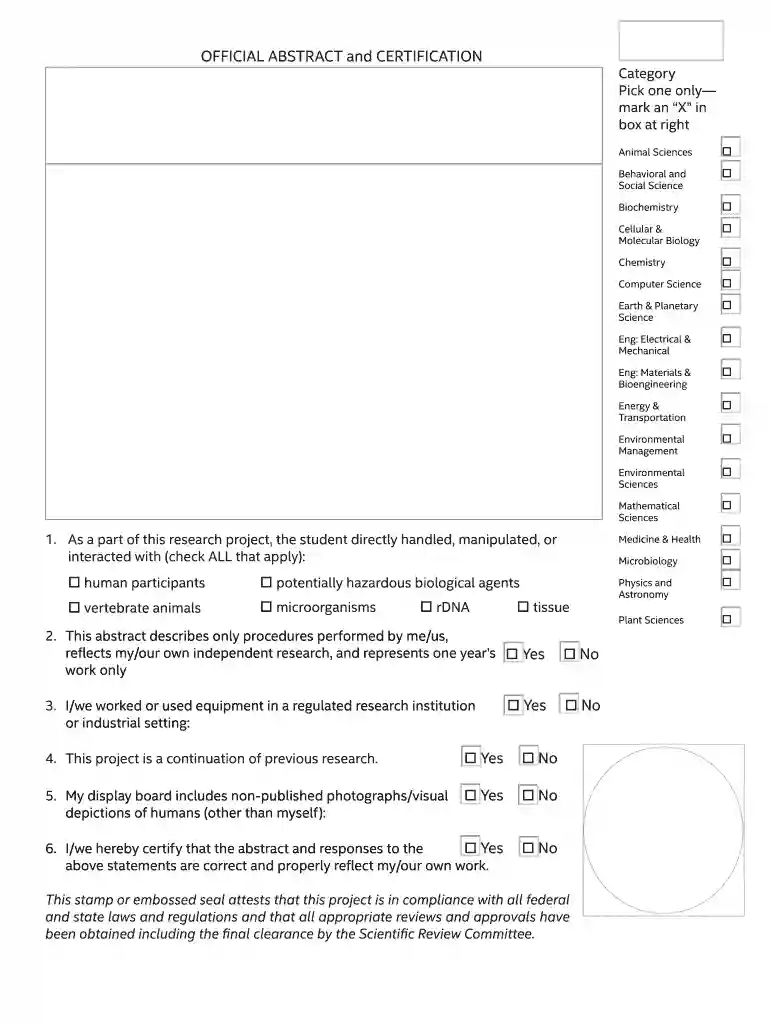
  2. Begin by selecting the appropriate category for your research. Mark an 'X' in the box next to your chosen field, such as Animal Sciences or Chemistry.
  3. Fill in your title, student name, and school information accurately. Ensure that all details are correct as they will be part of your formal submission.
  4. In the body section, start typing your abstract. Remember to adhere to the 250-word limit and include key components: purpose, procedure, data, and conclusions.
  5. Answer the certification questions at the bottom of the form carefully. These responses must reflect your own work and compliance with regulations.
  6. Review your completed abstract for clarity and adherence to guidelines before saving or printing it directly from our platform.

Start using our platform today for free to streamline your document editing and ensure a smooth submission process!

be ready to get more

Complete this form in 5 minutes or less

Get form

Got questions?

We have answers to the most popular questions from our customers. If you can't find an answer to your question, please contact us.
Contact us
There are four types of abstracts: informative, descriptive, critical, and highlight abstracts. However, students most often use informative abstracts. With that being said, always follow the guidelines dictated by your instructor or institution.
An abstract is a 150- to 250-word paragraph that provides readers with a quick overview of your essay or report and its organization. It should express your thesis (or central idea) and your key points; it should also suggest any implications or applications of the research you discuss in the paper.
Abstracts commonly have these parts: introduction, purpose, method, result, and conclusion. Each part has a different communicative goal or specific function. Most abstracts examined had purpose, method, and result with about half including a clear introduction and conclusion.
Usually an abstract includes the following. A brief introduction to the topic that youre investigating. Explanation of why the topic is important in your field/s. Statement about what the gap is in the research. Your research question/s / aim/s. An indication of your research methods and approach. Your key message.
ABC stands for Accurate, Brief, and Clear, directing how each sentence should be [1]. DEF stands for Dynamic, Engaging, and Flowing, representing how between-sentence and paragraph-level structure should be.

Security and compliance

At DocHub, your data security is our priority. We follow HIPAA, SOC2, GDPR, and other standards, so you can work on your documents with confidence.

Learn more
ccpa2
pci-dss
gdpr-compliance
hipaa
soc-compliance
be ready to get more

Complete this form in 5 minutes or less

Get form

People also ask

The four Cs of abstract writing CompletenessThe abstract covers the main part of your research/work Clarity The abstract is easily read, well organised and without too much jargon Cohesiveness Different parts of the abstract should be properly linked ensure that there is a logical and coherent flow1 more row
Complete it covers the major parts of the project. Concise it contains no excess wordiness or unnecessary information. Clear it is readable, well organized, and not too jargon-laden. Cohesive it flows smoothly between the parts.

Related links