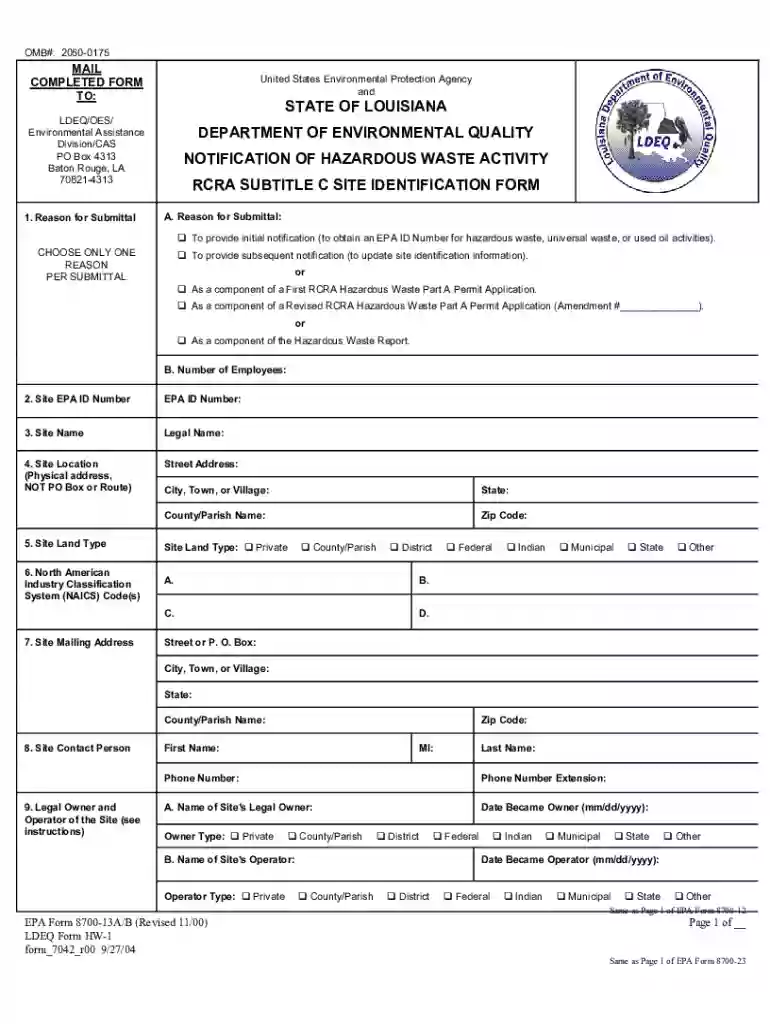
Ldeq hw 1 2026

Get Form
ldeq hw 1 Preview on Page 1

Here's how it works

01. Edit your form online
Type text, add images, blackout confidential details, add comments, highlights and more.

02. Sign it in a few clicks
Draw your signature, type it, upload its image, or use your mobile device as a signature pad.

03. Share your form with others
Send it via email, link, or fax. You can also download it, export it or print it out.

How to use or fill out ldeq hw 1 with our platform

Form edit decoration
9.5
Ease of Setup
DocHub User Ratings on G2
9.0
Ease of Use
DocHub User Ratings on G2
  1. Click ‘Get Form’ to open the ldeq hw 1 in the editor.
  2. Begin with Item 1, selecting the reason for submission. Check only one box that applies, such as initial notification or subsequent notification.
  3. In Item 2, enter your site's EPA ID number. If this is your first submission, leave it blank and proceed to Item 3.
  4. For Items 3 and 4, provide the legal name and physical address of your site. Ensure that the address is complete and not a P.O. Box.
  5. Complete Item 6 by entering the North American Industry Classification System (NAICS) code(s) relevant to your site’s activities.
  6. In Item 10, mark all applicable boxes indicating your hazardous waste activities at the site, ensuring compliance with state regulations.
  7. Finally, review all entries for accuracy before signing in Item 13. This certification must be completed by an authorized representative.

Start using our platform today to streamline your form completion process for free!

be ready to get more

Complete this form in 5 minutes or less

Get form

Got questions?

We have answers to the most popular questions from our customers. If you can't find an answer to your question, please contact us.
Contact us
Class I waste means solid waste that is not hazardous waste, and that is not prohibited from disposal in a lined landfill under Rule 62-701.300, F.A.C. View Source. Based on 13 documents. 13. Class I waste means household, commercial, and industrial; and small quantities of conditionally exempt hazardous waste.
They can be divided into seven groups depending on the type of manufacturing or industrial operation that creates them: Spent solvent wastes, Electroplating and other metal finishing wastes, Dioxin-bearing wastes, Chlorinated aliphatic hydrocarbons production, Wood preserving wastes,
Class 1: Explosives If any of your waste is considered explosive, you will need to report it so the proper authorities can decide which specific explosive division it falls under.
Designed to detonate, materials found in the U.S. Department of Transportations Hazardous Waste Class 1 Explosives category contains a wide range of potential threats. Many substances within this category are designed to cause an explosion, and these substances pose docHub threats if not properly managed.
Ignitable waste that combusts or burns easily. Corrosive waste that can cause damage or corrode any substances when it comes into contact with them. Reactive waste that may explode or violently react with air, water, or other substances. Toxic waste containing or that releases dangerous toxins.

Security and compliance

At DocHub, your data security is our priority. We follow HIPAA, SOC2, GDPR, and other standards, so you can work on your documents with confidence.

Learn more
ccpa2
pci-dss
gdpr-compliance
hipaa
soc-compliance
be ready to get more

Complete this form in 5 minutes or less

Get form

People also ask

Examples of Explosives Trinitrotoluene (TNT) and mixtures. Trinitrobenzene and mixtures. Ammonium picrate. Ammunition. Dipicryl sulfide. Hexotonal.

Related links