India grant pio card 2026

Get Form
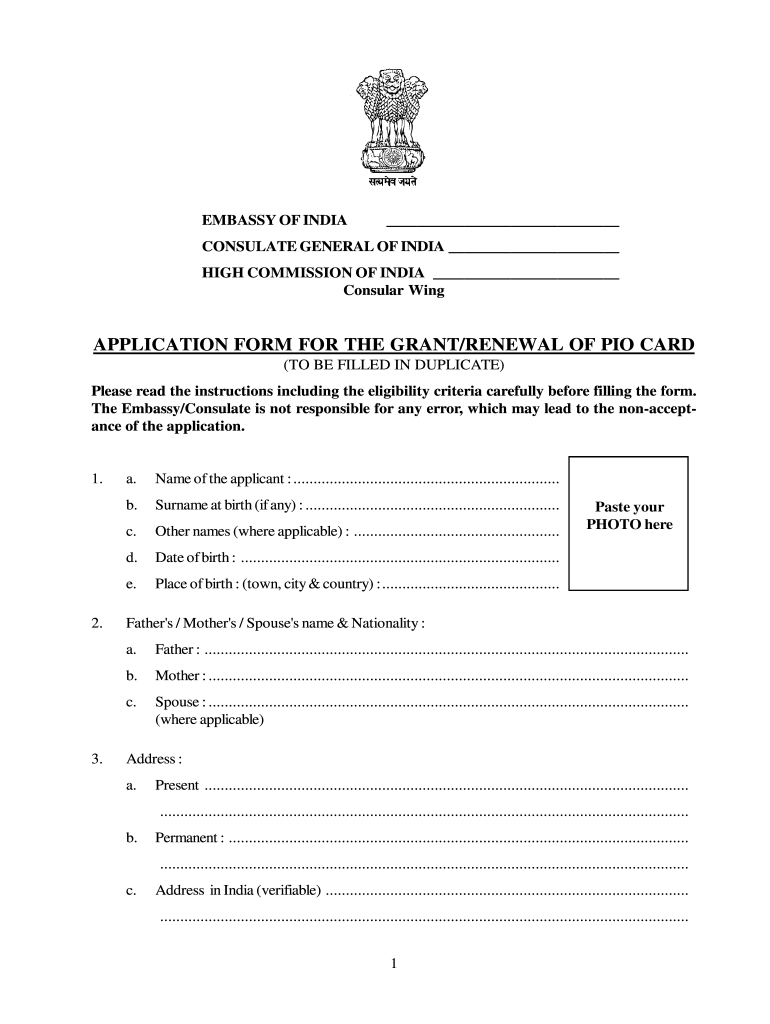
is expired pio card still valid Preview on Page 1

Here's how it works

01. Edit your is expired pio card still valid online
Type text, add images, blackout confidential details, add comments, highlights and more.
02. Sign it in a few clicks
Draw your signature, type it, upload its image, or use your mobile device as a signature pad.
03. Share your form with others
Send it via email, link, or fax. You can also download it, export it or print it out.

How to use or fill out the India Grant PIO Card

Form edit decoration
9.5
Ease of Setup
DocHub User Ratings on G2
9.0
Ease of Use
DocHub User Ratings on G2
  1. Click ‘Get Form’ to open it in the editor.
  2. Begin by entering your name in the designated field. Ensure that you include your surname at birth if applicable, along with any other names.
  3. Fill in your date and place of birth accurately. This information is crucial for identification purposes.
  4. Paste your recent photograph in the specified area on the form.
  5. Provide details about your parents or spouse, including their names and nationalities.
  6. Complete the address sections: present, permanent, and verifiable address in India.
  7. Indicate your profession or occupation, gender, marital status, and nationality at birth.
  8. Fill out passport particulars including number, issue date, expiry date, and issuing country.
  9. Answer questions regarding dual nationality and previous Indian passports held by you or your ancestors.
  10. Finally, review all entries for accuracy before signing the declaration at the end of the form.

Start using our platform today to fill out your India Grant PIO Card form online for free!

be ready to get more

Complete this form in 5 minutes or less

Get form

Got questions?

We have answers to the most popular questions from our customers. If you can't find an answer to your question, please contact us.
Contact us
A foreign national, - (i) who was a citizen of India at the time of, or at any time after 26th January, 1950; or (ii) who was eligible to become a citizen of India on 26th January, 1950; or (iii) who belonged to a territory that became part of India after 15th August, 1947; or (iv) who is a child or a grandchild or a
OCI cardholders can also engage in socio-cultural activities but will have more comprehensive rights and benefits. PIOs have certain economic benefits but may not enjoy the same level of parity. OCI cardholders have parity with Non-Resident Indians (NRIs) in financial, economic, and educational fields.
(i) the person at any time held an Indian passport; or (ii) the person or either of his/her parents or grand parents or great grand parents was born in, and was permanently resident in India, provided further that neither was at any time a citizen of any of the aforesaid excluded countries; or (iii) the person is the
A Person of Indian Origin (PIO) means a foreign citizen (except a national of. Pakistan, Afghanistan desh, China, Iran, Bhutan, Sri Lanka and Nepal) who at any time held an Indian passport.
If you are an PIO Card Holder, kindly register through OCI Registration (In Lieu Of Valid PIO-Card). If you are an PIO Card Holder and card is in lost state, kindly register through OCI Registration (In Lieu Of Lost PIO-Card).

Security and compliance

At DocHub, your data security is our priority. We follow HIPAA, SOC2, GDPR, and other standards, so you can work on your documents with confidence.

Learn more
ccpa2
pci-dss
gdpr-compliance
hipaa
soc-compliance
be ready to get more

Complete this form in 5 minutes or less

Get form

People also ask

Both PIO and OCI cardholders enjoy visa-free travel to India. However, OCI cardholders have no limit on the duration of their stay. In contrast, PIO card holders could stay up to 180 days without registration, a requirement that is now irrelevant due to the PIO-OCI merger.

Related links