




01. Edit your w147q online
Type text, add images, blackout confidential details, add comments, highlights and more.

Type text, add images, blackout confidential details, add comments, highlights and more.

Draw your signature, type it, upload its image, or use your mobile device as a signature pad.

Send w 147q via email, link, or fax. You can also download it, export it or print it out.
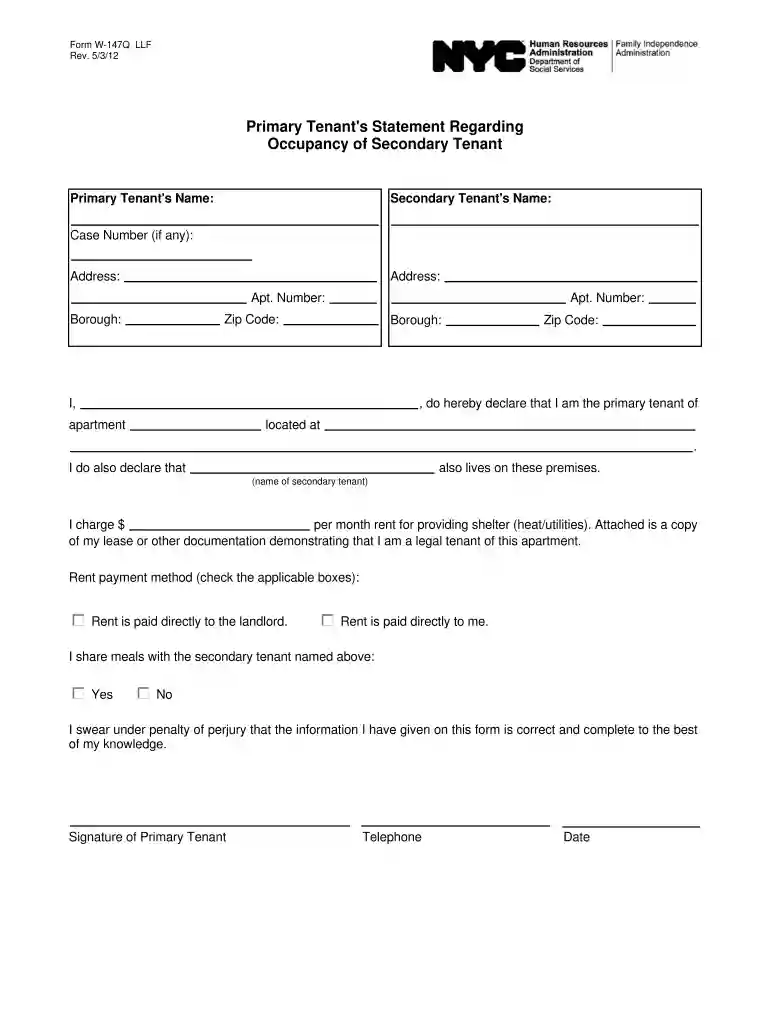
Form W-147Q, also known as the declaration by a primary tenant regarding the occupancy of a secondary tenant in an apartment, is an important document used mainly in New York City. This form is required by the Human Resources Administration (HRA) to verify the residency status of tenants living in public housing or receiving housing assistance. The form collects detailed information about both the primary and secondary tenants, such as names, addresses, and rental agreements, to ensure compliance with housing regulations. As a legally binding document, it serves the purpose of validating that the information is accurate, thus playing a vital role in maintaining the integrity of housing programs.
This document is essential in legal contexts, such as disputes regarding tenant rights or housing eligibility. Failure to truthfully complete the W-147Q can lead to serious legal repercussions, including potential eviction or loss of housing assistance. It helps prevent fraud by verifying that a secondary tenant's residence is legitimate and that all associated costs are transparent.
The W-147Q form incorporates several critical components that must be filled out accurately. Each section of the form serves a specific purpose in validating residency and housing costs. Here are the key elements typically included in the form:
Identification of Parties: This section requires the names and addresses of the primary tenant and secondary tenant, establishing clarity about who occupies the dwelling.
Occupancy Details: Information about how long the secondary tenant has been residing at the address is crucial for assessing eligibility for services or programs related to housing.
Rent Information: This includes details about the monthly rent and how costs are shared between the primary and secondary tenants, ensuring accurate financial documentation.
Affirmation Statement: The primary tenant must sign an affirmation stating the information provided is truthful under penalty of perjury, adding a layer of legal accountability.
Each of these elements is designed to create a comprehensive overview of the living arrangement and ensure legal and procedural compliance.
Completing the W-147Q form requires careful attention to detail to avoid discrepancies that could lead to potential legal issues. Here are the steps to guide you through the process:
Gather Required Information: Collect necessary details such as personal identification for both tenants and documentation related to the rent agreement.
Fill in Tenant Information: Enter the primary and secondary tenants’ names, addresses, and social security numbers (if applicable). Ensure accuracy to prevent issues during submission.
Document Rent Information: Clearly state the total monthly rent amount, indicating how costs are divided between tenants. Attach any relevant documentation to support these claims.
Complete the Affirmation Statement: This is a critical part of the form where the primary tenant must affirm the accuracy of the information provided. Ensure the statement is signed and dated.
Review the Form: Before submitting, review the form for any errors or omissions. It is crucial to ensure all required sections are filled completely.
Submit the Form: Follow the appropriate submission method for the HRA, whether that be online, via mail, or in person, as per the instructions provided by the local housing authority.
Taking these steps carefully will help ensure that the form is completed correctly and is accepted by the necessary housing agencies.
A clear understanding of terminology related to the W-147Q can enhance comprehension of its implications. Here are some critical terms:
Primary Tenant: An individual who holds the lease for the property and is responsible for the rental agreement terms.
Secondary Tenant: A person living in the unit with the primary tenant, often under an informal arrangement or sublease.
Affirmation: A formal statement confirming the truthfulness of the submitted information, carrying legal weight.
Housing Assistance: Government-funded programs designed to support individuals with housing costs, including rent subsidies.
Familiarity with these terms can provide better insight into the form’s purpose and its requirements.
The legal implications of using Form W-147Q are noteworthy. Different entities require this form to ensure compliance with housing regulations, especially in public assistance programs in New York City. Here's how the form is used legally:
Verification of Residency: Housing agencies utilize the W-147Q to confirm that all occupants meet eligibility requirements for housing assistance programs.
Preventing Fraud: By requiring tenants to affirm the content under penalty of perjury, the form helps maintain the integrity of housing assistance programs by ensuring no tenant misrepresents occupancy.
Legal Documentation: Should any disputes arise regarding tenants' rights or housing eligibility, the W-147Q serves as legal documentation that contains evidence of the living arrangements.
Understanding the legal use of the W-147Q allows tenants and landlords to navigate housing regulations effectively, ensuring compliance and protection of rights under the law.
Illustrating practical scenarios can clarify the use of Form W-147Q. Here are a few examples showcasing its importance:
Supporting a Housing Application: A primary tenant living with a colleague may need to complete the W-147Q when applying for housing support. This protects both individuals by ensuring that the occupancy arrangement is documented and verified by the housing authority.
Addressing Disputes: If a primary tenant evicts a secondary tenant due to alleged non-compliance, the W-147Q can provide evidence of occupancy status, rental agreements, and cost-sharing details that may aid in legal proceedings.
Assisting in Updating Lease Agreements: When a secondary tenant’s occupancy changes, completing a new W-147Q can assist landlords in adjusting lease agreements to reflect current housing arrangements.
These scenarios depict how the W-147Q is integral not only for individual tenants but for the legal landscape surrounding housing in New York City.
We've got more versions of the w147q form. Select the right w147q version from the list and start editing it straight away!
At DocHub, your data security is our priority. We follow HIPAA, SOC2, GDPR, and other standards, so you can work on your documents with confidence.




The form requires information about the tenant, the landlord, the rent. Web verification of secondary tenants residence and housing costs. Web up to 32% cash
I share with, or rent an apartment/house (or room) to, the secondary tenant W-147Q (E) 11/02/2018 (page 2 of 2). LLF. Human Resources Administration.Read more
The unit is suitable for field or shop use. The plastic case is sturdy, yet lightweight. The case provides ruggedness to withstand daily use.Read more


