
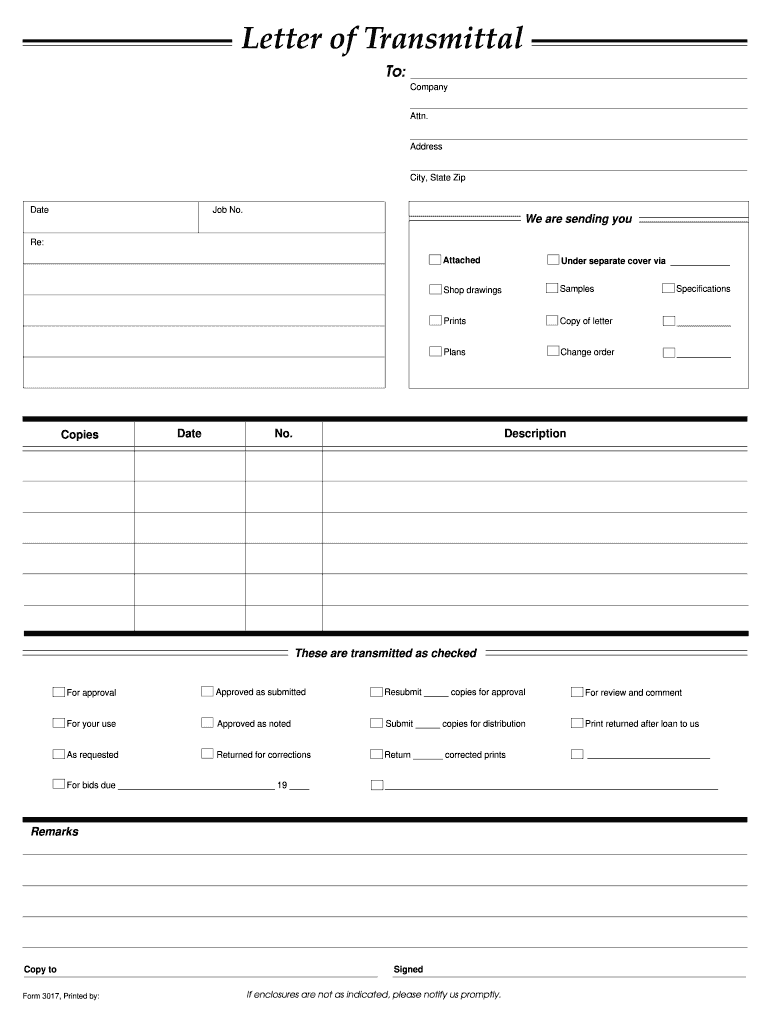







Definition and Meaning of the Transmittal Form
A transmittal form serves as a formal cover document used to accompany various materials, such as reports, documents, or plans, when they are sent to another party. This form outlines the nature of the enclosed items and may specify details like the quantity, the purpose of transmission, and any pertinent instructions necessary for handling the documents. Transmittal forms are commonly used in industries like construction, engineering, and project management, where precise documentation is crucial for tracking and managing changes.
The functionality of a transmittal form can vary across different applications. For example, in project management, it may detail shop drawings and specifications sent to clients or subcontractors. In other contexts, it may serve to convey documents for legal purposes, ensuring all parties are aware of the contents and the reason for their distribution.
How to Use the Transmittal Form
Utilizing a transmittal form involves several key steps that ensure effective communication and documentation.
-
Gather Information: Before completing the transmittal form, collect all relevant details about the documents you are sending, including the document titles, types, and any specific notes that should accompany them.
-
Fill Out the Form: Complete the transmittal form by filling in necessary sections, such as:
- Sender's details (name, company, and contact information)
- Recipient's details (name, company, and contact information)
- A detailed description of the enclosed items
- Purpose of the transmission (e.g., review, signature, information)
- Required action (if applicable)
-
Attach Supporting Documents: Include all applicable documents as outlined in the transmittal form. Make sure to assemble them in the indicated order to facilitate ease of review.
-
Review and Submit: Double-check all entries for accuracy and ensure that all required documents are attached. Submit the transmittal form either electronically or through traditional mail, depending on the method specified for the transaction.
-
Follow Up: After submitting, it's often wise to follow up with the recipient to confirm receipt and clarify any actions needed.
Steps to Complete the Transmittal Form
Completing a transmittal form can be straightforward if approached methodically. The following steps outline a comprehensive approach to ensure accuracy:
-
Identify the Document(s):
- Understand what specific documents need to be transmitted.
- This could include design plans, specifications, or reports.
-
Title and Description:
- Clearly list each document’s title.
- Provide brief descriptions to contextualize the content.
-
Indicate the Recipient:
- Include complete details of the person or organization receiving the documents.
- Ensure that contact information is up to date.
-
Select the Transmission Method:
- Note whether the documents will be sent via email, postal service, or facsimile.
- Understanding the method can affect the format of the documents.
-
Review Specific Instructions:
- Include any instructions that the recipient needs to follow when processing the documents.
- This might involve deadlines or particular actions required upon receipt.
-
Signature and Date:
- Include your signature and the date for accountability and record-keeping.
- This helps establish a timeline for the document flow.
Examples of Using the Transmittal Form
Transmittal forms are employed across various domains, emphasizing their adaptability and importance. Here are a few examples:
-
Construction Projects: A contractor uses a transmittal form to send architectural drawings to a client. The form includes document numbers, a due date for feedback, and specific notes about revisions needed.
-
Legal Exchanges: A law firm submits a transmittal form along with legal documents to a court. The form outlines what documents are enclosed, the case number, and any relevant deadlines for filings.
-
Corporate Reporting: In a business setting, a finance team may use a transmittal form to send annual reports to stakeholders. It highlights key operating results and supports further inquiry as needed.
Key Elements of the Transmittal Form
A transmittal form consists of several critical elements that enhance its functionality and effectiveness, including:
-
Header Information: The top portion usually contains the title 'Transmittal Form' and relevant company logos or identifiers.
-
Sender & Recipient Details: Detailed contact information that identifies the parties involved in the transmission.
-
Document List: A clear, organized list of all included documents along with brief descriptions.
-
Purpose & Notes: Space for indicating the purpose of sending the documents and any specific notes that clarify instructions or requests.
-
Tracking Functionality: Some forms may include tracking numbers for future reference and correspondence following the transmission.
Each of these elements contributes to the overall functionality of the transmittal form, ensuring clarity and accountability throughout the document transfer process.




