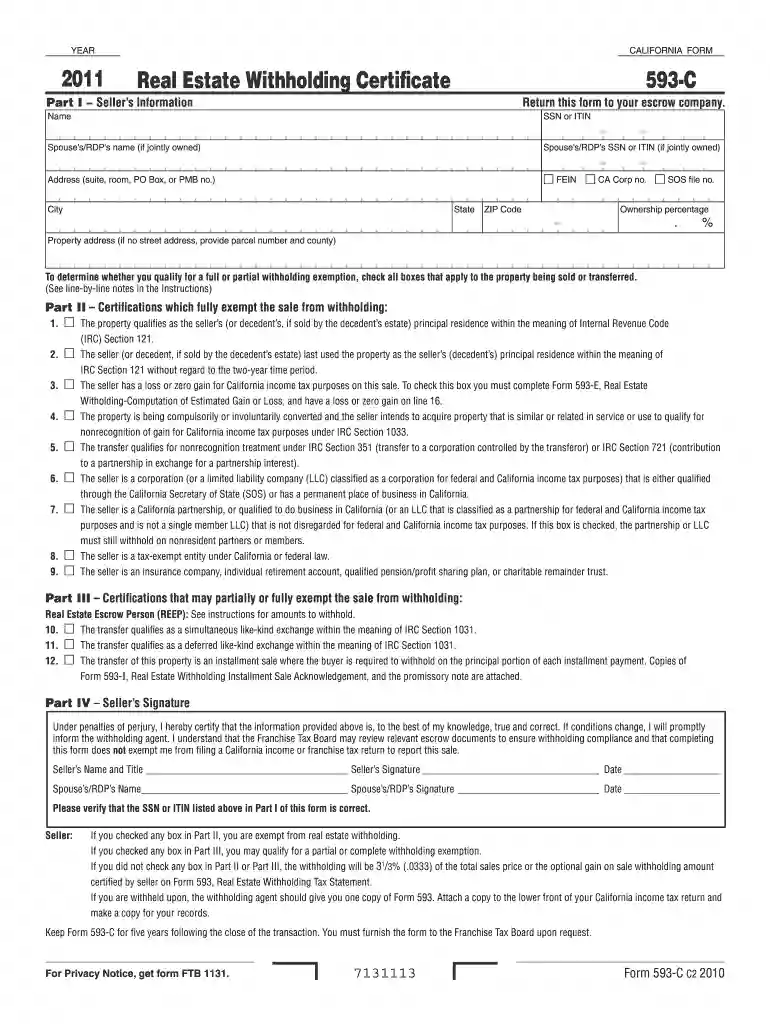
Real estate withholding certificate 593 c 2011 form-2026

Get Form
593 c form 2022 Preview on Page 1

Here's how it works

01. Edit your 593 c form 2022 online
Type text, add images, blackout confidential details, add comments, highlights and more.

02. Sign it in a few clicks
Draw your signature, type it, upload its image, or use your mobile device as a signature pad.

03. Share your form with others
Send it via email, link, or fax. You can also download it, export it or print it out.

How to use or fill out real estate withholding certificate 593 c 2011 form with our platform

Form edit decoration
9.5
Ease of Setup
DocHub User Ratings on G2
9.0
Ease of Use
DocHub User Ratings on G2
  1. Click ‘Get Form’ to open the real estate withholding certificate 593 c 2011 form in the editor.
  2. Begin by filling out Part I with the seller’s information, including name, SSN or ITIN, and address. Ensure accuracy as this information is crucial for processing.
  3. In Part II, check all applicable boxes that certify exemptions from withholding. Review each option carefully to determine your eligibility based on your situation.
  4. Proceed to Part III if you believe you may qualify for partial exemptions. Again, check the relevant boxes and ensure you understand the implications of each certification.
  5. Complete Part IV by signing and dating the form. Both seller and spouse/RDP must provide their signatures where required.
  6. Finally, review all entries for accuracy before saving or exporting your completed form directly from our platform.

Start using our platform today to fill out your real estate withholding certificate effortlessly and for free!

See more real estate withholding certificate 593 c 2011 form versions

We've got more versions of the real estate withholding certificate 593 c 2011 form form. Select the right real estate withholding certificate 593 c 2011 form version from the list and start editing it straight away!
Versions Form popularity Fillable & printable
2019 4.8 Satisfied (120 Votes)
2018 4.3 Satisfied (59 Votes)
2017 4.4 Satisfied (186 Votes)
2016 4.1 Satisfied (76 Votes)
2015 4.1 Satisfied (31 Votes)
2014 4.3 Satisfied (27 Votes)
2013 4.3 Satisfied (40 Votes)
2012 4.3 Satisfied (65 Votes)
2011 4.4 Satisfied (33 Votes)
be ready to get more

Complete this form in 5 minutes or less

Get form

Got questions?

We have answers to the most popular questions from our customers. If you can't find an answer to your question, please contact us.
Contact us
Withholding is not required when any of the following is true: The total sale price does not exceed $100,000. The seller is a bank acting as a fiduciary for a trust. The property is being foreclosed upon (see question 28). The seller meets a full exemption on FTB Form 593 -C.
To claim exemption from state income tax withholding, employees must submit a W-4 or DE-4 docHubing that they did not have any federal tax liability for the preceding year and that they do not anticipate any tax liability for the current taxable year.
A seller/transferor that qualifies for a full, partial, or no withholding exemption must file Form 593. Any remitter (individual, business entity, trust, estate, or REEP) who withheld on the sale/transfer of California real property must file Form 593 to report the amount withheld.
When you hire an employee, you must have the employee complete a Form W-4, Employees Withholding Certificate.
If the sale price is $300,000 or less Properties bought and sold for no more than $300,000 do not require a FIRPTA withholding, as long as the buyer or a member of the buyers family intends to live at the property for at least half of the first two years after the purchase.
be ready to get more

Complete this form in 5 minutes or less

Get form

People also ask

The amount is withheld by the Settlement Agent from the Sellers account at the closing of the transaction and sent to the Franchise Tax Board (FTB). The amount is considered a prepayment of income taxes on the potential gain.
Sole proprietors and general partnerships dont have to pay the California Franchise Tax, but they also dont have any personal liability protection. For some small businesses that have a low likelihood of being sued, operating as a sole proprietorship or general partnership may be good idea.

Related links