Va form 10 5345a 2026

Get Form
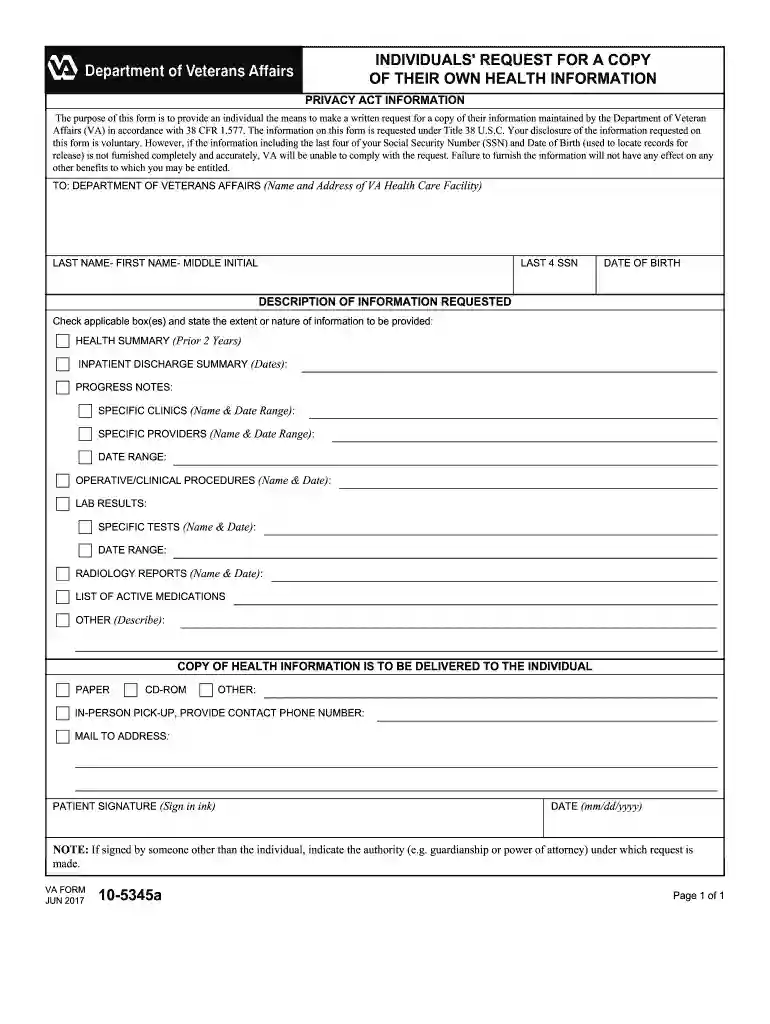
va form 10 5345a Preview on Page 1

Here's how it works

01. Edit your va form 10 5345a online
Type text, add images, blackout confidential details, add comments, highlights and more.
02. Sign it in a few clicks
Draw your signature, type it, upload its image, or use your mobile device as a signature pad.
03. Share your form with others
Send it via email, link, or fax. You can also download it, export it or print it out.

How to use or fill out va form 10 5345a with our platform

Form edit decoration
9.5
Ease of Setup
DocHub User Ratings on G2
9.0
Ease of Use
DocHub User Ratings on G2
  1. Click ‘Get Form’ to open the VA Form 10-5345a in the editor.
  2. Begin by entering your Social Security Number (SSN) at the top of the form. This is crucial for locating your records.
  3. Fill in your full name, including last name, first name, and middle initial. Ensure accuracy to avoid delays.
  4. Provide your date of birth in the specified format (mm/dd/yyyy). This helps verify your identity.
  5. In the 'Description of Information Requested' section, check all applicable boxes and specify the nature of information you need, including relevant dates.
  6. Indicate the facility where you were treated and select how you would like to receive your health information—either in-person or by mail. If by mail, include your complete address.
  7. Sign and date the form at the bottom. If someone else is signing on your behalf, indicate their authority.

Start using our platform today to fill out VA Form 10-5345a quickly and for free!

See more va form 10 5345a versions

We've got more versions of the va form 10 5345a form. Select the right va form 10 5345a version from the list and start editing it straight away!
Versions Form popularity Fillable & printable
2021 4.2 Satisfied (44 Votes)
2020 4.8 Satisfied (181 Votes)
2005 4.3 Satisfied (67 Votes)
be ready to get more

Complete this form in 5 minutes or less

Get form

Got questions?

We have answers to the most popular questions from our customers. If you can't find an answer to your question, please contact us.
Contact us
The holy grail for VA disability is achieving Permanent and Total (PT) status, which means the VA recognizes your service-connected disabilities are severe, wont improve, and youre protected from future reductions, unlocking benefits like free Space-A travel, state discounts, and often no more CP exams. While a 100% rating provides maximum compensation, PT adds DocHub quality-of-life perks and stability, making it the ultimate goal for many veterans with lifelong conditions. Key aspects of PT status: Not automatic: A standard 100% rating doesnt guarantee PT; PT means permanent, not just high-paying. Lifelong conditions: Awarded for disabilities with little to no chance of improvement, like losing both legs. Benefit Enhancements: Free military air travel: Space-Available (Space-A) flights. State benefits: Access to state-specific discounts and programs. Reduced scrutiny: VA usually stops requiring future medical exams for PT conditions. Other Grails (depending on veteran goals): High Combined Rating: Achieving 100% through combined ratings for multiple conditions, though its harder to get from 80% to 100% schedular. PACT Act Claims: For those exposed to toxins, the PACT Act has become a DocHub pathway to new benefits, sometimes called a holy grail for related conditions. Special Monthly Compensation (SMC): For extremely severe, single-impairment losses, SMC offers higher pay, but pursuing it can risk review of other ratings. AI can make mistakes, so double-check responsesIs there any difference to be weary of when getting a rating of 100% thats Nov 21, 2024 Risk of Reduction: When a veteran has a 100% PT rating, particularly based on a single condition, pursuing additionalRReddit r/VeteransBenefitsWhy The PACT Act is the Holy Grail of VA Benefits: A whopping 74.9% Aug 15, 2024 Why The PACT Act is the Holy Grail of VA Benefits: A whopping 74.9% | pact act explained | TikTok. Global video TikTok VA Claims Insider
Notice to Veterans and service members of evidence needed: Were required by law to tell you what evidence youll need to provide to support your disability claim. The information on this page is a summary of evidence requirements (called section 5103 notice).Jul 2, 2025
Fill out and submit a VA Form 10-5345a Individuals Request for a Copy of Their Own Health Information. Bring or send your request to your Release of Information Office at your VA facility.Aug 21, 2025
Good signs for a VA claim approval include strong, consistent medical evidence (diagnosis, treatment, symptoms over time), a clear link (nexus) to service, a positive Compensation Pension (CP) exam, and a fully developed claim with supporting statements, especially if you have a presumptive condition or file within a year of service. The VA requesting more info or scheduling multiple exams also suggests thorough review, while a favorable CP examiner noting the conditions severity is a strong indicator. Evidence Documentation Solid Medical Records: A current diagnosis, consistent treatment history, and clear documentation of symptoms (frequency, severity, duration) in military, VA, or private records. Nexus Letter: A letter from a doctor linking your current condition to service with a reasonable probability (e.g., at least as likely as not). Service Connection: Clear proof of an in-service event, injury, or exposure (e.g., in-service treatment, documented stressors). Fully Developed Claim (FDC): Submitting all relevant records, buddy letters, and personal statements upfront. Claim Process Indicators Favorable CP Exam: The examiner accurately documents symptoms, understands the condition, and confirms service connection or severity. Scheduling More Exams: Indicates the VA is taking the claim seriously and thoroughly reviewing it. Filing Secondary Conditions: Claiming conditions like depression or migraines caused by a primary service-connected issue, with medical support. Presumptive Conditions: Filing for conditions assumed to be service-connected (e.g., Agent Orange-related). Early Filing: Submitting within one year of leaving service often leads to quicker approval for certain conditions. Personal Supporting Statements Powerful Personal Statement: A detailed, truthful account of how symptoms affect daily life, making the claim more real. Buddy Letters: Supportive statements from fellow service members or family can corroborate your experience. AI can make mistakes, so double-check responses7 Signs Your VA Disability Claim Will Be Approved!Jul 10, 2025 or sleep apnnea due to weight gain from meds your odds improve the VA has already acknowledged a foundation. so your cYouTube VA Claims Insider7 Signs Your VA Disability Will Be Approved!Jul 18, 2025 and youre filing for a secondary condition like GIRD connected to PTSD. or sleep apnnea due to weight gain from meds YouTube VA Claims Insider
VA Form 10-5345, Request for and Authorization to Release Health Information, is used by a Veteran to give the Department of Veterans Affairs (VA) permission to share their health records with an outside, non-VA individual or organization, such as a private doctor, hospital, or for legal/court purposes, ensuring HIPAA compliance for sensitive data. It acts as a signed authorization for the VA to disclose Protected Health Information (PHI) to a third party, differing from form 10-5345a, which is used for a Veteran to request their own records. When to use VA Form 10-5345 Sharing with a new doctor: When a Veteran starts seeing a private physician or specialist. Insurance or legal needs: For insurance claims, disability applications, or court-ordered evaluations (like Veterans Court). Transferring care: When moving between VA facilities or seeking care at a State Veterans Home. Releasing records to others: To allow family members, legal representatives, or other entities access to records. Key points about the form Authorization: Its an authorization for the VA to release information to someone else. Signature required: Requires the Veterans signature (or legal representatives) and date. Sensitive information: Includes specific sections for authorizing disclosure of sensitive information like mental health or status, with options to control what is shared. AI can make mistakes, so double-check responsesAbout VA Form 10-5345 | Veterans AffairsDec 18, 2025 Request for and Authorization to Release Health Information. Form revision date: July 2021. Related to: Health care. WVA.gov Home | Veterans AffairsRequest for and Authorization to Release Health Information - VA.govHUMAN IMMUNODEFICIENCY VIRUS () UNDER THE FOLLOWING CONDITION(S): I request and authorize Department of Veterans Affairs to relVA.gov Home | Veterans Affairs

Security and compliance

At DocHub, your data security is our priority. We follow HIPAA, SOC2, GDPR, and other standards, so you can work on your documents with confidence.

Learn more
ccpa2
pci-dss
gdpr-compliance
hipaa
soc-compliance

People also ask

What is a 5103 Notice? Officially, this is known as the Veterans Claims Assistance Act (VCAA) Notice. Under the law, at least supposedly (do you detect the sarcasm?), the VA has a Duty to Assist Veterans. This means they are legally required to help you gather evidence to support your claim.Nov 24, 2025
The hardest VA claims to get often involve subjective conditions or proving a strong link (nexus) to service, with PTSD (especially from Military Sexual Trauma - MST), sleep apnea, chronic pain, tinnitus/hearing loss, and claims for aggravation of pre-existing conditions (like flat feet) being notoriously difficult due to lack of objective proof, poor in-service documentation, or proving the worsening went beyond natural progression. Exposure-related illnesses and secondary conditions also present DocHub challenges. Why These Claims Are Hard: PTSD/MST: Requires a verified stressor (hard for MST) and subjective symptoms, often lacking in-service records. Sleep Apnea: Needs a sleep study and proving service connection if not diagnosed in service, often linked to obesity or other issues. Tinnitus Hearing Loss: Common but require specific, calibrated audiograms and functional impact documentation, with tinnitus having a low maximum rating. Chronic Pain/Invisible Injuries: Difficult to objectively measure and often require detailed functional limitation descriptions. Aggravation of Pre-existing Conditions: Requires showing service worsened it beyond normal progression, needing strong before/after evidence and expert opinions. Toxic Exposures (Non-Presumptive): Proving exposure, latency, and nexus without robust scientific evidence is tough. Key Challenges Across Difficult Claims: Lack of In-Service Records: Missing documentation of events or symptoms at the time. Subjective Symptoms: Conditions like pain or mental health struggles are hard to objectively measure. Nexus (Link) Requirement: Proving the military event directly caused or aggravated the condition. How to Improve Your Chances: Gather Extensive Evidence: Buddy statements, personal journals, private medical records, and detailed timelines. Get Expert Opinions: Nexus letters from specialists are crucial. Document Functional Impact: Show how the condition affects your daily life and work. Build a Consistent Record: Show a clear story over time. AI can make mistakes, so double-check responsesWhat is the Hardest VA Claim to Get?Coskrey LawTop 10 Hardest VA Claims to Get Approved!Jan 27, 2026 doesnt meet the VAs cut offs above 0% you may only receive 0% service connected rating. and as long as the evidence YouTube VA Claims Insider
To get a 70% PTSD rating, you need to show the VA severe occupational and social impairment with symptoms like near-continuous panic/depression, suicidal thoughts, inability to maintain jobs/relationships, illogical speech, impaired impulse control, obsessive rituals, and neglect of hygiene, providing specific examples of how these symptoms disrupt daily life in your medical records, personal statements (VA Form 21-4138), and CP exams. Honesty, detail, and strong evidence linking symptoms to service are key. What to Say Document (Examples) Impact on Function: I cant hold a job because I have irrational anger outbursts and cant handle stress; I get fired or quit, or I struggle to maintain friendships because my speech becomes illogical or I push people away. Intense Symptoms: Describe near-continuous panic attacks, suicidal thoughts, or overwhelming depression that stops you from functioning. Specific Behaviors: I have to check my locks 20 times before leaving the house (obsessive ritual), I neglect my appearance/hygiene because I cant make myself do it, or I cant control my impulses, leading to violent outbursts. Speech: Mention if your speech is intermittently illogical, obscure, or irrelevant. How to Provide Evidence Medical Records: Document all treatments, hospitalizations, therapist notes, and diagnoses. Personal Statement (VA Form 21-4138): Write a detailed account of your symptoms and their impact on your work, school, and relationships. Lay Statements: Get statements from family, friends, or fellow service members who witnessed your struggles. CP Exam: Be completely honest and dont downplay symptoms; describe frequency, severity, and effects on your life. Nexus Letter: A letter from a medical professional linking your PTSD to your military service can be crucial. Key Criteria for 70% Deficiencies in most areas (work, school, family, judgment, mood). Symptoms are frequent, severe, and persistent enough to make it almost impossible to maintain employment or relationships. This is for informational purposes only. For medical advice or diagnosis, consult a professional. Guide to PTSD VA Disability Ratings - Hill PontonWhat other evidence can a veteran use to show an in-service event for PTSD? On the other hand, if the veteran was not in active duHill PontonWhat Does It Take To Get a 70% PTSD VA Rating?Oct 29, 2021Woods Woods, LLC

Related links