




01. Edit your form online
Type text, add images, blackout confidential details, add comments, highlights and more.

Type text, add images, blackout confidential details, add comments, highlights and more.

Draw your signature, type it, upload its image, or use your mobile device as a signature pad.

Send it via email, link, or fax. You can also download it, export it or print it out.
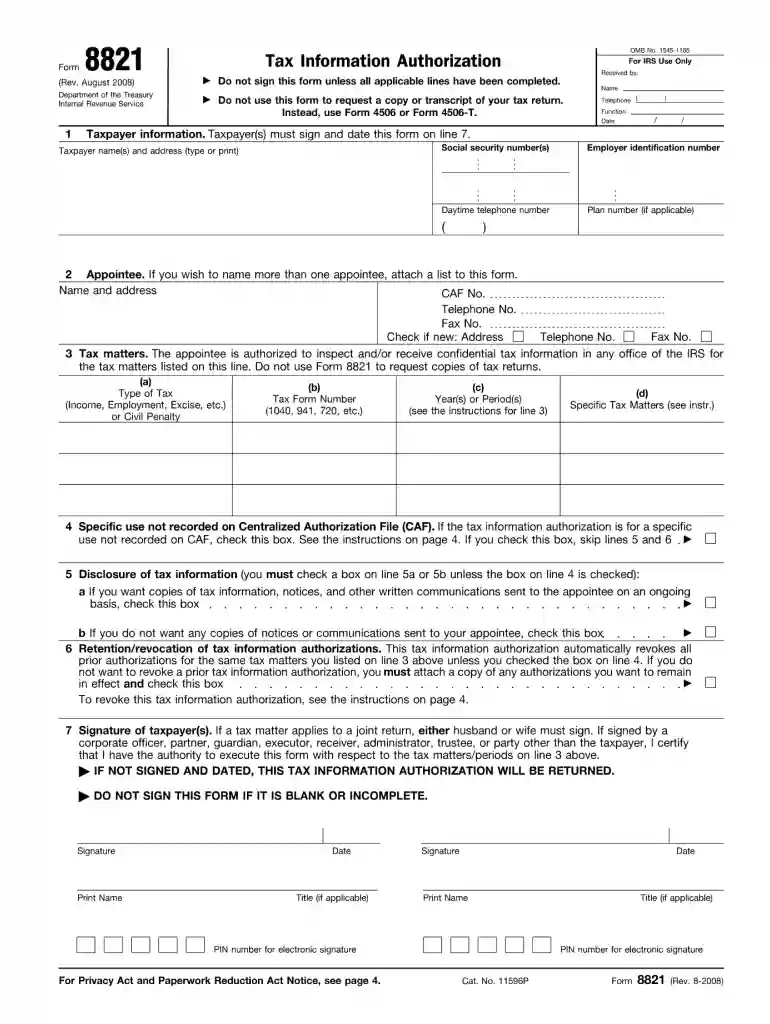
Form 8821, known as the Tax Information Authorization form, is utilized by taxpayers to authorize individuals or entities to inspect and receive confidential tax information on their behalf from the IRS. This form grants permission to access, but not to act on, confidential tax details, a role reserved for Form 2848 — Power of Attorney and Declaration of Representative. The 2008 fillable version is designed for ease of use, allowing information to be entered directly into a digital form, minimizing errors often associated with manual entries.
The fillable version of Form 8821 provides a streamlined method for authorizing a third party to access your tax information. It is particularly useful because it allows you to:
Follow these steps to effectively use the Form 8821 fillable 2008:
To accurately complete Form 8821, it is essential to follow the structured steps for entering information:
The fillable version of Form 8821 includes specific elements crucial to the completion process:
Form 8821 is strictly for information access and must not be confused with legal representation, which requires forms like 2848. The form enables:
Understanding these legal limitations is vital to prevent unauthorized use or overstepping of roles granted by the form.
IRS guidelines state that the Form 8821 must be submitted within 60 days of the taxpayer's signature date. This timeframe is critical for ensuring the validity of the authorization. Key deadlines include:
To efficiently fill out Form 8821, it is crucial to use compatible software:
Form 8821 is particularly beneficial in various taxpayer scenarios:
Knowing the range of scenarios where Form 8821 is applicable enhances its usability and ensures proper tax information management.


We've got more versions of the Form 8821 fillable 2008 form. Select the right Form 8821 fillable 2008 version from the list and start editing it straight away!
eSignatures are a great replacement for traditional signing, as they save time, effort, and money people spend on printing, scanning, and paper delivery. You can eSign your Form 8821 fillable 2008 utilizing a trustworthy and robust online document management tool like DocHub. It complies with main eSignature standards (ESIGN and UETA), so all documents approved there are legally binding and have the same validity as physically signed ones.
You can easily edit fill out your Form 8821 fillable 2008 on any iOS gadget. Open an internet browser of your liking, go to the DocHub website, authorize or create a new account, upload your file for editing, and make your required alterations. Our service is mobile-friendly, so using its features on your phone will be a no-brainer, even on the first try.
At DocHub, your data security is our priority. We follow HIPAA, SOC2, GDPR, and other standards, so you can work on your documents with confidence.
Dec 16, 2024 2008 began with your 2010 tax return and ends with your 2024 tax 8,821. 12,076. 10,382. 77,400. 77,450. 12,087. 8,827. 12,087. 10,393.Read more
Revision Date Dec 2008, Posted Date 07/17/2012. Product Number Form 8874 Product Number Form 8821-A Title IRS Disclosure Authorization for Victims ofRead more


