




01. Edit your form online
Type text, add images, blackout confidential details, add comments, highlights and more.

Type text, add images, blackout confidential details, add comments, highlights and more.

Draw your signature, type it, upload its image, or use your mobile device as a signature pad.

Send it via email, link, or fax. You can also download it, export it or print it out.
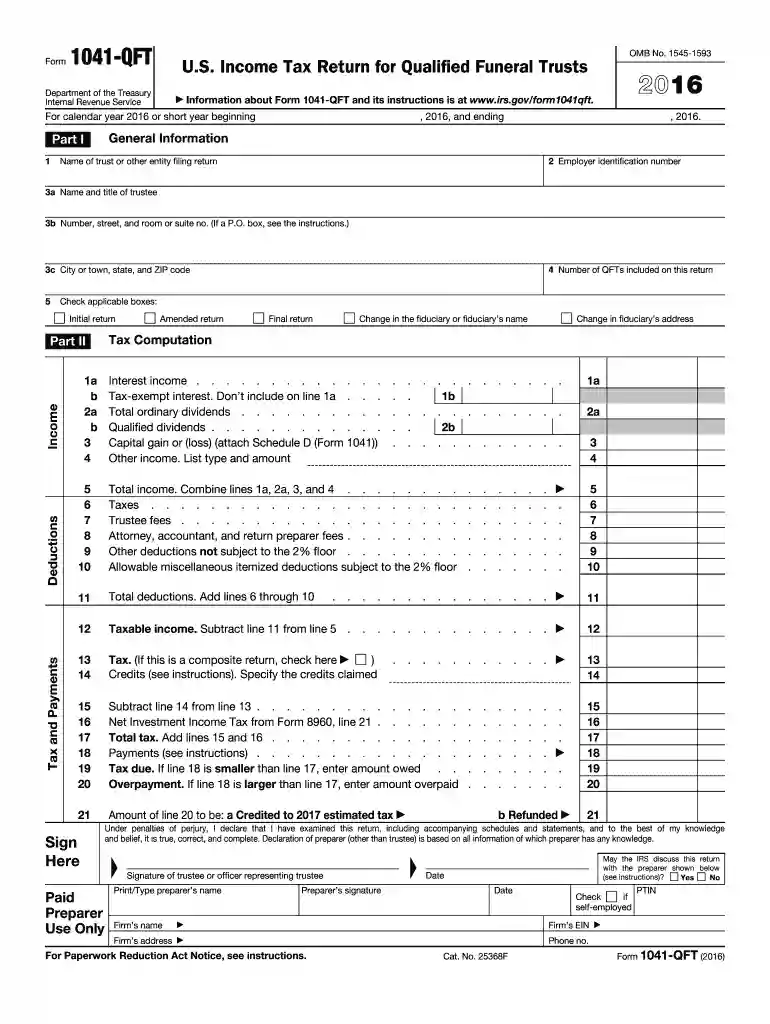
The 2016 Form 1041-QFT is specifically designed for trustees to report the income, deductions, gains, losses, and tax liabilities of Qualified Funeral Trusts (QFTs) in the United States. As a trust tax form, it provides the guidelines necessary for trustees to comply with IRS regulations regarding the financial reporting of QFTs. Understanding the purpose of this form is vital for those managing funeral trusts, ensuring that the financial activities of such trusts are legally recorded and transparent. This form addresses specific requirements such as eligibility criteria, tax computations, and the reporting of financial transactions, offering a structured approach to maintaining compliance with U.S. tax law.
To effectively complete the form, trustees must be familiar with its key components. These include:
A trust qualifies as a funeral trust if it meets certain criteria set forth by the IRS. The parameters include:
Understanding these criteria is essential for maintaining the QFT status, as failure to comply can affect eligibility and result in tax implications or penalties.


Completing the 1041-QFT form requires precision and attention to detail. Here is a step-by-step process:
Each step is crucial for ensuring the form is filled out correctly and submitted in a timely manner, thereby avoiding non-compliance issues.
Understanding terminology specific to Form 1041-QFT can assist in accurate completion and comprehension. Key terms include:
Familiarity with these terms can help clarify the instructions and requirements of the form, supporting trustees in effective form submission.
The IRS provides comprehensive guidelines to ensure proper compliance with Form 1041-QFT. These guidelines include instructions on filling out each section of the form, details on how to compute taxes accurately, and documentation requirements. The IRS instructions also offer insight into filing deadlines and the necessity for precise record-keeping. Trustees are advised to review these guidelines regularly and consult them as an authoritative resource during the form completion process.
Adhering to filing deadlines for Form 1041-QFT is vital to avoid penalties. Typically, the filing deadline aligns with the calendar year. For 2016, it is generally required by April 15 of the following year. However, trustees should verify the current year’s deadlines as they may change annually. Filing on time ensures the trust remains in good standing and avoids unnecessary late fees and interest charges. If an extension is needed, trustees must file the appropriate request with the IRS to secure an extension.
Failure to comply with Form 1041-QFT requirements can lead to various penalties, including:
Ensuring accurate and timely completion of the form eliminates the risk of these penalties, safeguarding the trust’s financial stability and compliance status.
We've got more versions of the form 1041 qft 2016 form. Select the right form 1041 qft 2016 version from the list and start editing it straight away!
| Versions | Form popularity | Fillable & printable |
|---|---|---|
| 2025 | 4.1 Satisfied (23 Votes) | |
| 2024 | 4.3 Satisfied (33 Votes) | |
| 2023 | 4.4 Satisfied (58 Votes) | |
| 2022 | 4.9 Satisfied (38 Votes) | |
| 2021 | 4.8 Satisfied (59 Votes) | |
| 2020 | 4.2 Satisfied (44 Votes) | |
| 2019 | 4.1 Satisfied (69 Votes) | |
| 2018 | 4.2 Satisfied (79 Votes) | |
| 2017 | 4.2 Satisfied (95 Votes) | |
| 2016 | 4.4 Satisfied (573 Votes) | |
| 2015 | 4.1 Satisfied (74 Votes) | |
| 2014 | 4 Satisfied (27 Votes) | |
| 2013 | 4 Satisfied (23 Votes) | |
| 2012 | 4.3 Satisfied (43 Votes) | |
| 2011 | 4 Satisfied (34 Votes) |
At DocHub, your data security is our priority. We follow HIPAA, SOC2, GDPR, and other standards, so you can work on your documents with confidence.
Page 1041. / ( d I r ;. Page 1042. s zC3 :|L o q *Q G2H7oe J f cH U Y q f t J\ I / D - P r + NhV 1a a Q. GY: 1 dtw 8 -qs A M2 q Z M E@ + 8 j NRead more
For calendar year 2016 or short year beginning. , 2016, and ending. , 2016. Part I. General Information. 1 Name of trust or other entity filing return. 2Read more
Jun 22, 2017 Form 1041-QFT, U.S. Income Tax Return for. Qualified Funeral Trusts. 64. Center for Agricultural Law Taxation. Formation, Termination and.Read more


