




01. Edit your patient profile template online
Type text, add images, blackout confidential details, add comments, highlights and more.

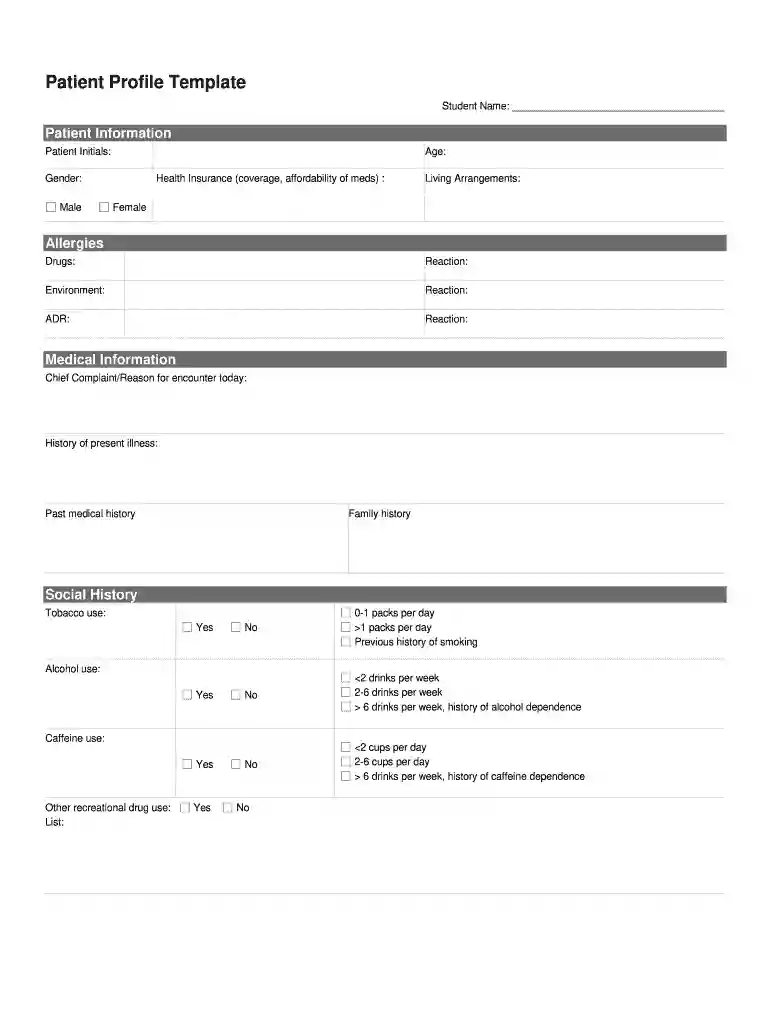
Type text, add images, blackout confidential details, add comments, highlights and more.

Draw your signature, type it, upload its image, or use your mobile device as a signature pad.

Send patient profile example via email, link, or fax. You can also download it, export it or print it out.
The Patient Profile Template is an essential document designed to collect and organize a patient's health information, supporting healthcare providers in managing patient care efficiently. It typically encompasses various categories of data, each influencing the patient's treatment and overall health assessment.
A well-structured patient profile template includes specific sections that ensure all relevant information is captured. The following components are critical:
Demographic Information
Medical History
Current Medications
Allergies and Adverse Reactions
Vital Signs
Immunization Status
To create an effective patient profile form, consider the following steps:
Determine Required Fields
Incorporate Interactive Fields
Establish Data Privacy Protections
Test the Template
Provide Training
Utilizing a patient profile template offers numerous advantages:
Streamlined Data Collection
Enhanced Communication Among Care Teams
Improved Patient Experience
Facilitation of Clinical Decision-Making
Examining completed patient profiles can offer insights into effective documentation practices. Here are a few examples:
Example 1: Adult Patient
Example 2: Pediatric Patient
Choosing between digital and paper patient profiles involves weighing several factors:
Accessibility
Integration with EHRs
Environmental Considerations
The patient profile template is an indispensable tool for healthcare providers aimed at improving patient care. It enables the collection, organization, and accessibility of critical health information, ultimately leading to enhanced treatment outcomes and patient satisfaction.
At DocHub, your data security is our priority. We follow HIPAA, SOC2, GDPR, and other standards, so you can work on your documents with confidence.
A succinct, cogent presentation allows colleagues to internalize patients stories and improves diagnostic reasoning. Standard structures enable physicians toRead more
Aug 26, 2025 Each patients profile features a dashboard with tools for information assortment, scheduling, and consultoria valores behavior interventionRead more
JavaScript is disabled. In order to continue, we need to verify that youre not a robot. This requires JavaScript. Enable JavaScript and then reload the page.


