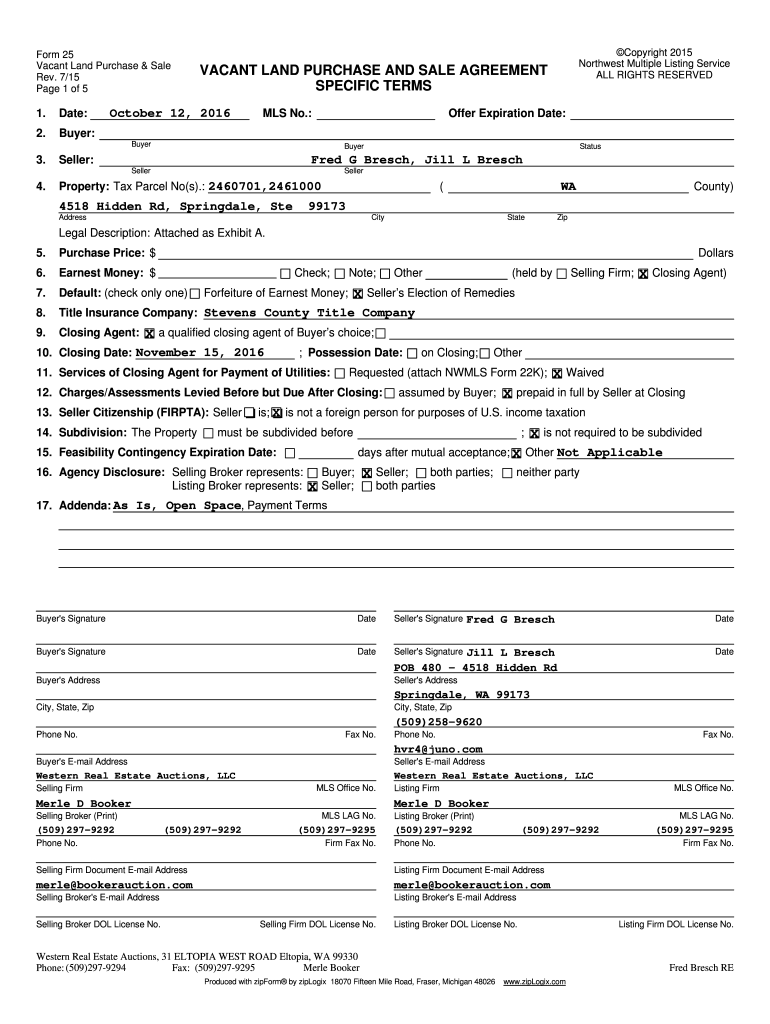
Vacant Land Purchase & Sale 2026

Get Form
Vacant Land Purchase & Sale Preview on Page 1

Here's how it works

01. Edit your form online
Type text, add images, blackout confidential details, add comments, highlights and more.
02. Sign it in a few clicks
Draw your signature, type it, upload its image, or use your mobile device as a signature pad.
03. Share your form with others
Send it via email, link, or fax. You can also download it, export it or print it out.

How to use or fill out Vacant Land Purchase & Sale with our platform

Form edit decoration
9.5
Ease of Setup
DocHub User Ratings on G2
9.0
Ease of Use
DocHub User Ratings on G2
  1. Click ‘Get Form’ to open the Vacant Land Purchase & Sale document in the editor.
  2. Begin by entering the date of the agreement at the top of the form. This is crucial for establishing timelines.
  3. Fill in the Buyer and Seller information, including names and contact details. Ensure accuracy to avoid future complications.
  4. Specify the Property details, including Tax Parcel Numbers and MLS Number, which are essential for identification.
  5. Enter the Purchase Price and Earnest Money amounts clearly. This section outlines financial commitments.
  6. Select your preferred Default option by checking one box that aligns with your agreement terms.
  7. Complete sections regarding Title Insurance Company and Closing Agent, ensuring all parties are informed about who will handle these processes.
  8. Review additional clauses related to Closing Date, Possession Date, and any contingencies that may apply to your purchase.
  9. Finally, ensure both Buyer and Seller sign and date the document electronically for a valid agreement.

Start filling out your Vacant Land Purchase & Sale today using our platform for a seamless experience!

be ready to get more

Complete this form in 5 minutes or less

Get form

Got questions?

We have answers to the most popular questions from our customers. If you can't find an answer to your question, please contact us.
Contact us
A land purchase agreement is a contract between a buyer and a seller outlining the terms and conditions of purchasing a plot of land. Drafting a contract without the help of a lawyer can be daunting, but land purchase agreements can be straightforward if you follow a structured template.
What Are the Different Parts of a Purchase Agreement? Legal identity of all parties. Detailed property or product description. Terms of payment and method. Purchase and sale agreement clauses like contingencies, deposit info, delivery date. Defined closing procedures. Warranties and disclosures. Dispute resolution methods.
A purchase and sale agreement, also called a sales and purchase agreement or a purchase and sales contract, is a legally binding document that parties in a transaction use to stipulate the terms and conditions that will guide the sale and transfer of goods or property.
The purpose of a purchase agreement is to protect both parties by: Clearly documenting the terms agreed upon during negotiations. Setting expectations regarding the transaction timeline. Establishing recourse if either party fails to meet their obligations.
How do I write a Sales Agreement? Specify your location. Provide the buyers and sellers information. Describe the goods and services. State the price and deposit details (if applicable) Outline payment details. Provide delivery terms. Include liability details. State if theres a warranty on the goods.

Security and compliance

At DocHub, your data security is our priority. We follow HIPAA, SOC2, GDPR, and other standards, so you can work on your documents with confidence.

Learn more
ccpa2
pci-dss
gdpr-compliance
hipaa
soc-compliance
be ready to get more

Complete this form in 5 minutes or less

Get form

People also ask

The important difference is that an offer hasnt been agreed upon yet. A signed purchase agreement also usually contains the terms of the sale, spelling out what is required for the sale to be completed and that both parties have agreed to.
Most real estate contracts include contingencies conditions that must be met for the agreement to move forward. If the seller included their own contingencies, such as a clause stating the sale is contingent upon their ability to find a new home, they can back out if those conditions are not met.

Related links