




01. Edit your death certificate ontario online
Type text, add images, blackout confidential details, add comments, highlights and more.

Type text, add images, blackout confidential details, add comments, highlights and more.

Draw your signature, type it, upload its image, or use your mobile device as a signature pad.

Send ontario death certificate via email, link, or fax. You can also download it, export it or print it out.
The Ontario death certificate serves as an official document that verifies the death of an individual. It is essential for legal and administrative purposes, providing necessary information regarding the deceased, including personal details such as name, date of birth, date of death, and place of death. This document is instrumental when settling the estates of the deceased and is often required for insurance claims, inheritance proceedings, and other legal matters.
Obtaining an Ontario death certificate involves following a specific process. The request can be made by a family member or someone authorized to handle the deceased's affairs, such as an executor of the estate.
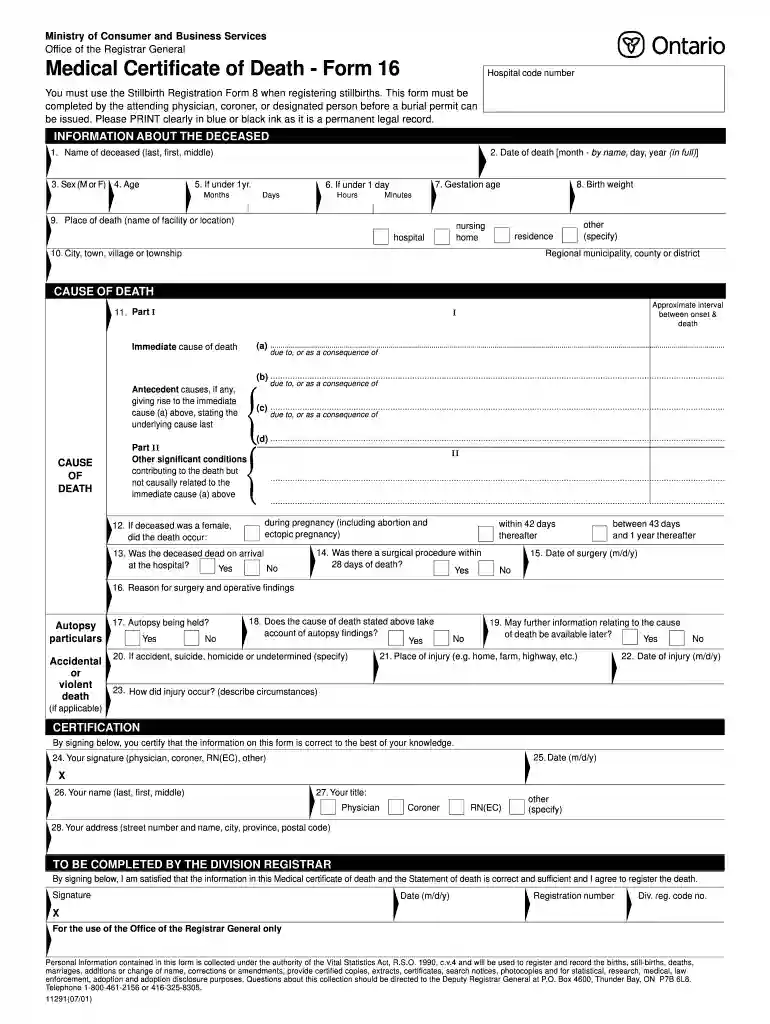
Completing the Ontario death certificate requires careful attention to detail to ensure that all sections are accurately filled out. Commonly used forms include the Medical Certificate of Death (Form 16), which provides critical information about the cause of death.
Medical Certificate of Death (Form 16): This form must be filled out by a physician or coroner and includes:
Additional Information: When applying for a death certificate, additional forms or information may be needed, depending on specific circumstances such as:
The Ontario death certificate contains specific key elements that confirm the death and serve various legal purposes. Understanding these elements is crucial for proper usage.
The Ontario death certificate holds significant legal weight, as it is often required for various administrative and legal proceedings. Here are key considerations for its legal use:
Estate Management: Executors of estates need to present the death certificate when applying for probate or when accessing the deceased's financial accounts.
Insurance Claims: Beneficiaries must present the death certificate to insurance companies to claim life insurance benefits.
Government Services: It may be needed to access pensions, social benefits, or resolve issues related to government contracts or obligations.
Potential Legal Issues: Handling a death certificate improperly can lead to legal disputes, especially regarding the distribution of property and adherence to the deceased's wishes.
Several parties may require the Ontario death certificate for various purposes, reflecting its importance across different contexts.
Each of these users may have differing reasons for needing the certificate, highlighting its role as a critical document in both personal and bureaucratic processes.


At DocHub, your data security is our priority. We follow HIPAA, SOC2, GDPR, and other standards, so you can work on your documents with confidence.
Warning indicates a hazard that could result in injury or death. Caution. Caution indicates a hazard that could result in property or vehicle damage. A circleRead more
How do I acquire a copy of a birth, death or marriage certificate? View All FAQs. /FAQ.aspx. Designation of Newspapers Doing Business Under an Assumed Name.Read more


