
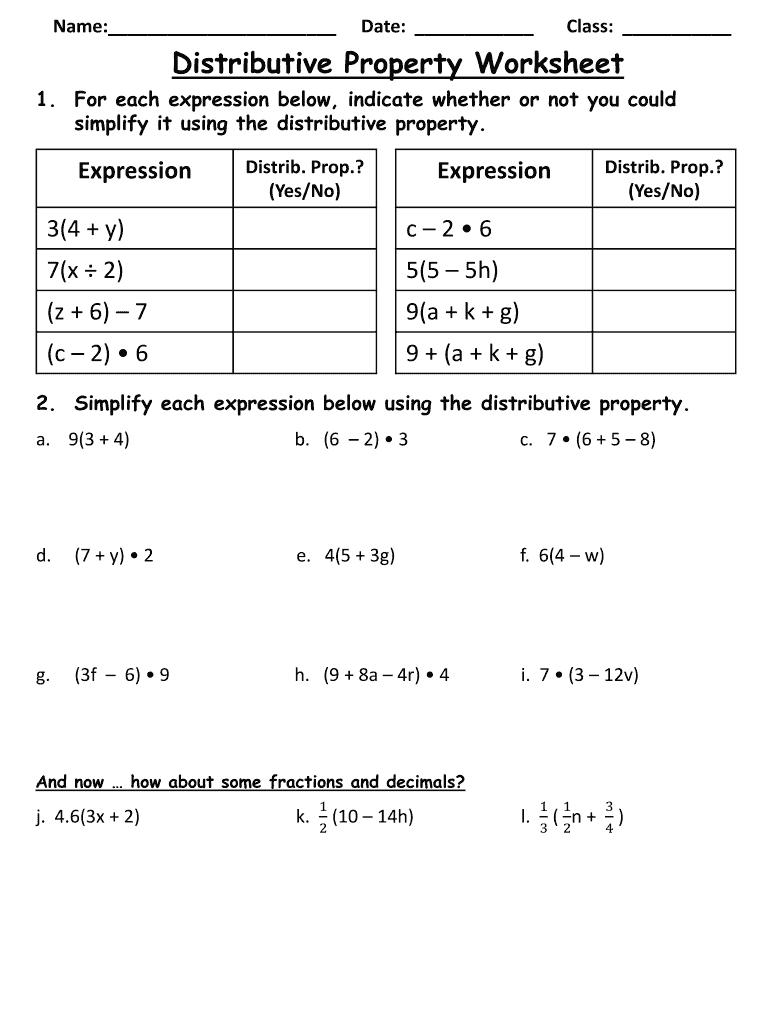







Understanding the Distributive Property Worksheet
The distributive property worksheet is a crucial educational tool in mathematics, particularly for students in grades five through eight. It focuses on teaching the distributive property, which states that when you multiply a number by a sum, you can distribute the multiplication across each addend. This principle is foundational for simplifying expressions and solving equations.
Key Features of the Distributive Property Worksheet
The contents of a distributive property worksheet generally include:
- Definition of the Distributive Property: A clear explanation of the property itself and its importance in mathematics.
- Practice Problems: Exercises that require students to apply the distributive property to simplify expressions.
- Real-World Applications: Examples that illustrate how the distributive property is used in everyday situations, enhancing learners' understanding and retention.
Types of Distributive Property Worksheets
Several variations of distributive property worksheets are designed to cater to different levels of understanding, including:
- Easy Distributive Property Worksheet PDF: Geared towards younger students, these worksheets typically include simpler numbers and more straightforward problems.
- 6th Grade Distributive Property Worksheet PDF: Incorporates more complex expressions and may begin introducing variables.
- Distributive Property Problems Worksheet: Focused specifically on problem-solving, this format challenges students with varied questions to test their mastery of the concept.
Simplifying Expressions with the Distributive Property
Students are often tasked with simplifying expressions by applying the distributive property. A standard example is:
- 3(x + 4) = 3x + 12.
Such exercises not only hone students' skills in applying the property but also help build their algebraic thinking as they combine like terms and work with variables.
Sample Problems for Practice
Worksheets often include a variety of problem types, such as:
- Identify and Simplify: Determine if an expression can be simplified using the distributive property (e.g., 5(2 + 3)).
- Equivalence Checks: Students are provided two expressions and asked to verify their equality by applying the distributive property (e.g., is 4(x + 1) the same as 4x + 4).
- Variable Involvement: Exercises that involve variables, teaching students how to apply the property in more dynamic scenarios (e.g., a(b + c) = ab + ac).
Fillable and Interactive Exercises
Many modern worksheets integrate fillable sections, allowing students to practice directly on the documents. These interactive components can include:
- Text boxes for students to input answers.
- Checkboxes to mark completed sections.
- Spaces for step-by-step work, encouraging thoroughness in problem-solving.
Answer Keys and Self-Assessment
To facilitate learning, many distributive property worksheets come with answer keys. These keys provide:
- Immediate feedback for students once they complete the worksheet.
- Insight into common mistakes or misunderstandings, allowing for self-correction.
- Opportunities for teachers to guide discussions based on widespread errors, enhancing group learning.
Additional Resources
Alongside the worksheets, educators often provide supplementary materials, such as:
- Video tutorials that explain the distributive property using visual aids.
- Interactive quizzes for a more engaging reinforcement of concepts.
- Group activities that allow peer collaboration while solving problems.
Conclusion
The distributive property worksheet is an indispensable resource for students learning foundational principles in math. By providing a structured format, various difficulty levels, interactive elements, and answer keys, these worksheets support a well-rounded educational experience that promotes mastery of this essential mathematical property.




