




01. Edit your ssa 632 f4 online
Type text, add images, blackout confidential details, add comments, highlights and more.

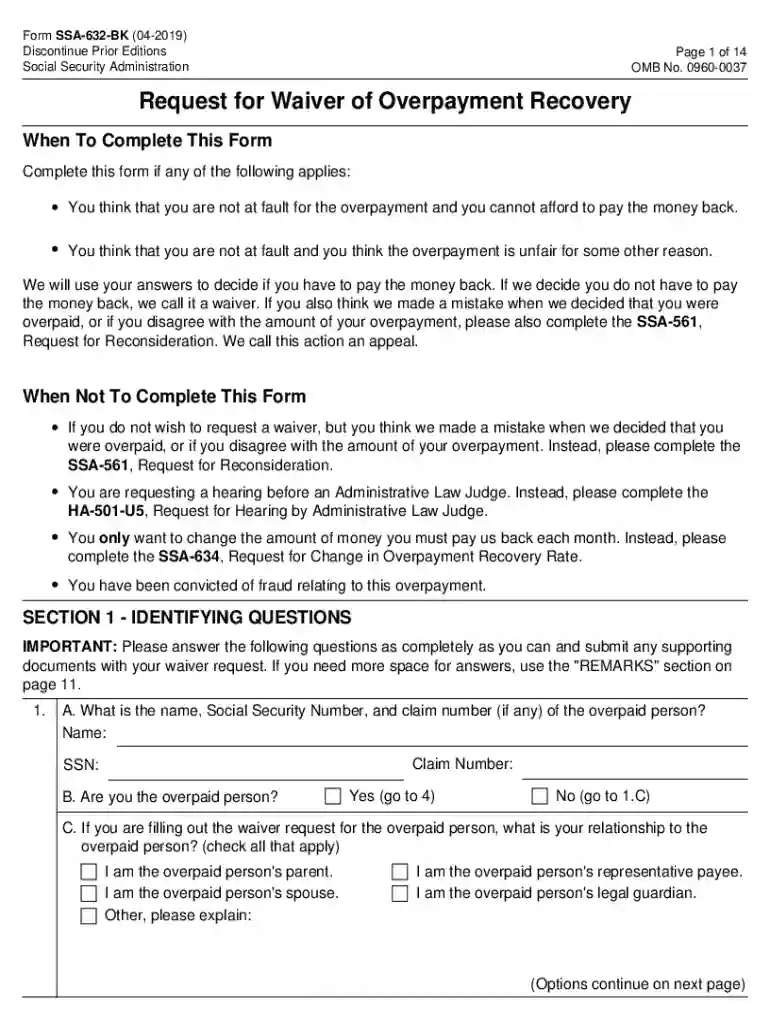
Type text, add images, blackout confidential details, add comments, highlights and more.

Draw your signature, type it, upload its image, or use your mobile device as a signature pad.

Send ssa 632 bk printable form via email, link, or fax. You can also download it, export it or print it out.
The SSA-632, officially titled "Request for Waiver of Overpayment Recovery or Change in Repayment Rate," is a form used by individuals to petition the Social Security Administration (SSA) to waive the recovery of overpaid benefits. This form is specifically designed for cases where the recipient believes they are not at fault for the overpayment or argue that repaying would cause financial hardship. The form comprises several sections, including personal identification information, financial status, and an explanation for the waiver request. This tool ensures that recipients have a structured method to communicate their financial situation and reasoning to the SSA.
To submit the SSA-632, applicants must meet certain eligibility criteria. Primarily, applicants should have received an overpayment notice from the SSA. The core eligibility hinges on the applicant's belief that the overpayment was not their fault or that repaying it would constitute a financial burden. Recipients must ensure they truthfully document their financial situation when requesting a waiver. SSA may also consider whether the overpaid funds were spent in good faith before the recipient became aware of the overpayment.


Complying with the legal requirements of the SSA-632 form is paramount. The information provided must be accurate and truthful, as providing misleading information could result in legal consequences. This form is not bound by traditional tax deadlines but should be submitted promptly after receiving an overpayment notice. Misuse of the form could involve penalties, including legal action or suspension of benefits. The acknowledgment of truthfulness signed at the end of the form underscores the importance of compliance.
While the SSA-632 form is a federal form, there can be nuances in how it is applied, considering variations in state assistance programs that can affect income and financial status declarations. Recipients should consider consulting with a local SSA office for guidance regarding state-specific concerns that may impact their waiver petition. Specific states may have programs or exceptions that could reinforce the grounds for financial hardship claims.
Consider a retired individual who notices an overpayment after spending the funds on essential home repairs. If repayment would strain their fixed income, they could use SSA-632 to request a waiver. Another instance might involve someone who received excess benefits due to a miscalculation beyond their control. By documenting these scenarios comprehensively, applicants can better argue their case for waiver eligibility.
The SSA provides multiple channels for submitting the SSA-632 form, including:
Ensuring all sections are filled accurately and supported by additional documentation remains critical regardless of the submission method.
We've got more versions of the ssa 632 f4 form. Select the right ssa 632 f4 version from the list and start editing it straight away!
Based on eSignature laws, documents approved digitally have the same validity as those approved with pen and paper. You can eSign almost any business and private documentation. Four types of documents still call for handwritten signatures only - wills and testamentary trusts, court orders and other court papers, state statutes regulating divorce, adoption, or other family law, and notice of cancellation of utility services. If you follow the rules and use a secure and compliant software solution, like DocHub, you can eSign your ssa 632 without printing it.
As a comprehensive document modifying platform, DocHub is available on mobile phones. Open DocHub in your choice of mobile internet browser and employ our smart mobile-friendly toolset to fill out your edd overpayment waiver form.
At DocHub, your data security is our priority. We follow HIPAA, SOC2, GDPR, and other standards, so you can work on your documents with confidence.




Jul 11, 1994 — When waiver is requested, the individual gives SSA information (usually on Form SSA-632-BK (Request for Waiver of Overpayment Recovery or ...
Reconsider our decision, if you believe you are not overpaid;; Waive (not collect) the overpayment; or; Let you pay back the amount at a different rate. If you ...
Published in Bulletin of The Seismological Society of America (BSSA) by Seismological Society of America (SSA). 1976 Volume 66, p631-632 ...


