




01. Edit your form mc 031 online
Type text, add images, blackout confidential details, add comments, highlights and more.

Type text, add images, blackout confidential details, add comments, highlights and more.

Draw your signature, type it, upload its image, or use your mobile device as a signature pad.

Send mc 030 via email, link, or fax. You can also download it, export it or print it out.
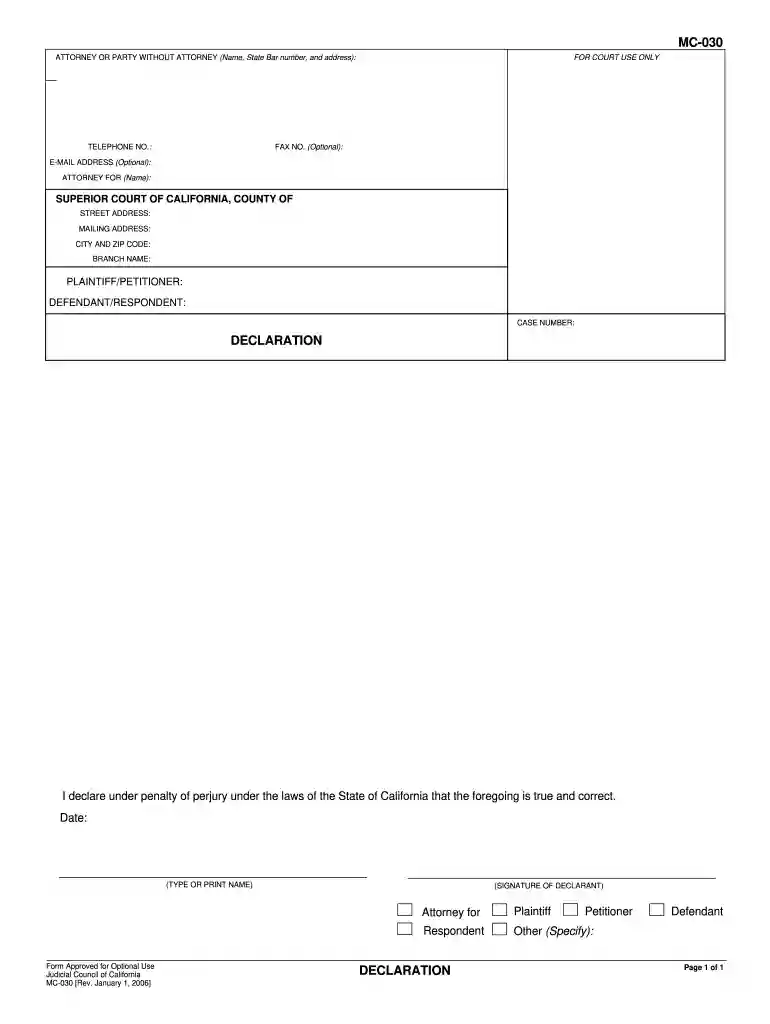
The MC-030 is a legal form used in the Superior Court of California for declarations made under penalty of perjury. It serves as a formal statement of information about a legal proceeding, requiring the declarant to assert truthfulness in their statement, thereby ensuring clarity and accuracy in legal documentation. This form is critical for maintaining integrity in court proceedings and is primarily used by attorneys or parties involved in a case.
Using the MC-030 form involves filling out several key sections that gather pertinent information related to the court case. Users must provide:
It is crucial to complete each section accurately to avoid complications within the legal process. Once filled, the MC-030 should be filed with the appropriate court as part of the official case records, ensuring all declarations meet legal standards.
The MC-030 is commonly used by:


The MC-030 plays a significant role in the court's validation of statements provided by parties in a case. It is crucial in the following legal contexts:
To access the MC-030, individuals can visit:
Being aware of available resources helps in easy and quick access to the necessary legal documents.
When dealing with the MC-030, understanding key terms is crucial:
California law outlines specific rules for the use of the MC-030:
Understanding these rules ensures the form's proper usage and compliance with state legal systems.
At DocHub, your data security is our priority. We follow HIPAA, SOC2, GDPR, and other standards, so you can work on your documents with confidence.




I declare under penalty of perjury under the laws of the State of California that the foregoing is true and correct. MC-030. FOR COURT USE ONLY.Read more
Jun 23, 2011 Subject: Obsolescence Notice: Bendix MC-30 ABS Modules, M-30T Modulator Assemblies, and EC-30T. ABS ECUs with Power Line Carrier (PLC).Read more
Blank Declaration (MC -030) if not using declaration space on RFO. Page 6. Page 7. FAMILY SUPPORT. Most Common Forms: Income and Expense: (FL # 150).Read more


