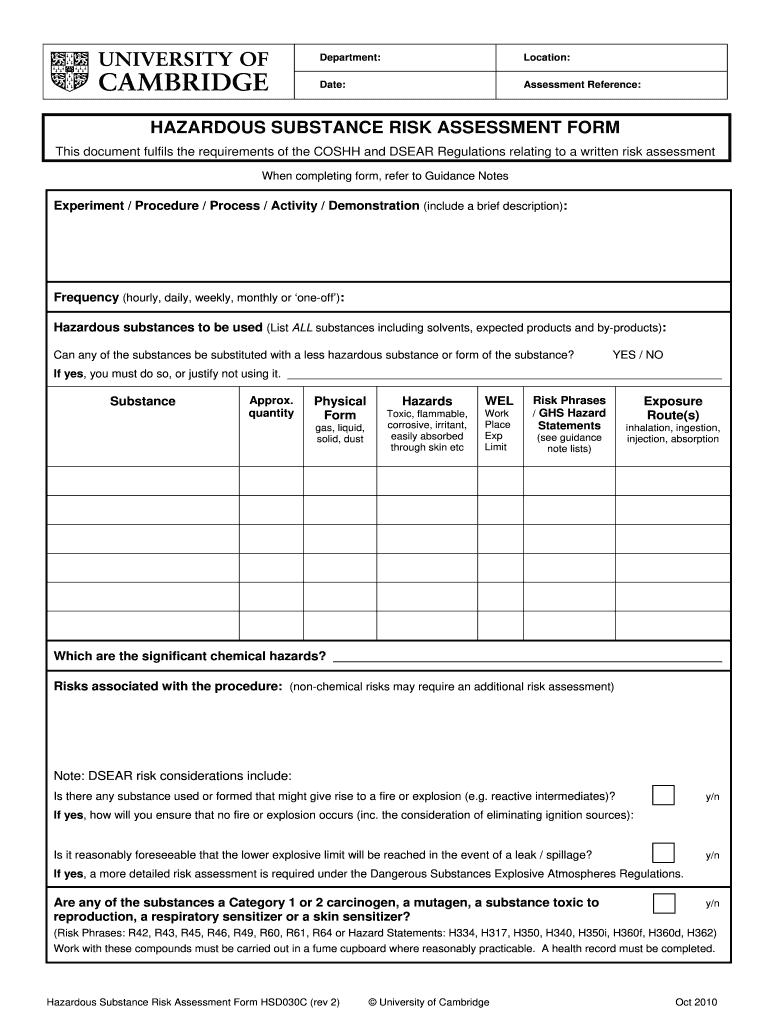
HAZARDOUS SUBSTANCE RISK ASSESSMENT FORM - esc cam ac 2025

Get Form
HAZARDOUS SUBSTANCE RISK ASSESSMENT FORM - esc cam ac Preview on Page 1

Here's how it works

01. Edit your form online
Type text, add images, blackout confidential details, add comments, highlights and more.
02. Sign it in a few clicks
Draw your signature, type it, upload its image, or use your mobile device as a signature pad.
03. Share your form with others
Send it via email, link, or fax. You can also download it, export it or print it out.

How to use or fill out HAZARDOUS SUBSTANCE RISK ASSESSMENT FORM - esc cam ac with our platform

Form edit decoration
9.5
Ease of Setup
DocHub User Ratings on G2
9.0
Ease of Use
DocHub User Ratings on G2
  1. Click ‘Get Form’ to open the HAZARDOUS SUBSTANCE RISK ASSESSMENT FORM in the editor.
  2. Begin by filling in the 'Department', 'Location', and 'Date' fields at the top of the form. This information is crucial for identifying where and when the assessment is taking place.
  3. In the 'Assessment Reference' section, provide a unique identifier for this risk assessment to facilitate tracking and referencing.
  4. Describe the experiment or procedure in detail under 'Experiment / Procedure / Process / Activity / Demonstration'. Be concise yet informative.
  5. Indicate how often the hazardous substances will be used by selecting from options like hourly, daily, weekly, monthly, or ‘one-off’.
  6. List all hazardous substances involved in your process, including solvents and by-products. Ensure accuracy as this impacts safety measures.
  7. Answer whether any substances can be substituted with less hazardous options. If yes, provide justification if you choose not to substitute.
  8. Complete sections on hazards, control measures, waste disposal routes, and emergency procedures thoroughly to ensure comprehensive risk management.

Start using our platform today for free to streamline your document editing and form completion!

be ready to get more

Complete this form in 5 minutes or less

Get form

Got questions?

We have answers to the most popular questions from our customers. If you can't find an answer to your question, please contact us.
Contact us
2. Steps needed to manage risk Identify hazards. Assess the risks. Control the risks. Record your findings. Review the controls.
The 4 Ps of risk assessmentPredict, Prevent, Prepare, and Protecttakes on a heightened significance in environments where the potential for severe and costly risks is ever-present. Effective risk assessment is paramount to ensure safety, operational continuity, and environmental responsibility.
The air risk staff generally follows a basic four step risk assessment process, including hazard identification, exposure assessment, dose-response assessment, and risk characterization, as described below.
Site Menu Identify chemicals to be used and circumstances of use. Consult sources of information. Evaluate type of toxicity. Consider possible routes of entry. Evaluate quantitative information on toxicity. Select appropriate procedures to minimize exposure. Prepare for contingencies.
In this post, we look at the 5 different types of risk assessment in health and safety. And when and why you might use each one. Including qualitative, quantitative, generic, site-specific and dynamic risk assessments. Not all risk assessments are the same.
be ready to get more

Complete this form in 5 minutes or less

Get form

People also ask

In risk management, risks are generally classified into four main categories: strategic risk, operational risk, financial risk, and compliance risk. Each of these categories has unique characteristics and requires specific mitigation strategies.

Related links