
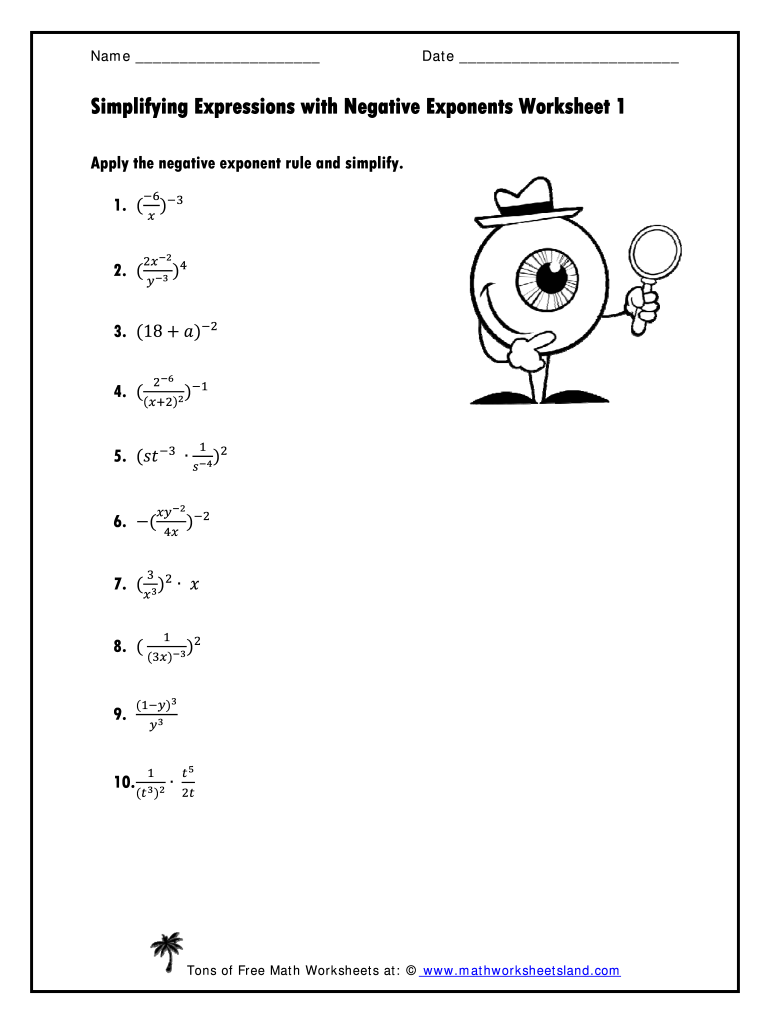







Overview of Simplifying Expressions with Negative Exponents
Understanding how to simplify expressions with negative exponents is a fundamental aspect of algebra that can enhance problem-solving skills. Negative exponents indicate reciprocal values and can lead to a clearer understanding of exponential expressions. Worksheets focusing on this topic allow students to practice and reinforce their skills in manipulating and simplifying these types of mathematical expressions.
Definition and Significance of Negative Exponents
Negative exponents can be defined as an expression that indicates the reciprocal of the base raised to the positive exponent. For instance, (a^{-n} = \frac{1}{a^n}). This concept is essential for simplifying algebraic expressions, particularly when dealing with fractions and rational numbers.
Utilizing negative exponents has several benefits:
- Enhanced Understanding: It promotes a deeper comprehension of how exponents operate, particularly the concept of division.
- Simplification: They allow for the transformation of complex fractions into simpler forms, making calculations easier.
- Foundation for Advanced Concepts: A solid grasp of negative exponents paves the way for understanding logarithms and other higher concepts in mathematics.
Practical Examples of Simplifying Expressions with Negative Exponents
To illustrate the process of simplifying expressions containing negative exponents, consider these examples:
-
Single Base Example:
- Simplify (2^{-3}):
- Rewrite as (\frac{1}{2^3} = \frac{1}{8}).
- Simplify (2^{-3}):
-
Multiple Bases:
- Simplify (\frac{3^{-2}}{5^{-1}}):
- Rewrite as (\frac{1/3^2}{1/5} = \frac{5}{3^2} = \frac{5}{9}).
- Simplify (\frac{3^{-2}}{5^{-1}}):
-
Complex Expression:
- Simplify (\frac{4^{-1} \cdot 2^3}{5^{-2}}):
- Rewrite as (\frac{1/4 \cdot 8}{1/25} = \frac{8 \cdot 25}{4} = \frac{200}{4} = 50).
- Simplify (\frac{4^{-1} \cdot 2^3}{5^{-2}}):
By working through these various expressions, students can solidify their understanding of the rules governing negative exponents and their application in simplification.
Guiding Principles for Simplification
A worksheet on simplifying expressions with negative exponents should begin with these basic rules:
- Rule of Reciprocals: Recognize that (a^{-n} = \frac{1}{a^n}).
- Multiplication of Exponents: Understand that (a^{-n} \cdot a^m = a^{m-n}).
- Division of Exponents: Learn that (\frac{a^m}{a^{-n}} = a^{m+n}).
Incorporating these principles into practice problems can aid students in consistently applying the concepts to a variety of scenarios, allowing for more effective problem-solving.
Types of Worksheets Available
Various worksheets can reinforce skills in simplifying expressions with negative exponents. These include:
- Worksheets Focusing on Basic Operations: Targeted practice on simple expressions using direct negative exponents.
- Rational Expressions Worksheets: Problems that involve fractions and require simplification using negative and positive exponents.
- Combining Negative and Zero Exponents Worksheets: Exercises that require an understanding of both negative and zero exponents in one problem.
The diversity in worksheet types ensures comprehensive coverage of the topic and caters to different learning styles.
Answer Keys and Detailed Solutions
Providing answer keys alongside worksheets plays a crucial role in self-assessment and learning. Answers should include detailed solutions, explaining each step involved in the simplification process. This helps students identify mistakes and understand the reasoning behind each step.
- Detailed Steps: Include clear, sequential explanations for obtaining the simplified forms.
- Common Mistakes: Highlight frequent errors, such as misinterpreting the negative exponents or forgetting to convert when necessary.
Application to Real-World Situations
Understanding negative exponents has practical applications beyond the classroom.
- Scientific Notation: In fields like physics and chemistry, negative exponents are used to express small decimal values, simplifying calculations in research.
- Financial Models: Negative exponents can be used in various financial formulas that deal with depreciation or growth rates.
Recognizing these applications can motivate students to appreciate the relevance of mathematics in everyday life.
Overall, mastering the simplification of expressions with negative exponents equips students with essential skills needed for advanced mathematical study and practical application in numerous fields. Students gain the confidence and ability to tackle complex problems with ease.




