




01. Edit your form 8949 for 2014 online
Type text, add images, blackout confidential details, add comments, highlights and more.

Type text, add images, blackout confidential details, add comments, highlights and more.

Draw your signature, type it, upload its image, or use your mobile device as a signature pad.

Send it via email, link, or fax. You can also download it, export it or print it out.
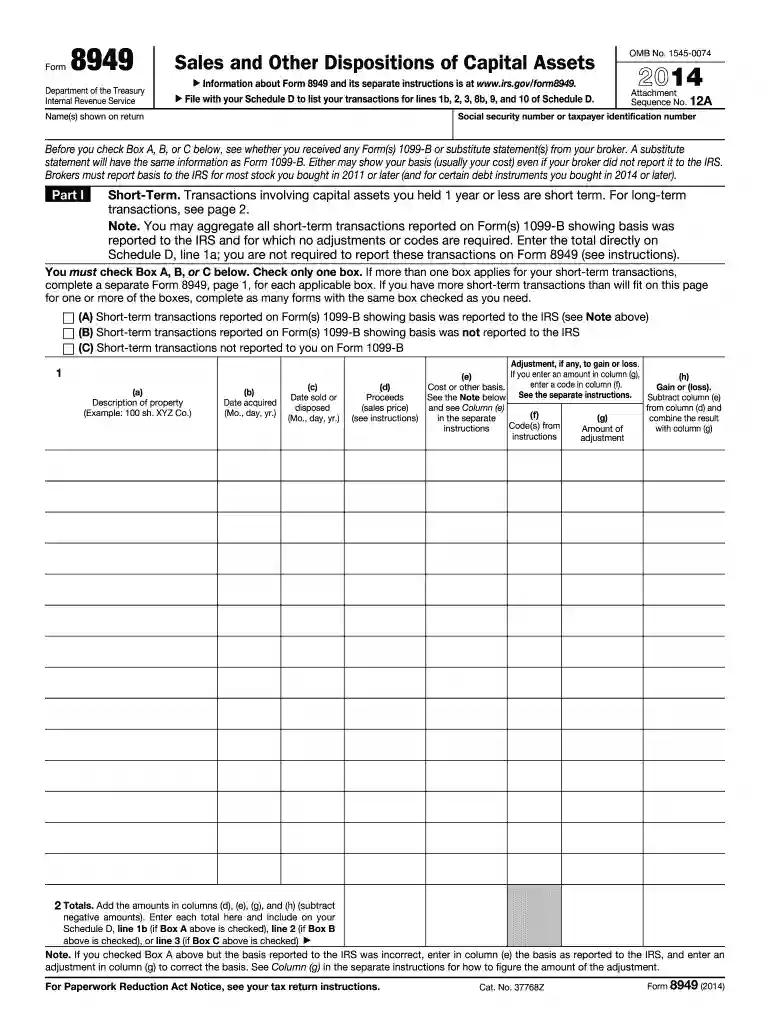
IRS Form 8949, Sale and Other Dispositions of Capital Assets, is utilized by taxpayers in the United States to report sales and other dispositions of capital assets. This form is essential for calculating gains and losses from investment transactions, and it must be filed alongside the Schedule D. Taxpayers must distinguish between short-term and long-term transactions, and indicate whether the cost basis was reported to the IRS. Accurate reporting in Form 8949 ensures compliance with tax regulations and helps determine potential tax liabilities or refunds.
To obtain the 2014 IRS Form 8949, taxpayers can visit the official IRS website and download the form directly. Additionally, tax software programs such as TurboTax and QuickBooks may provide the form within their systems to facilitate electronic filing. Local IRS offices offer paper versions for those who prefer physical copies. Taxpayers may also consult with tax professionals who can supply both the form and expert guidance on filling it out.
Failing to accurately file IRS Form 8949 can result in financial penalties. Underreporting capital gains may lead the IRS to impose fines or additional taxes. Furthermore, incomplete or incorrect reporting could trigger an audit. It's crucial to ensure all entries are accurate and comprehensive to avoid potential penalties and interest charges.
The IRS provides detailed instructions for completing Form 8949. These guidelines outline how to fill out each section, explain the different adjustment codes, and clarify what documentation must accompany the form. Taxpayers should review these guidelines meticulously to ensure that their submission is correct and complete.
Many modern tax software providers, including TurboTax and QuickBooks, are compatible with Form 8949, making it easier for users to import transaction data, calculate gains/losses, and submit the form electronically. This compatibility simplifies the filing process, reduces manual errors, and facilitates prompt submission.
Various taxpayer groups may need to engage with Form 8949:
Each scenario involves specific considerations, such as cost basis adjustments for inherited assets or split shares, which can affect the filing outcome.


For the 2014 tax year, IRS Form 8949 is due with a taxpayer’s federal income tax return by April 15, 2015. Extensions are available, pushing the deadline to October 15, if approved. Missing these deadlines can result in penalties, so timely filing is crucial. Taxpayers should mark these dates and plan ahead to avoid last-minute rushes and potential errors.
We've got more versions of the form 8949 for 2014 form. Select the right form 8949 for 2014 version from the list and start editing it straight away!
| Versions | Form popularity | Fillable & printable |
|---|---|---|
| 2025 | 4.3 Satisfied (53 Votes) | |
| 2024 | 4.3 Satisfied (58 Votes) | |
| 2023 | 4.2 Satisfied (49 Votes) | |
| 2022 | 4.8 Satisfied (35 Votes) | |
| 2021 | 4.8 Satisfied (47 Votes) | |
| 2020 | 4.4 Satisfied (165 Votes) | |
| 2019 | 4.3 Satisfied (129 Votes) | |
| 2018 | 4.4 Satisfied (280 Votes) | |
| 2017 | 4.2 Satisfied (50 Votes) | |
| 2016 | 4.4 Satisfied (280 Votes) | |
| 2015 | 4 Satisfied (32 Votes) | |
| 2014 | 4.1 Satisfied (32 Votes) | |
| 2013 | 4.2 Satisfied (38 Votes) | |
| 2012 | 4.4 Satisfied (39 Votes) | |
| 2011 | 4.1 Satisfied (56 Votes) |
At DocHub, your data security is our priority. We follow HIPAA, SOC2, GDPR, and other standards, so you can work on your documents with confidence.
Form 8949 is used to report sales and exchanges of capital assets. Form 8949 allows the taxpayer and the IRS to reconcile amounts that were reported on FormRead more
Apr 15, 2015 file Form 8949 or Schedule D (Form. 1040) if both of the following apply. 1. You have no capital losses, and your only capital gains areRead more
Form 8949 allows you and the IRS to reconcile amounts that were reported to you and the. IRS on Form 1099-B or 1099-S (or substitute statement) with the amounts.Read more


